

8.4 Coherent Detection Schemes
351
BER =
1
2
erf
1
2
ηN p
(8.68)
Here one needs a minimum of 36 photons per bit for a 10
−9 BER. In the case of
asynchronous heterodyne OOK detection, the bit error rate is given by
BER =
1
2
exp
−
1
2
ηN p
(8.69)
Thus asynchronous heterodyne OOK detection requires 40 photons per bit for a
10
−9 BER, which is 3 dB less sensitive than DPSK.
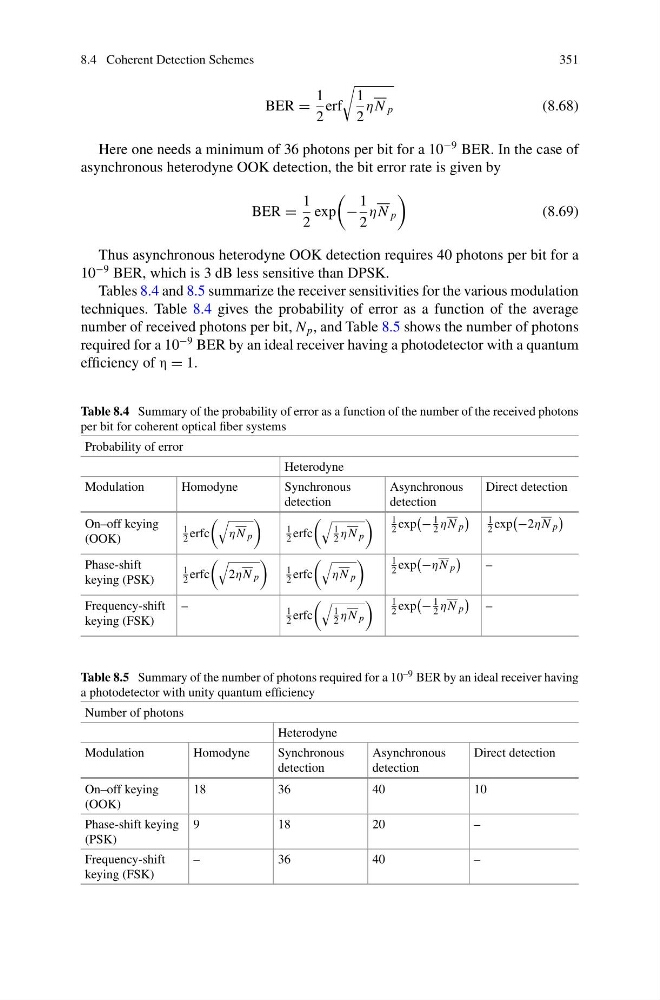
Tables 8.4 and 8.5 summarize the receiver sensitivities for the various modulation
techniques. Table 8.4 gives the probability of error as a function of the average
number of received photons per bit, N p , and Table 8.5 shows the number of photons
required for a 10
−9 BER by an ideal receiver having a photodetector with a quantum
efficiency of η = 1.
Table 8.4 Summary of the probability of error as a function of the number of the received photons
per bit for coherent optical fiber systems
Probability of error
Heterodyne
Modulation
Homodyne
Synchronous
detection
Asynchronous
detection
Direct detection
On–off keying
(OOK)
1
2 erfc
ηN p
1
2 erfc
1
2 ηN p
1
2 exp
−
1
2 ηN p
1
2 exp
−2ηN p
Phase-shift
keying (PSK)
1
2 erfc
2ηN p
1
2 erfc
ηN p
1
2 exp
−ηN p
–
Frequency-shift
keying (FSK)
–
1
2 erfc
1
2 ηN p
1
2 exp
−
1
2 ηN p
–
Table 8.5 Summary of the number of photons required for a 10 –9 BER by an ideal receiver having
a photodetector with unity quantum efficiency
Number of photons
Heterodyne
Modulation
Homodyne
Synchronous
detection
Asynchronous
detection
Direct detection
On–off keying
(OOK)
18
36
40
10
Phase-shift keying
(PSK)
9
18
20
–
Frequency-shift
keying (FSK)
–
36
40
–
351
BER =
1
2
erf
1
2
ηN p
(8.68)
Here one needs a minimum of 36 photons per bit for a 10
−9 BER. In the case of
asynchronous heterodyne OOK detection, the bit error rate is given by
BER =
1
2
exp
−
1
2
ηN p
(8.69)
Thus asynchronous heterodyne OOK detection requires 40 photons per bit for a
10
−9 BER, which is 3 dB less sensitive than DPSK.
Tables 8.4 and 8.5 summarize the receiver sensitivities for the various modulation
techniques. Table 8.4 gives the probability of error as a function of the average
number of received photons per bit, N p , and Table 8.5 shows the number of photons
required for a 10
−9 BER by an ideal receiver having a photodetector with a quantum
efficiency of η = 1.
Table 8.4 Summary of the probability of error as a function of the number of the received photons
per bit for coherent optical fiber systems
Probability of error
Heterodyne
Modulation
Homodyne
Synchronous
detection
Asynchronous
detection
Direct detection
On–off keying
(OOK)
1
2 erfc
ηN p
1
2 erfc
1
2 ηN p
1
2 exp
−
1
2 ηN p
1
2 exp
−2ηN p
Phase-shift
keying (PSK)
1
2 erfc
2ηN p
1
2 erfc
ηN p
1
2 exp
−ηN p
–
Frequency-shift
keying (FSK)
–
1
2 erfc
1
2 ηN p
1
2 exp
−
1
2 ηN p
–
Table 8.5 Summary of the number of photons required for a 10 –9 BER by an ideal receiver having
a photodetector with unity quantum efficiency
Number of photons
Heterodyne
Modulation
Homodyne
Synchronous
detection
Asynchronous
detection
Direct detection
On–off keying
(OOK)
18
36
40
10
Phase-shift keying
(PSK)
9
18
20
–
Frequency-shift
keying (FSK)
–
36
40
–