

350
8 Digital Optical Fiber Links
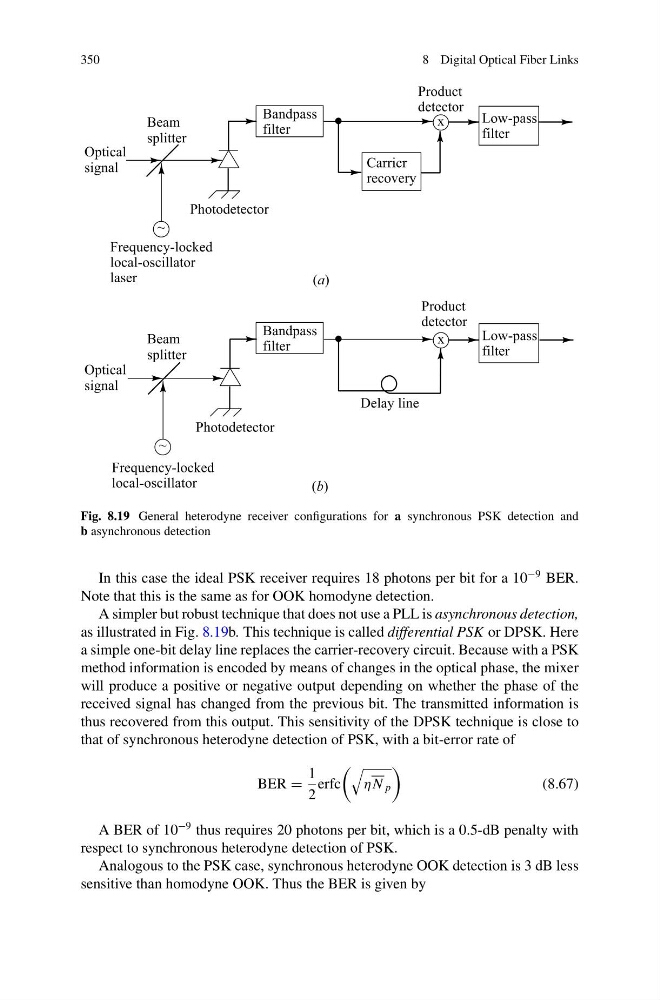
Fig. 8.19 General heterodyne receiver configurations for a synchronous PSK detection and
b asynchronous detection
In this case the ideal PSK receiver requires 18 photons per bit for a 10
−9 BER.
Note that this is the same as for OOK homodyne detection.
A simpler but robust technique that does not use a PLL is asynchronous detection,
as illustrated in Fig. 8.19b. This technique is called differential PSK or DPSK. Here
a simple one-bit delay line replaces the carrier-recovery circuit. Because with a PSK
method information is encoded by means of changes in the optical phase, the mixer
will produce a positive or negative output depending on whether the phase of the
received signal has changed from the previous bit. The transmitted information is
thus recovered from this output. This sensitivity of the DPSK technique is close to
that of synchronous heterodyne detection of PSK, with a bit-error rate of
BER =
1
2
erfc
ηN p
(8.67)
A BER of 10
−9 thus requires 20 photons per bit, which is a 0.5-dB penalty with
respect to synchronous heterodyne detection of PSK.
Analogous to the PSK case, synchronous heterodyne OOK detection is 3 dB less
sensitive than homodyne OOK. Thus the BER is given by
8 Digital Optical Fiber Links
Fig. 8.19 General heterodyne receiver configurations for a synchronous PSK detection and
b asynchronous detection
In this case the ideal PSK receiver requires 18 photons per bit for a 10
−9 BER.
Note that this is the same as for OOK homodyne detection.
A simpler but robust technique that does not use a PLL is asynchronous detection,
as illustrated in Fig. 8.19b. This technique is called differential PSK or DPSK. Here
a simple one-bit delay line replaces the carrier-recovery circuit. Because with a PSK
method information is encoded by means of changes in the optical phase, the mixer
will produce a positive or negative output depending on whether the phase of the
received signal has changed from the previous bit. The transmitted information is
thus recovered from this output. This sensitivity of the DPSK technique is close to
that of synchronous heterodyne detection of PSK, with a bit-error rate of
BER =
1
2
erfc
ηN p
(8.67)
A BER of 10
−9 thus requires 20 photons per bit, which is a 0.5-dB penalty with
respect to synchronous heterodyne detection of PSK.
Analogous to the PSK case, synchronous heterodyne OOK detection is 3 dB less
sensitive than homodyne OOK. Thus the BER is given by