

334
8 Digital Optical Fiber Links
message retransmission in case errors are detected at the receiver. Because each
such retransmission adds at least one roundtrip time of latency, ARQ may not be
feasible for applications in which data must arrive within a certain time in order to be
useful. Forward error correction avoids the shortcomings of ARQ for high-bandwidth
optical networks requiring low delays. In FEC techniques, redundant information is
transmitted along with the original information. If some of the original data is lost
or received in error, the redundant information is used to reconstruct it. Section 8.3.4
gives an overview of popular Reed-Solomon codes used in FEC techniques.
8.3.1 Concept of Error Detection
An error in a data stream can be categorized as a single-bit error or a burst error. As
its name implies, a single-bit error means that only one bit within a data unit (e.g.,
a byte, code word, a packet, or a frame) is changed from a 1 to a 0, or vice versa.
Single-bit errors are not very common in a typical transmission system because most
bit-corrupting noise effects last longer than a bit period.
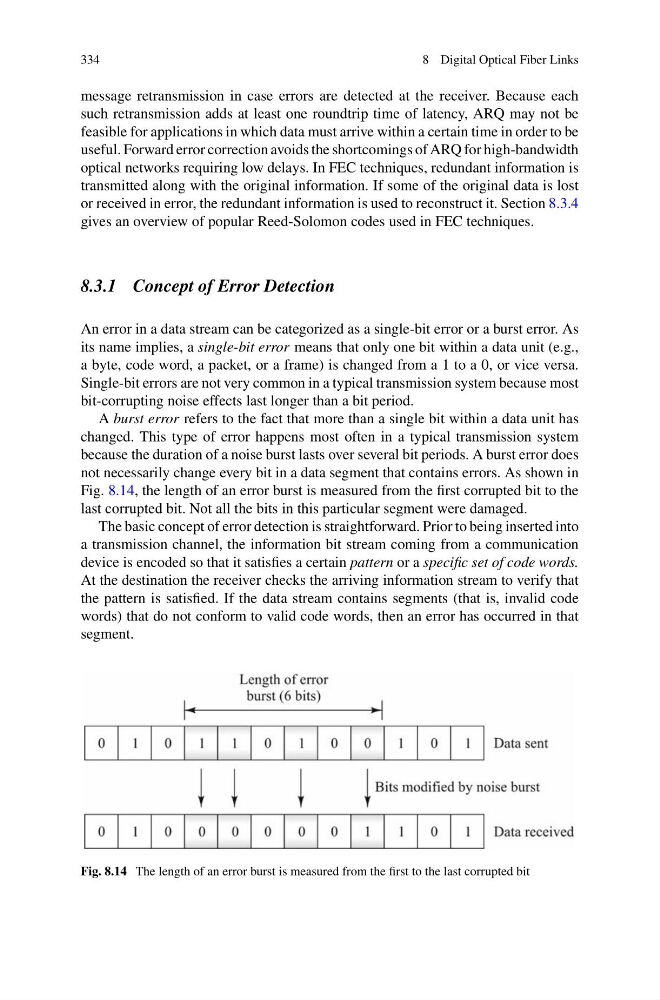
A burst error refers to the fact that more than a single bit within a data unit has
changed. This type of error happens most often in a typical transmission system
because the duration of a noise burst lasts over several bit periods. A burst error does
not necessarily change every bit in a data segment that contains errors. As shown in
Fig. 8.14, the length of an error burst is measured from the first corrupted bit to the
last corrupted bit. Not all the bits in this particular segment were damaged.
The basic concept of error detection is straightforward. Prior to being inserted into
a transmission channel, the information bit stream coming from a communication
device is encoded so that it satisfies a certain pattern or a specific set of code words.
At the destination the receiver checks the arriving information stream to verify that
the pattern is satisfied. If the data stream contains segments (that is, invalid code
words) that do not conform to valid code words, then an error has occurred in that
segment.
Fig. 8.14 The length of an error burst is measured from the first to the last corrupted bit
8 Digital Optical Fiber Links
message retransmission in case errors are detected at the receiver. Because each
such retransmission adds at least one roundtrip time of latency, ARQ may not be
feasible for applications in which data must arrive within a certain time in order to be
useful. Forward error correction avoids the shortcomings of ARQ for high-bandwidth
optical networks requiring low delays. In FEC techniques, redundant information is
transmitted along with the original information. If some of the original data is lost
or received in error, the redundant information is used to reconstruct it. Section 8.3.4
gives an overview of popular Reed-Solomon codes used in FEC techniques.
8.3.1 Concept of Error Detection
An error in a data stream can be categorized as a single-bit error or a burst error. As
its name implies, a single-bit error means that only one bit within a data unit (e.g.,
a byte, code word, a packet, or a frame) is changed from a 1 to a 0, or vice versa.
Single-bit errors are not very common in a typical transmission system because most
bit-corrupting noise effects last longer than a bit period.
A burst error refers to the fact that more than a single bit within a data unit has
changed. This type of error happens most often in a typical transmission system
because the duration of a noise burst lasts over several bit periods. A burst error does
not necessarily change every bit in a data segment that contains errors. As shown in
Fig. 8.14, the length of an error burst is measured from the first corrupted bit to the
last corrupted bit. Not all the bits in this particular segment were damaged.
The basic concept of error detection is straightforward. Prior to being inserted into
a transmission channel, the information bit stream coming from a communication
device is encoded so that it satisfies a certain pattern or a specific set of code words.
At the destination the receiver checks the arriving information stream to verify that
the pattern is satisfied. If the data stream contains segments (that is, invalid code
words) that do not conform to valid code words, then an error has occurred in that
segment.
Fig. 8.14 The length of an error burst is measured from the first to the last corrupted bit