

332
8 Digital Optical Fiber Links
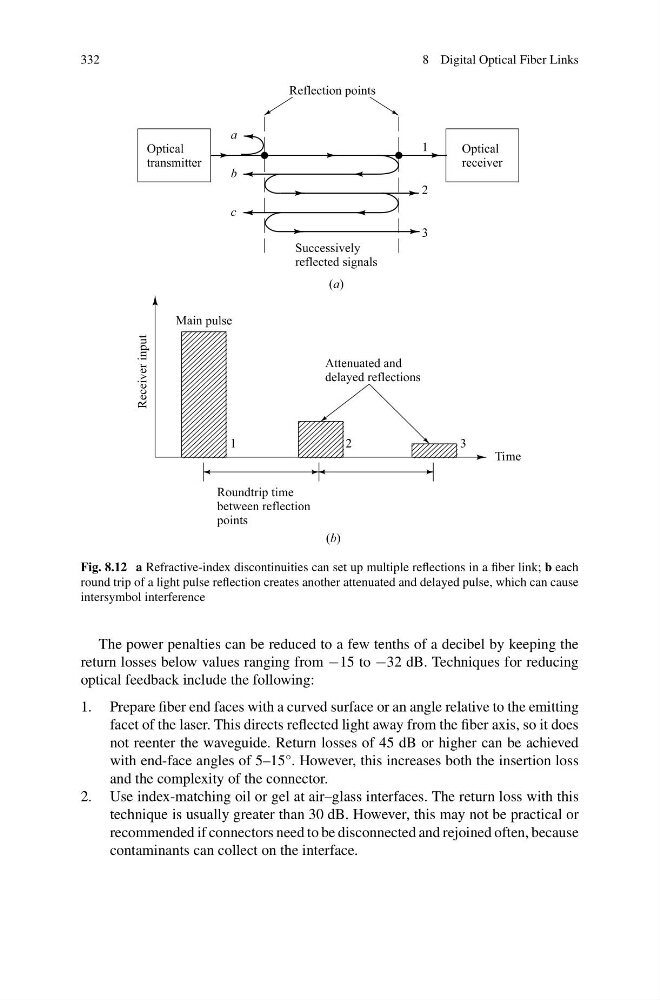
Fig. 8.12 a Refractive-index discontinuities can set up multiple reflections in a fiber link; b each
round trip of a light pulse reflection creates another attenuated and delayed pulse, which can cause
intersymbol interference
The power penalties can be reduced to a few tenths of a decibel by keeping the
return losses below values ranging from −15 to −32 dB. Techniques for reducing
optical feedback include the following:
1. Prepare fiber end faces with a curved surface or an angle relative to the emitting
facet of the laser. This directs reflected light away from the fiber axis, so it does
not reenter the waveguide. Return losses of 45 dB or higher can be achieved
with end-face angles of 5–15°. However, this increases both the insertion loss
and the complexity of the connector.
2. Use index-matching oil or gel at air–glass interfaces. The return loss with this
technique is usually greater than 30 dB. However, this may not be practical or
recommended if connectors need to be disconnected and rejoined often, because
contaminants can collect on the interface.
8 Digital Optical Fiber Links
Fig. 8.12 a Refractive-index discontinuities can set up multiple reflections in a fiber link; b each
round trip of a light pulse reflection creates another attenuated and delayed pulse, which can cause
intersymbol interference
The power penalties can be reduced to a few tenths of a decibel by keeping the
return losses below values ranging from −15 to −32 dB. Techniques for reducing
optical feedback include the following:
1. Prepare fiber end faces with a curved surface or an angle relative to the emitting
facet of the laser. This directs reflected light away from the fiber axis, so it does
not reenter the waveguide. Return losses of 45 dB or higher can be achieved
with end-face angles of 5–15°. However, this increases both the insertion loss
and the complexity of the connector.
2. Use index-matching oil or gel at air–glass interfaces. The return loss with this
technique is usually greater than 30 dB. However, this may not be practical or
recommended if connectors need to be disconnected and rejoined often, because
contaminants can collect on the interface.