

330
8 Digital Optical Fiber Links
range from 0.6 to 0.8. To keep the power penalty less than 0.5 dB, a well-designed
system should have the quantity BL D C D σ λ < 0.1.
Mode-partition noise becomes more pronounced for higher bit rates. The errors
due to mode-partition noise can be reduced and sometimes eliminated by setting the
bias point of the laser above threshold. However, raising the bias power level reduces
the available signal-pulse power, thereby reducing the achievable signal-to-thermalnoise ratio.
8.2.6 Chirping-Induced Power Penalties
A laser that oscillates in a single longitudinal mode under CW operation may experience dynamic line broadening when the injection current is directly modulated
above about 2.5 Gb/s [27–29]. This line broadening is a frequency “chirp” associated with modulation-induced changes in the carrier density. Laser chirping can
lead to significant dispersion effects for intensity-modulated pulses when the laser
emission wavelength is displaced from the zero-dispersion wavelength of the fiber.
This is particularly true in systems operating at 1550 nm, where dispersion in G.652
non-dispersion-shifted fibers is much greater than at 1300 nm.
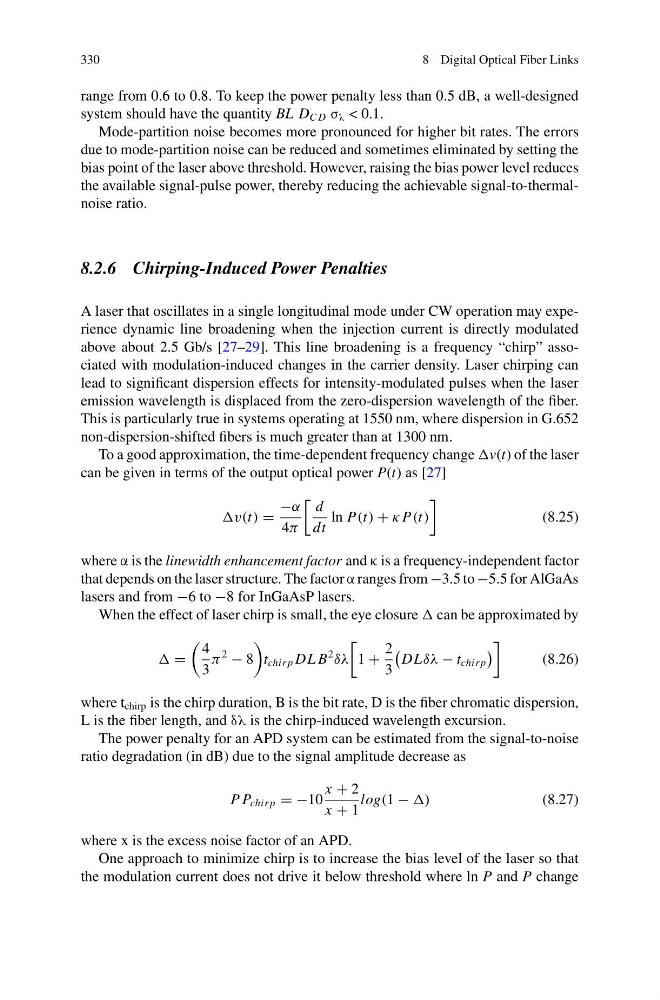
To a good approximation, the time-dependent frequency change v(t) of the laser
can be given in terms of the output optical power P(t) as [27]
v(t) =
−α
4π
d
dt
ln P(t) + κ P(t)
(8.25)
where α is the linewidth enhancement factor and κ is a frequency-independent factor
that depends on the laser structure. The factor α ranges from −3.5 to −5.5 for AlGaAs
lasers and from −6 to −8 for InGaAsP lasers.
When the effect of laser chirp is small, the eye closure can be approximated by
=
4
3
π
2
− 8
t chir p DL B
2
δλ
1 +
2
3
DLδλ − t chir p
(8.26)
where t chirp is the chirp duration, B is the bit rate, D is the fiber chromatic dispersion,
L is the fiber length, and δλ is the chirp-induced wavelength excursion.
The power penalty for an APD system can be estimated from the signal-to-noise
ratio degradation (in dB) due to the signal amplitude decrease as
P P chir p = −10
x + 2
x + 1
log(1 − )
(8.27)
where x is the excess noise factor of an APD.
One approach to minimize chirp is to increase the bias level of the laser so that
the modulation current does not drive it below threshold where ln P and P change
8 Digital Optical Fiber Links
range from 0.6 to 0.8. To keep the power penalty less than 0.5 dB, a well-designed
system should have the quantity BL D C D σ λ < 0.1.
Mode-partition noise becomes more pronounced for higher bit rates. The errors
due to mode-partition noise can be reduced and sometimes eliminated by setting the
bias point of the laser above threshold. However, raising the bias power level reduces
the available signal-pulse power, thereby reducing the achievable signal-to-thermalnoise ratio.
8.2.6 Chirping-Induced Power Penalties
A laser that oscillates in a single longitudinal mode under CW operation may experience dynamic line broadening when the injection current is directly modulated
above about 2.5 Gb/s [27–29]. This line broadening is a frequency “chirp” associated with modulation-induced changes in the carrier density. Laser chirping can
lead to significant dispersion effects for intensity-modulated pulses when the laser
emission wavelength is displaced from the zero-dispersion wavelength of the fiber.
This is particularly true in systems operating at 1550 nm, where dispersion in G.652
non-dispersion-shifted fibers is much greater than at 1300 nm.
To a good approximation, the time-dependent frequency change v(t) of the laser
can be given in terms of the output optical power P(t) as [27]
v(t) =
−α
4π
d
dt
ln P(t) + κ P(t)
(8.25)
where α is the linewidth enhancement factor and κ is a frequency-independent factor
that depends on the laser structure. The factor α ranges from −3.5 to −5.5 for AlGaAs
lasers and from −6 to −8 for InGaAsP lasers.
When the effect of laser chirp is small, the eye closure can be approximated by
=
4
3
π
2
− 8
t chir p DL B
2
δλ
1 +
2
3
DLδλ − t chir p
(8.26)
where t chirp is the chirp duration, B is the bit rate, D is the fiber chromatic dispersion,
L is the fiber length, and δλ is the chirp-induced wavelength excursion.
The power penalty for an APD system can be estimated from the signal-to-noise
ratio degradation (in dB) due to the signal amplitude decrease as
P P chir p = −10
x + 2
x + 1
log(1 − )
(8.27)
where x is the excess noise factor of an APD.
One approach to minimize chirp is to increase the bias level of the laser so that
the modulation current does not drive it below threshold where ln P and P change