

8.2 Concepts of Link Power Penalties
329
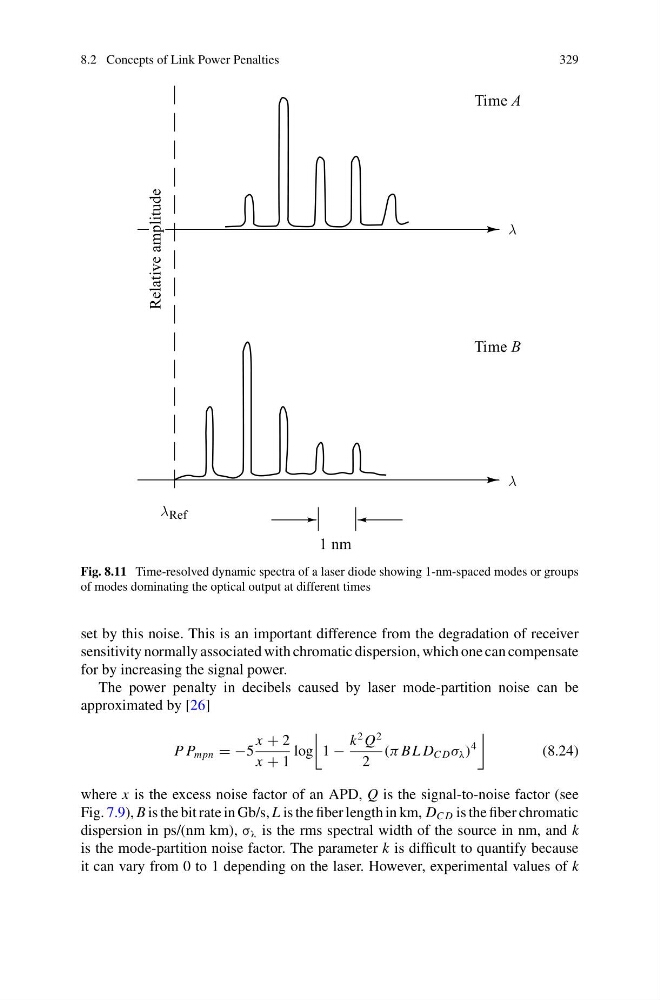
Fig. 8.11 Time-resolved dynamic spectra of a laser diode showing 1-nm-spaced modes or groups
of modes dominating the optical output at different times
set by this noise. This is an important difference from the degradation of receiver
sensitivity normally associated with chromatic dispersion, which one can compensate
for by increasing the signal power.
The power penalty in decibels caused by laser mode-partition noise can be
approximated by [26]
P P mpn = −5
x + 2
x + 1
log
1 −
k
2 Q
2
2
(π B L D C D σ λ )
4
(8.24)
where x is the excess noise factor of an APD, Q is the signal-to-noise factor (see
Fig. 7.9), B is the bit rate in Gb/s, L is the fiber length in km, D C D is the fiber chromatic
dispersion in ps/(nm km), σ λ is the rms spectral width of the source in nm, and k
is the mode-partition noise factor. The parameter k is difficult to quantify because
it can vary from 0 to 1 depending on the laser. However, experimental values of k
329
Fig. 8.11 Time-resolved dynamic spectra of a laser diode showing 1-nm-spaced modes or groups
of modes dominating the optical output at different times
set by this noise. This is an important difference from the degradation of receiver
sensitivity normally associated with chromatic dispersion, which one can compensate
for by increasing the signal power.
The power penalty in decibels caused by laser mode-partition noise can be
approximated by [26]
P P mpn = −5
x + 2
x + 1
log
1 −
k
2 Q
2
2
(π B L D C D σ λ )
4
(8.24)
where x is the excess noise factor of an APD, Q is the signal-to-noise factor (see
Fig. 7.9), B is the bit rate in Gb/s, L is the fiber length in km, D C D is the fiber chromatic
dispersion in ps/(nm km), σ λ is the rms spectral width of the source in nm, and k
is the mode-partition noise factor. The parameter k is difficult to quantify because
it can vary from 0 to 1 depending on the laser. However, experimental values of k