

310
8 Digital Optical Fiber Links
Optical
transmitter
Optical
transmitter
Optical
receiver
Optical
receiver
Splice
d
r
o
c
h
c
t
a
P
d
r
o
c
h
c
t
a
P
= Connectors
Cable plant
Transmitter output
Receiver sensitivity
Distance from transmitter
Power level
versus distance
Link loss
budget
Optical
power
budget
Margin
Fiber
loss
Joint
losses
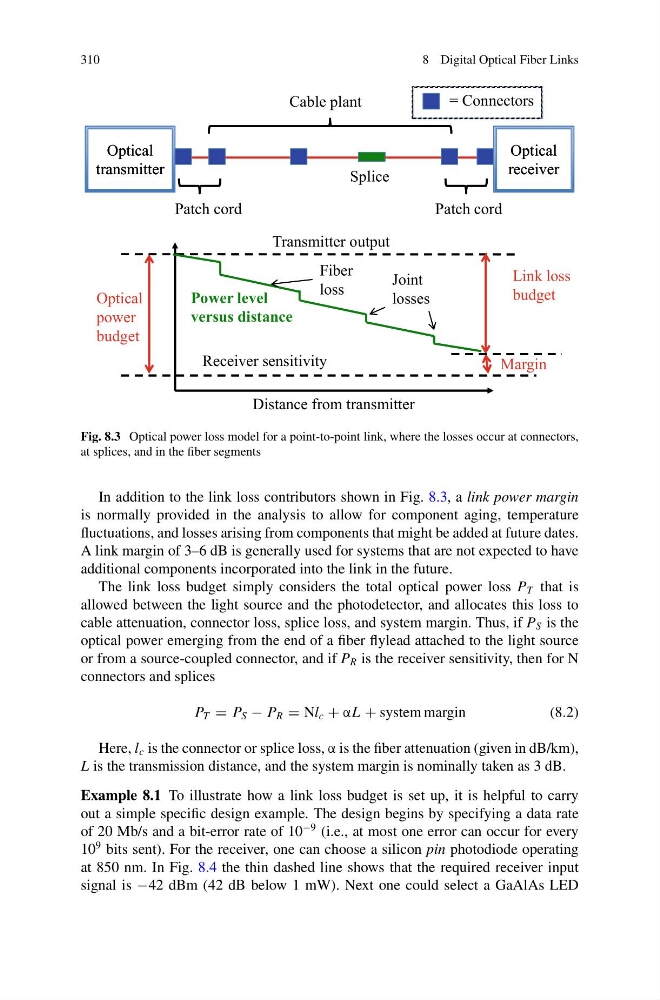
Fig. 8.3 Optical power loss model for a point-to-point link, where the losses occur at connectors,
at splices, and in the fiber segments
In addition to the link loss contributors shown in Fig. 8.3, a link power margin
is normally provided in the analysis to allow for component aging, temperature
fluctuations, and losses arising from components that might be added at future dates.
A link margin of 3–6 dB is generally used for systems that are not expected to have
additional components incorporated into the link in the future.
The link loss budget simply considers the total optical power loss P T that is
allowed between the light source and the photodetector, and allocates this loss to
cable attenuation, connector loss, splice loss, and system margin. Thus, if P S is the
optical power emerging from the end of a fiber flylead attached to the light source
or from a source-coupled connector, and if P R is the receiver sensitivity, then for N
connectors and splices
P T = P S − P R = Nl c + αL + system margin
(8.2)
Here, l c is the connector or splice loss, α is the fiber attenuation (given in dB/km),
L is the transmission distance, and the system margin is nominally taken as 3 dB.
Example 8.1 To illustrate how a link loss budget is set up, it is helpful to carry
out a simple specific design example. The design begins by specifying a data rate
of 20 Mb/s and a bit-error rate of 10
−9 (i.e., at most one error can occur for every
10
9 bits sent). For the receiver, one can choose a silicon pin photodiode operating
at 850 nm. In Fig. 8.4 the thin dashed line shows that the required receiver input
signal is −42 dBm (42 dB below 1 mW). Next one could select a GaAlAs LED
8 Digital Optical Fiber Links
Optical
transmitter
Optical
transmitter
Optical
receiver
Optical
receiver
Splice
d
r
o
c
h
c
t
a
P
d
r
o
c
h
c
t
a
P
= Connectors
Cable plant
Transmitter output
Receiver sensitivity
Distance from transmitter
Power level
versus distance
Link loss
budget
Optical
power
budget
Margin
Fiber
loss
Joint
losses
Fig. 8.3 Optical power loss model for a point-to-point link, where the losses occur at connectors,
at splices, and in the fiber segments
In addition to the link loss contributors shown in Fig. 8.3, a link power margin
is normally provided in the analysis to allow for component aging, temperature
fluctuations, and losses arising from components that might be added at future dates.
A link margin of 3–6 dB is generally used for systems that are not expected to have
additional components incorporated into the link in the future.
The link loss budget simply considers the total optical power loss P T that is
allowed between the light source and the photodetector, and allocates this loss to
cable attenuation, connector loss, splice loss, and system margin. Thus, if P S is the
optical power emerging from the end of a fiber flylead attached to the light source
or from a source-coupled connector, and if P R is the receiver sensitivity, then for N
connectors and splices
P T = P S − P R = Nl c + αL + system margin
(8.2)
Here, l c is the connector or splice loss, α is the fiber attenuation (given in dB/km),
L is the transmission distance, and the system margin is nominally taken as 3 dB.
Example 8.1 To illustrate how a link loss budget is set up, it is helpful to carry
out a simple specific design example. The design begins by specifying a data rate
of 20 Mb/s and a bit-error rate of 10
−9 (i.e., at most one error can occur for every
10
9 bits sent). For the receiver, one can choose a silicon pin photodiode operating
at 850 nm. In Fig. 8.4 the thin dashed line shows that the required receiver input
signal is −42 dBm (42 dB below 1 mW). Next one could select a GaAlAs LED