

286
7 Optical Receiver Operation
and produces no dark current; that is, no electron–hole pairs are generated in the
absence of an optical pulse. Given this condition, it is possible to find the minimum
received optical power required for a specific bit-error rate performance in a digital
system. This minimum received power level is known as the quantum limit, because
all system parameters are assumed ideal and the performance is limited only by the
photodetection statistics.
Assume that an optical pulse of energy E falls on the photodetector in a time
interval τ. The receiver can only interpret this condition as a 0 pulse if no electron–
hole pairs are generated with the pulse present. From Eq. (7.2) the probability that n
= 0 electrons are excited in a time interval t is
P r (0) = e
−N
(7.23)
where the average number of electron–hole pairs N is given by Eq. (7.1). Thus, for
a given error probability P r (0), we can find the minimum energy E required at a
specific wavelength λ.
Example 7.9 A 10-Mb/s digital fiber optic link operating at 850 nm requires a
maximum BER of 10
−9 .
(a) The first step is to find the quantum limit in terms of the quantum efficiency of
the detector and the energy of the incident photon. From Eq. (7.23) the probability
of error is P r (0) = e
−N
= 10
−9 . Solving for N yields N = 9 ln 10 = 20.7 ≈ 21.
Hence, an average of 21 photons per pulse is required for this BER. Using Eq. (7.1)
and solving for E gives E = 20.7 hν/η.
(b) The next step is to find the minimum incident optical power P i that must fall
on the photodetector to achieve a 10
−9 BER at a data rate of 10 Mb/s for a simple
binary-level signaling scheme. If the detector quantum efficiency η = 1, then
E = P i τ = 20.7hv = 20.7 hv/λ
where 1/τ is one-half the data rate B; that is, 1/τ = B/2. (Note: This assumes an equal
number of 0 and 1 pulses.) Solving for P i yields
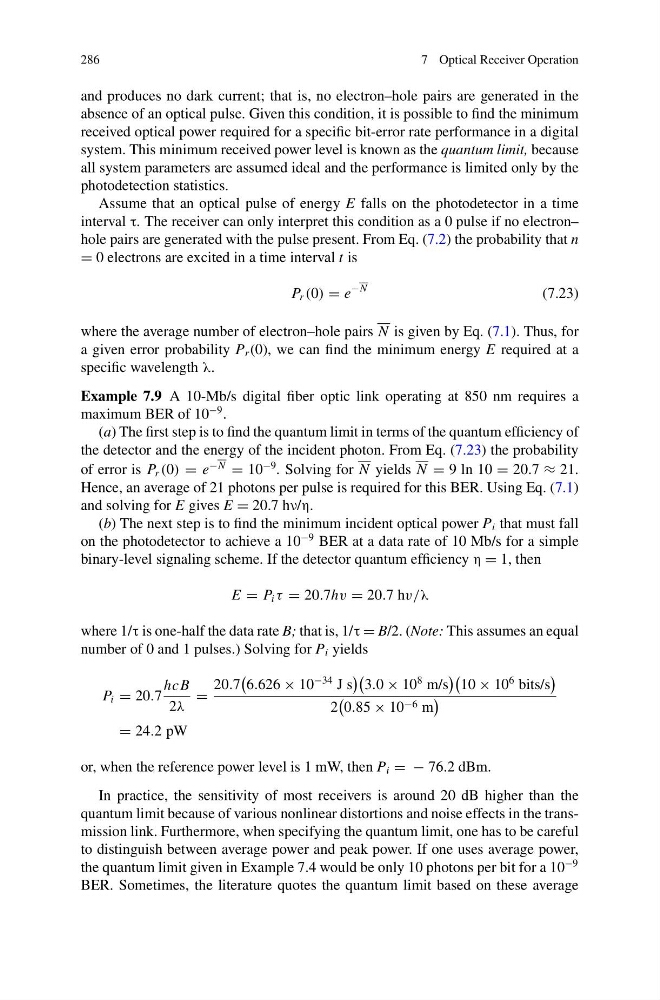
P i = 20.7
hcB
2λ
=
20.7
6.626 × 10
−34 J s
3.0 × 10
8 m/s
10 × 10
6 bits/s
2
0.85 × 10 −6 m
= 24.2 pW
or, when the reference power level is 1 mW, then P i = − 76.2 dBm.
In practice, the sensitivity of most receivers is around 20 dB higher than the
quantum limit because of various nonlinear distortions and noise effects in the transmission link. Furthermore, when specifying the quantum limit, one has to be careful
to distinguish between average power and peak power. If one uses average power,
the quantum limit given in Example 7.4 would be only 10 photons per bit for a 10
−9
BER. Sometimes, the literature quotes the quantum limit based on these average
7 Optical Receiver Operation
and produces no dark current; that is, no electron–hole pairs are generated in the
absence of an optical pulse. Given this condition, it is possible to find the minimum
received optical power required for a specific bit-error rate performance in a digital
system. This minimum received power level is known as the quantum limit, because
all system parameters are assumed ideal and the performance is limited only by the
photodetection statistics.
Assume that an optical pulse of energy E falls on the photodetector in a time
interval τ. The receiver can only interpret this condition as a 0 pulse if no electron–
hole pairs are generated with the pulse present. From Eq. (7.2) the probability that n
= 0 electrons are excited in a time interval t is
P r (0) = e
−N
(7.23)
where the average number of electron–hole pairs N is given by Eq. (7.1). Thus, for
a given error probability P r (0), we can find the minimum energy E required at a
specific wavelength λ.
Example 7.9 A 10-Mb/s digital fiber optic link operating at 850 nm requires a
maximum BER of 10
−9 .
(a) The first step is to find the quantum limit in terms of the quantum efficiency of
the detector and the energy of the incident photon. From Eq. (7.23) the probability
of error is P r (0) = e
−N
= 10
−9 . Solving for N yields N = 9 ln 10 = 20.7 ≈ 21.
Hence, an average of 21 photons per pulse is required for this BER. Using Eq. (7.1)
and solving for E gives E = 20.7 hν/η.
(b) The next step is to find the minimum incident optical power P i that must fall
on the photodetector to achieve a 10
−9 BER at a data rate of 10 Mb/s for a simple
binary-level signaling scheme. If the detector quantum efficiency η = 1, then
E = P i τ = 20.7hv = 20.7 hv/λ
where 1/τ is one-half the data rate B; that is, 1/τ = B/2. (Note: This assumes an equal
number of 0 and 1 pulses.) Solving for P i yields
P i = 20.7
hcB
2λ
=
20.7
6.626 × 10
−34 J s
3.0 × 10
8 m/s
10 × 10
6 bits/s
2
0.85 × 10 −6 m
= 24.2 pW
or, when the reference power level is 1 mW, then P i = − 76.2 dBm.
In practice, the sensitivity of most receivers is around 20 dB higher than the
quantum limit because of various nonlinear distortions and noise effects in the transmission link. Furthermore, when specifying the quantum limit, one has to be careful
to distinguish between average power and peak power. If one uses average power,
the quantum limit given in Example 7.4 would be only 10 photons per bit for a 10
−9
BER. Sometimes, the literature quotes the quantum limit based on these average