

7.2 Performance Characteristics of Digital Receivers
277
E ≥
hc
ηλ
ln
1
B E R
Thus, if E min is the minimum energy needed to achieve a specific BER, then for
a bit rate B = 1/T b the minimum average power is
P ave =
E min
2T b
= E min B/2
Drill Problem 7.2 Consider a photodetector that has a quantum efficiency of
0.65 at a 1310-nm wavelength. Show that the minimum average power needed
to achieve a 10
−12 BER at a 1-Gb/s data rate at 1310 nm is 3.74 nW = −
54.3 dBm.
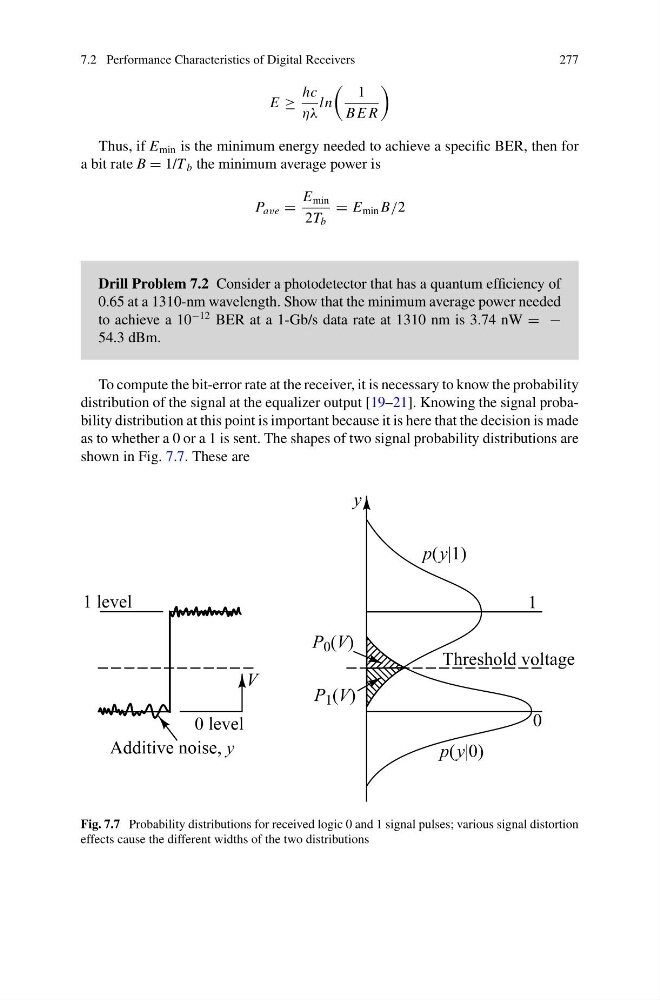
To compute the bit-error rate at the receiver, it is necessary to know the probability
distribution of the signal at the equalizer output [19–21]. Knowing the signal probability distribution at this point is important because it is here that the decision is made
as to whether a 0 or a 1 is sent. The shapes of two signal probability distributions are
shown in Fig. 7.7. These are
Fig. 7.7 Probability distributions for received logic 0 and 1 signal pulses; various signal distortion
effects cause the different widths of the two distributions
277
E ≥
hc
ηλ
ln
1
B E R
Thus, if E min is the minimum energy needed to achieve a specific BER, then for
a bit rate B = 1/T b the minimum average power is
P ave =
E min
2T b
= E min B/2
Drill Problem 7.2 Consider a photodetector that has a quantum efficiency of
0.65 at a 1310-nm wavelength. Show that the minimum average power needed
to achieve a 10
−12 BER at a 1-Gb/s data rate at 1310 nm is 3.74 nW = −
54.3 dBm.
To compute the bit-error rate at the receiver, it is necessary to know the probability
distribution of the signal at the equalizer output [19–21]. Knowing the signal probability distribution at this point is important because it is here that the decision is made
as to whether a 0 or a 1 is sent. The shapes of two signal probability distributions are
shown in Fig. 7.7. These are
Fig. 7.7 Probability distributions for received logic 0 and 1 signal pulses; various signal distortion
effects cause the different widths of the two distributions