

6.1 Operation of Photodiodes
247
layer, the longer it takes for the photogenerated carriers to drift across the reversebiased junction. Because the carrier drift time determines the response speed of the
photodiode, a compromise has to be made between response speed and quantum
efficiency. This relationship is discussed further in Sect. 6.3.
The performance of a photodiode is often characterized by the responsivity R.
This is related to the quantum efficiency by
R =
i p
P in
=
ηq
hν
(6.6)
The responsivity parameter is quite useful because it specifies the photocurrent
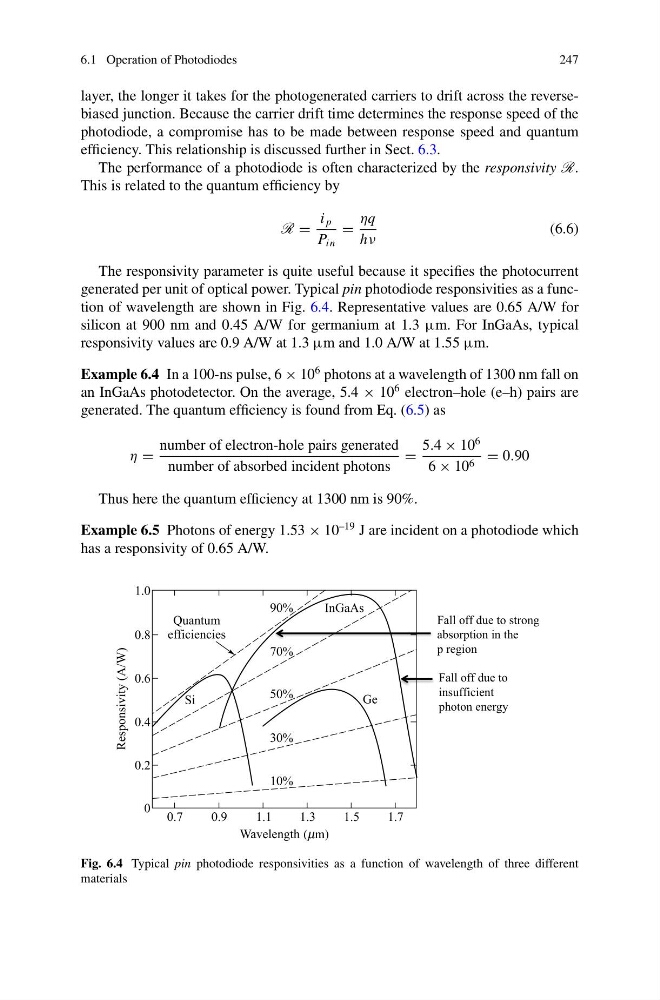
generated per unit of optical power. Typical pin photodiode responsivities as a function of wavelength are shown in Fig. 6.4. Representative values are 0.65 A/W for
silicon at 900 nm and 0.45 A/W for germanium at 1.3 μm. For InGaAs, typical
responsivity values are 0.9 A/W at 1.3 μm and 1.0 A/W at 1.55 μm.
Example 6.4 In a 100-ns pulse, 6 × 10
6 photons at a wavelength of 1300 nm fall on
an InGaAs photodetector. On the average, 5.4 × 10
6 electron–hole (e–h) pairs are
generated. The quantum efficiency is found from Eq. (6.5) as
η =
number of electron-hole pairs generated
number of absorbed incident photons
=
5.4 × 10
6
6 × 10 6 = 0.90
Thus here the quantum efficiency at 1300 nm is 90%.
Example 6.5 Photons of energy 1.53 × 10
–19 J are incident on a photodiode which
has a responsivity of 0.65 A/W.
Fall off due to strong
absorption in the
p region
Fall off due to
insufficient
photon energy
Fig. 6.4 Typical pin photodiode responsivities as a function of wavelength of three different
materials
247
layer, the longer it takes for the photogenerated carriers to drift across the reversebiased junction. Because the carrier drift time determines the response speed of the
photodiode, a compromise has to be made between response speed and quantum
efficiency. This relationship is discussed further in Sect. 6.3.
The performance of a photodiode is often characterized by the responsivity R.
This is related to the quantum efficiency by
R =
i p
P in
=
ηq
hν
(6.6)
The responsivity parameter is quite useful because it specifies the photocurrent
generated per unit of optical power. Typical pin photodiode responsivities as a function of wavelength are shown in Fig. 6.4. Representative values are 0.65 A/W for
silicon at 900 nm and 0.45 A/W for germanium at 1.3 μm. For InGaAs, typical
responsivity values are 0.9 A/W at 1.3 μm and 1.0 A/W at 1.55 μm.
Example 6.4 In a 100-ns pulse, 6 × 10
6 photons at a wavelength of 1300 nm fall on
an InGaAs photodetector. On the average, 5.4 × 10
6 electron–hole (e–h) pairs are
generated. The quantum efficiency is found from Eq. (6.5) as
η =
number of electron-hole pairs generated
number of absorbed incident photons
=
5.4 × 10
6
6 × 10 6 = 0.90
Thus here the quantum efficiency at 1300 nm is 90%.
Example 6.5 Photons of energy 1.53 × 10
–19 J are incident on a photodiode which
has a responsivity of 0.65 A/W.
Fall off due to strong
absorption in the
p region
Fall off due to
insufficient
photon energy
Fig. 6.4 Typical pin photodiode responsivities as a function of wavelength of three different
materials