

222
5 Optical Power Coupling
yields.
s = f = 2R L
Thus the focal point is located on the lens surface at point A.
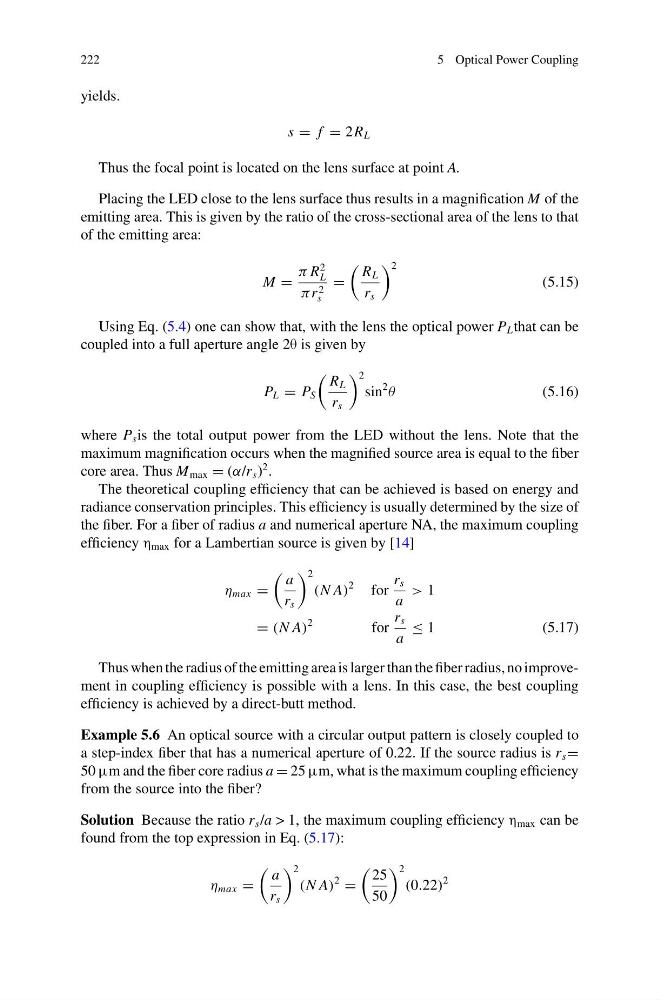
Placing the LED close to the lens surface thus results in a magnification M of the
emitting area. This is given by the ratio of the cross-sectional area of the lens to that
of the emitting area:
M =
π R
2
L
πr 2
s
=
R L
r s
2
(5.15)
Using Eq. (5.4) one can show that, with the lens the optical power P L that can be
coupled into a full aperture angle 2θ is given by
P L = P S
R L
r s
2
sin
2
θ
(5.16)
where P s is the total output power from the LED without the lens. Note that the
maximum magnification occurs when the magnified source area is equal to the fiber
core area. Thus M max = (α/r s )
2 .
The theoretical coupling efficiency that can be achieved is based on energy and
radiance conservation principles. This efficiency is usually determined by the size of
the fiber. For a fiber of radius a and numerical aperture NA, the maximum coupling
efficiency η max for a Lambertian source is given by [14]
η max =
a
r s
2
(N A)
2
for
r s
a
> 1
= (N A)
2
for
r s
a
≤ 1
(5.17)
Thus when the radius of the emitting area is larger than the fiber radius, no improvement in coupling efficiency is possible with a lens. In this case, the best coupling
efficiency is achieved by a direct-butt method.
Example 5.6 An optical source with a circular output pattern is closely coupled to
a step-index fiber that has a numerical aperture of 0.22. If the source radius is r s =
50 μm and the fiber core radius a = 25 μm, what is the maximum coupling efficiency
from the source into the fiber?
Solution Because the ratio r s /a > 1, the maximum coupling efficiency η max can be
found from the top expression in Eq. (5.17):
η max =
a
r s
2
(N A)
2
=
25
50
2
(0.22)
2
5 Optical Power Coupling
yields.
s = f = 2R L
Thus the focal point is located on the lens surface at point A.
Placing the LED close to the lens surface thus results in a magnification M of the
emitting area. This is given by the ratio of the cross-sectional area of the lens to that
of the emitting area:
M =
π R
2
L
πr 2
s
=
R L
r s
2
(5.15)
Using Eq. (5.4) one can show that, with the lens the optical power P L that can be
coupled into a full aperture angle 2θ is given by
P L = P S
R L
r s
2
sin
2
θ
(5.16)
where P s is the total output power from the LED without the lens. Note that the
maximum magnification occurs when the magnified source area is equal to the fiber
core area. Thus M max = (α/r s )
2 .
The theoretical coupling efficiency that can be achieved is based on energy and
radiance conservation principles. This efficiency is usually determined by the size of
the fiber. For a fiber of radius a and numerical aperture NA, the maximum coupling
efficiency η max for a Lambertian source is given by [14]
η max =
a
r s
2
(N A)
2
for
r s
a
> 1
= (N A)
2
for
r s
a
≤ 1
(5.17)
Thus when the radius of the emitting area is larger than the fiber radius, no improvement in coupling efficiency is possible with a lens. In this case, the best coupling
efficiency is achieved by a direct-butt method.
Example 5.6 An optical source with a circular output pattern is closely coupled to
a step-index fiber that has a numerical aperture of 0.22. If the source radius is r s =
50 μm and the fiber core radius a = 25 μm, what is the maximum coupling efficiency
from the source into the fiber?
Solution Because the ratio r s /a > 1, the maximum coupling efficiency η max can be
found from the top expression in Eq. (5.17):
η max =
a
r s
2
(N A)
2
=
25
50
2
(0.22)
2