

184
4 Light Sources for Fiber Links
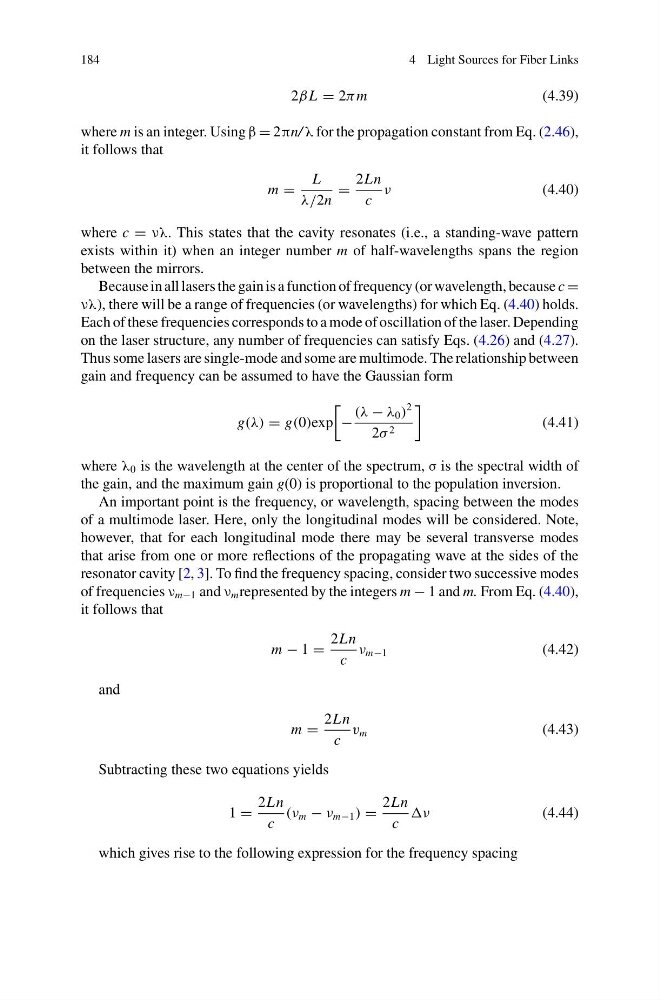
2β L = 2π m
(4.39)
where m is an integer. Using β = 2πn/ λ for the propagation constant from Eq. (2.46),
it follows that
m =
L
λ/2n
=
2Ln
c
ν
(4.40)
where c = νλ. This states that the cavity resonates (i.e., a standing-wave pattern
exists within it) when an integer number m of half-wavelengths spans the region
between the mirrors.
Because in all lasers the gain is a function of frequency (or wavelength, because c =
νλ), there will be a range of frequencies (or wavelengths) for which Eq. (4.40) holds.
Each of these frequencies corresponds to a mode of oscillation of the laser. Depending
on the laser structure, any number of frequencies can satisfy Eqs. (4.26) and (4.27).
Thus some lasers are single-mode and some are multimode. The relationship between
gain and frequency can be assumed to have the Gaussian form
g(λ) = g(0)exp
−
(λ − λ 0 )
2
2σ 2
(4.41)
where λ 0 is the wavelength at the center of the spectrum, σ is the spectral width of
the gain, and the maximum gain g(0) is proportional to the population inversion.
An important point is the frequency, or wavelength, spacing between the modes
of a multimode laser. Here, only the longitudinal modes will be considered. Note,
however, that for each longitudinal mode there may be several transverse modes
that arise from one or more reflections of the propagating wave at the sides of the
resonator cavity [2, 3]. To find the frequency spacing, consider two successive modes
of frequencies ν m−1 and ν m represented by the integers m − 1 and m. From Eq. (4.40),
it follows that
m − 1 =
2Ln
c
ν m−1
(4.42)
and
m =
2Ln
c
v m
(4.43)
Subtracting these two equations yields
1 =
2Ln
c
(ν m − ν m−1 ) =
2Ln
c
ν
(4.44)
which gives rise to the following expression for the frequency spacing
4 Light Sources for Fiber Links
2β L = 2π m
(4.39)
where m is an integer. Using β = 2πn/ λ for the propagation constant from Eq. (2.46),
it follows that
m =
L
λ/2n
=
2Ln
c
ν
(4.40)
where c = νλ. This states that the cavity resonates (i.e., a standing-wave pattern
exists within it) when an integer number m of half-wavelengths spans the region
between the mirrors.
Because in all lasers the gain is a function of frequency (or wavelength, because c =
νλ), there will be a range of frequencies (or wavelengths) for which Eq. (4.40) holds.
Each of these frequencies corresponds to a mode of oscillation of the laser. Depending
on the laser structure, any number of frequencies can satisfy Eqs. (4.26) and (4.27).
Thus some lasers are single-mode and some are multimode. The relationship between
gain and frequency can be assumed to have the Gaussian form
g(λ) = g(0)exp
−
(λ − λ 0 )
2
2σ 2
(4.41)
where λ 0 is the wavelength at the center of the spectrum, σ is the spectral width of
the gain, and the maximum gain g(0) is proportional to the population inversion.
An important point is the frequency, or wavelength, spacing between the modes
of a multimode laser. Here, only the longitudinal modes will be considered. Note,
however, that for each longitudinal mode there may be several transverse modes
that arise from one or more reflections of the propagating wave at the sides of the
resonator cavity [2, 3]. To find the frequency spacing, consider two successive modes
of frequencies ν m−1 and ν m represented by the integers m − 1 and m. From Eq. (4.40),
it follows that
m − 1 =
2Ln
c
ν m−1
(4.42)
and
m =
2Ln
c
v m
(4.43)
Subtracting these two equations yields
1 =
2Ln
c
(ν m − ν m−1 ) =
2Ln
c
ν
(4.44)
which gives rise to the following expression for the frequency spacing