

4.3 Principles of Laser Diodes
183
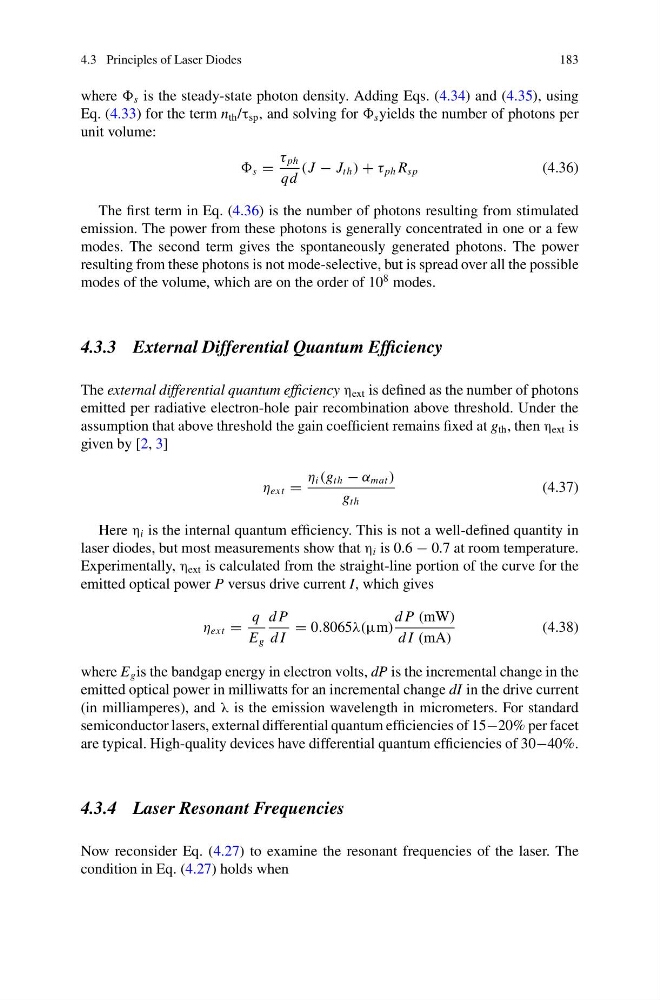
where s is the steady-state photon density. Adding Eqs. (4.34) and (4.35), using
Eq. (4.33) for the term n th /τ sp , and solving for s yields the number of photons per
unit volume:
s =
τ ph
qd
(J − J th ) + τ ph R sp
(4.36)
The first term in Eq. (4.36) is the number of photons resulting from stimulated
emission. The power from these photons is generally concentrated in one or a few
modes. The second term gives the spontaneously generated photons. The power
resulting from these photons is not mode-selective, but is spread over all the possible
modes of the volume, which are on the order of 10
8 modes.
4.3.3 External Differential Quantum Efficiency
The external differential quantum efficiency η ext is defined as the number of photons
emitted per radiative electron-hole pair recombination above threshold. Under the
assumption that above threshold the gain coefficient remains fixed at g th , then η ext is
given by [2, 3]
η ext =
η i (g th − α mat )
g th
(4.37)
Here η i is the internal quantum efficiency. This is not a well-defined quantity in
laser diodes, but most measurements show that η i is 0.6 − 0.7 at room temperature.
Experimentally, η ext is calculated from the straight-line portion of the curve for the
emitted optical power P versus drive current I, which gives
η ext =
q
E g
d P
d I
= 0.8065λ(μm)
d P (mW)
d I (mA)
(4.38)
where E g is the bandgap energy in electron volts, dP is the incremental change in the
emitted optical power in milliwatts for an incremental change dI in the drive current
(in milliamperes), and λ is the emission wavelength in micrometers. For standard
semiconductor lasers, external differential quantum efficiencies of 15−20% per facet
are typical. High-quality devices have differential quantum efficiencies of 30−40%.
4.3.4 Laser Resonant Frequencies
Now reconsider Eq. (4.27) to examine the resonant frequencies of the laser. The
condition in Eq. (4.27) holds when
183
where s is the steady-state photon density. Adding Eqs. (4.34) and (4.35), using
Eq. (4.33) for the term n th /τ sp , and solving for s yields the number of photons per
unit volume:
s =
τ ph
qd
(J − J th ) + τ ph R sp
(4.36)
The first term in Eq. (4.36) is the number of photons resulting from stimulated
emission. The power from these photons is generally concentrated in one or a few
modes. The second term gives the spontaneously generated photons. The power
resulting from these photons is not mode-selective, but is spread over all the possible
modes of the volume, which are on the order of 10
8 modes.
4.3.3 External Differential Quantum Efficiency
The external differential quantum efficiency η ext is defined as the number of photons
emitted per radiative electron-hole pair recombination above threshold. Under the
assumption that above threshold the gain coefficient remains fixed at g th , then η ext is
given by [2, 3]
η ext =
η i (g th − α mat )
g th
(4.37)
Here η i is the internal quantum efficiency. This is not a well-defined quantity in
laser diodes, but most measurements show that η i is 0.6 − 0.7 at room temperature.
Experimentally, η ext is calculated from the straight-line portion of the curve for the
emitted optical power P versus drive current I, which gives
η ext =
q
E g
d P
d I
= 0.8065λ(μm)
d P (mW)
d I (mA)
(4.38)
where E g is the bandgap energy in electron volts, dP is the incremental change in the
emitted optical power in milliwatts for an incremental change dI in the drive current
(in milliamperes), and λ is the emission wavelength in micrometers. For standard
semiconductor lasers, external differential quantum efficiencies of 15−20% per facet
are typical. High-quality devices have differential quantum efficiencies of 30−40%.
4.3.4 Laser Resonant Frequencies
Now reconsider Eq. (4.27) to examine the resonant frequencies of the laser. The
condition in Eq. (4.27) holds when