

174
4 Light Sources for Fiber Links
LED. Laser diodes typically have response times less than 1 ns, can have spectral
widths of 1 nm or less, and are capable of coupling tens of milliwatts of useful
luminescent power into optical fibers with small cores and small mode-field diameters. The majority of laser diodes in use are multilayered heterojunction devices. As
mentioned in Sect. 4.2, the double-heterojunction LED configuration evolved from
the successful demonstration of both carrier and optical confinement in heterojunction injection laser diodes. The more rapid evolvement and utilization of LEDs as
compared with laser diodes lies in the inherently simpler construction, the smaller
temperature dependence of the emitted optical power, and the absence of catastrophic
degradation in LEDs. The construction of laser diodes is more complicated, mainly
because of the additional requirement of current confinement in a small lasing cavity.
Stimulated emission in semiconductor lasers arises from optical transitions
between distributions of energy states in the valence and conduction bands. This
differs from gas and solid-state lasers, in which radiative transitions occur between
discrete isolated atomic or molecular levels. The radiation in one type of laser
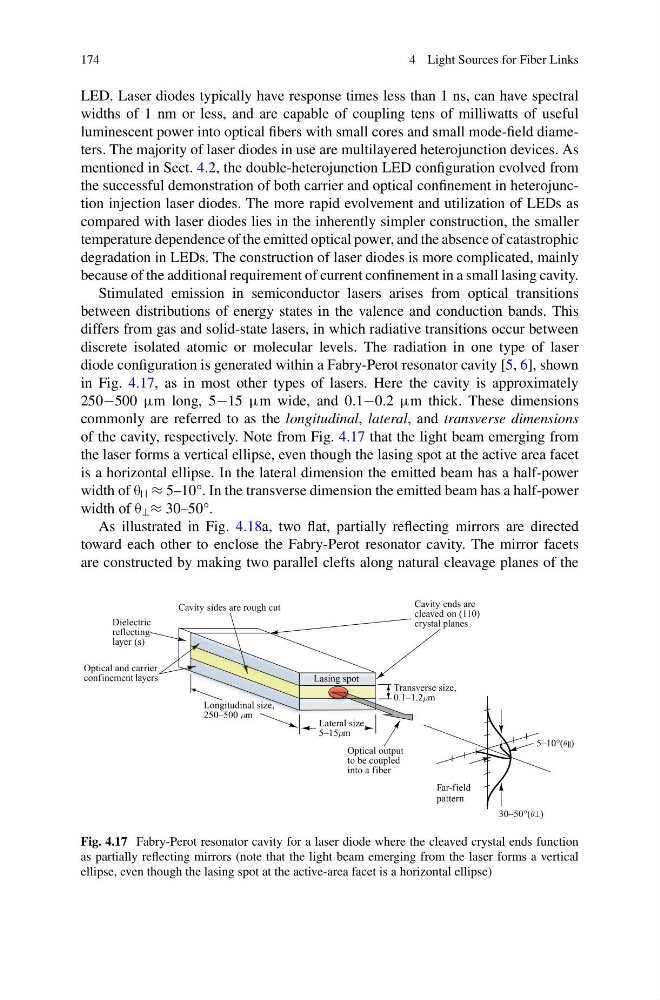
diode configuration is generated within a Fabry-Perot resonator cavity [5, 6], shown
in Fig. 4.17, as in most other types of lasers. Here the cavity is approximately
250−500 μm long, 5−15 μm wide, and 0.1−0.2 μm thick. These dimensions
commonly are referred to as the longitudinal, lateral, and transverse dimensions
of the cavity, respectively. Note from Fig. 4.17 that the light beam emerging from
the laser forms a vertical ellipse, even though the lasing spot at the active area facet
is a horizontal ellipse. In the lateral dimension the emitted beam has a half-power
width of θ | | ≈ 5–10°. In the transverse dimension the emitted beam has a half-power
width of θ ⊥ ≈ 30–50°.
As illustrated in Fig. 4.18a, two flat, partially reflecting mirrors are directed
toward each other to enclose the Fabry-Perot resonator cavity. The mirror facets
are constructed by making two parallel clefts along natural cleavage planes of the
Fig. 4.17 Fabry-Perot resonator cavity for a laser diode where the cleaved crystal ends function
as partially reflecting mirrors (note that the light beam emerging from the laser forms a vertical
ellipse, even though the lasing spot at the active-area facet is a horizontal ellipse)
4 Light Sources for Fiber Links
LED. Laser diodes typically have response times less than 1 ns, can have spectral
widths of 1 nm or less, and are capable of coupling tens of milliwatts of useful
luminescent power into optical fibers with small cores and small mode-field diameters. The majority of laser diodes in use are multilayered heterojunction devices. As
mentioned in Sect. 4.2, the double-heterojunction LED configuration evolved from
the successful demonstration of both carrier and optical confinement in heterojunction injection laser diodes. The more rapid evolvement and utilization of LEDs as
compared with laser diodes lies in the inherently simpler construction, the smaller
temperature dependence of the emitted optical power, and the absence of catastrophic
degradation in LEDs. The construction of laser diodes is more complicated, mainly
because of the additional requirement of current confinement in a small lasing cavity.
Stimulated emission in semiconductor lasers arises from optical transitions
between distributions of energy states in the valence and conduction bands. This
differs from gas and solid-state lasers, in which radiative transitions occur between
discrete isolated atomic or molecular levels. The radiation in one type of laser
diode configuration is generated within a Fabry-Perot resonator cavity [5, 6], shown
in Fig. 4.17, as in most other types of lasers. Here the cavity is approximately
250−500 μm long, 5−15 μm wide, and 0.1−0.2 μm thick. These dimensions
commonly are referred to as the longitudinal, lateral, and transverse dimensions
of the cavity, respectively. Note from Fig. 4.17 that the light beam emerging from
the laser forms a vertical ellipse, even though the lasing spot at the active area facet
is a horizontal ellipse. In the lateral dimension the emitted beam has a half-power
width of θ | | ≈ 5–10°. In the transverse dimension the emitted beam has a half-power
width of θ ⊥ ≈ 30–50°.
As illustrated in Fig. 4.18a, two flat, partially reflecting mirrors are directed
toward each other to enclose the Fabry-Perot resonator cavity. The mirror facets
are constructed by making two parallel clefts along natural cleavage planes of the
Fig. 4.17 Fabry-Perot resonator cavity for a laser diode where the cleaved crystal ends function
as partially reflecting mirrors (note that the light beam emerging from the laser forms a vertical
ellipse, even though the lasing spot at the active-area facet is a horizontal ellipse)