

4.3 Principles of Laser Diodes
173
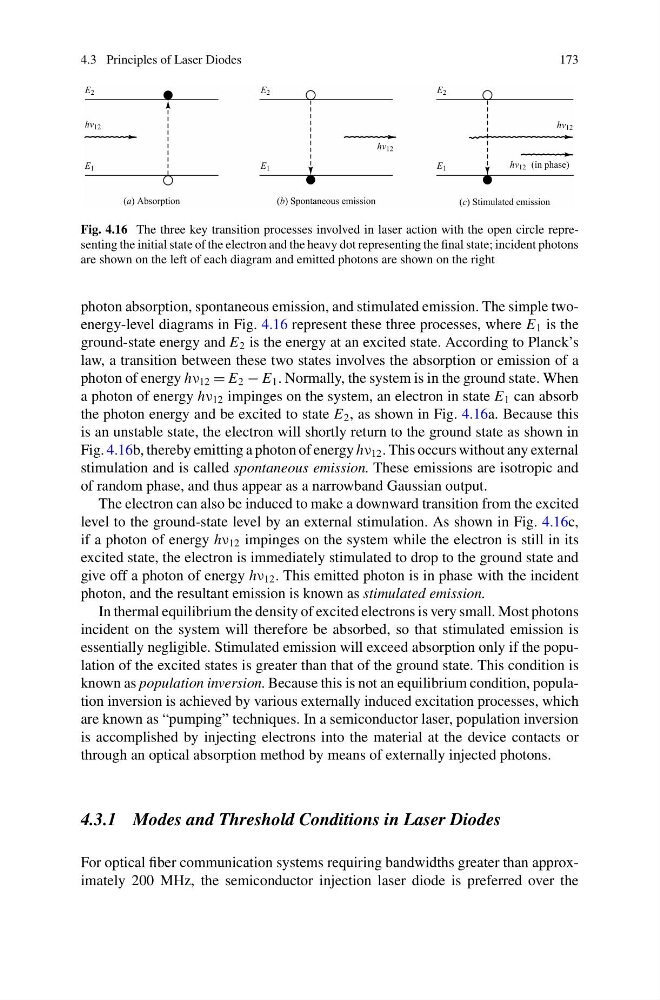
Fig. 4.16 The three key transition processes involved in laser action with the open circle representing the initial state of the electron and the heavy dot representing the final state; incident photons
are shown on the left of each diagram and emitted photons are shown on the right
photon absorption, spontaneous emission, and stimulated emission. The simple twoenergy-level diagrams in Fig. 4.16 represent these three processes, where E 1 is the
ground-state energy and E 2 is the energy at an excited state. According to Planck’s
law, a transition between these two states involves the absorption or emission of a
photon of energy hν 12 = E 2 − E 1 . Normally, the system is in the ground state. When
a photon of energy hν 12 impinges on the system, an electron in state E 1 can absorb
the photon energy and be excited to state E 2 , as shown in Fig. 4.16a. Because this
is an unstable state, the electron will shortly return to the ground state as shown in
Fig. 4.16b, thereby emitting a photon of energy hν 12 . This occurs without any external
stimulation and is called spontaneous emission. These emissions are isotropic and
of random phase, and thus appear as a narrowband Gaussian output.
The electron can also be induced to make a downward transition from the excited
level to the ground-state level by an external stimulation. As shown in Fig. 4.16c,
if a photon of energy hν 12 impinges on the system while the electron is still in its
excited state, the electron is immediately stimulated to drop to the ground state and
give off a photon of energy hν 12 . This emitted photon is in phase with the incident
photon, and the resultant emission is known as stimulated emission.
In thermal equilibrium the density of excited electrons is very small. Most photons
incident on the system will therefore be absorbed, so that stimulated emission is
essentially negligible. Stimulated emission will exceed absorption only if the population of the excited states is greater than that of the ground state. This condition is
known as population inversion. Because this is not an equilibrium condition, population inversion is achieved by various externally induced excitation processes, which
are known as “pumping” techniques. In a semiconductor laser, population inversion
is accomplished by injecting electrons into the material at the device contacts or
through an optical absorption method by means of externally injected photons.
4.3.1 Modes and Threshold Conditions in Laser Diodes
For optical fiber communication systems requiring bandwidths greater than approximately 200 MHz, the semiconductor injection laser diode is preferred over the
173
Fig. 4.16 The three key transition processes involved in laser action with the open circle representing the initial state of the electron and the heavy dot representing the final state; incident photons
are shown on the left of each diagram and emitted photons are shown on the right
photon absorption, spontaneous emission, and stimulated emission. The simple twoenergy-level diagrams in Fig. 4.16 represent these three processes, where E 1 is the
ground-state energy and E 2 is the energy at an excited state. According to Planck’s
law, a transition between these two states involves the absorption or emission of a
photon of energy hν 12 = E 2 − E 1 . Normally, the system is in the ground state. When
a photon of energy hν 12 impinges on the system, an electron in state E 1 can absorb
the photon energy and be excited to state E 2 , as shown in Fig. 4.16a. Because this
is an unstable state, the electron will shortly return to the ground state as shown in
Fig. 4.16b, thereby emitting a photon of energy hν 12 . This occurs without any external
stimulation and is called spontaneous emission. These emissions are isotropic and
of random phase, and thus appear as a narrowband Gaussian output.
The electron can also be induced to make a downward transition from the excited
level to the ground-state level by an external stimulation. As shown in Fig. 4.16c,
if a photon of energy hν 12 impinges on the system while the electron is still in its
excited state, the electron is immediately stimulated to drop to the ground state and
give off a photon of energy hν 12 . This emitted photon is in phase with the incident
photon, and the resultant emission is known as stimulated emission.
In thermal equilibrium the density of excited electrons is very small. Most photons
incident on the system will therefore be absorbed, so that stimulated emission is
essentially negligible. Stimulated emission will exceed absorption only if the population of the excited states is greater than that of the ground state. This condition is
known as population inversion. Because this is not an equilibrium condition, population inversion is achieved by various externally induced excitation processes, which
are known as “pumping” techniques. In a semiconductor laser, population inversion
is accomplished by injecting electrons into the material at the device contacts or
through an optical absorption method by means of externally injected photons.
4.3.1 Modes and Threshold Conditions in Laser Diodes
For optical fiber communication systems requiring bandwidths greater than approximately 200 MHz, the semiconductor injection laser diode is preferred over the