

4.2 Principles of Light-Emitting Diodes (LEDs)
171
Electrical 3-dB point
Optical 3-dB point
Electrical bandwidth
Optical bandwidth
Current ratio I
out /I
in
Modulation frequency
1.000
0.707
0.500
Small-signal region
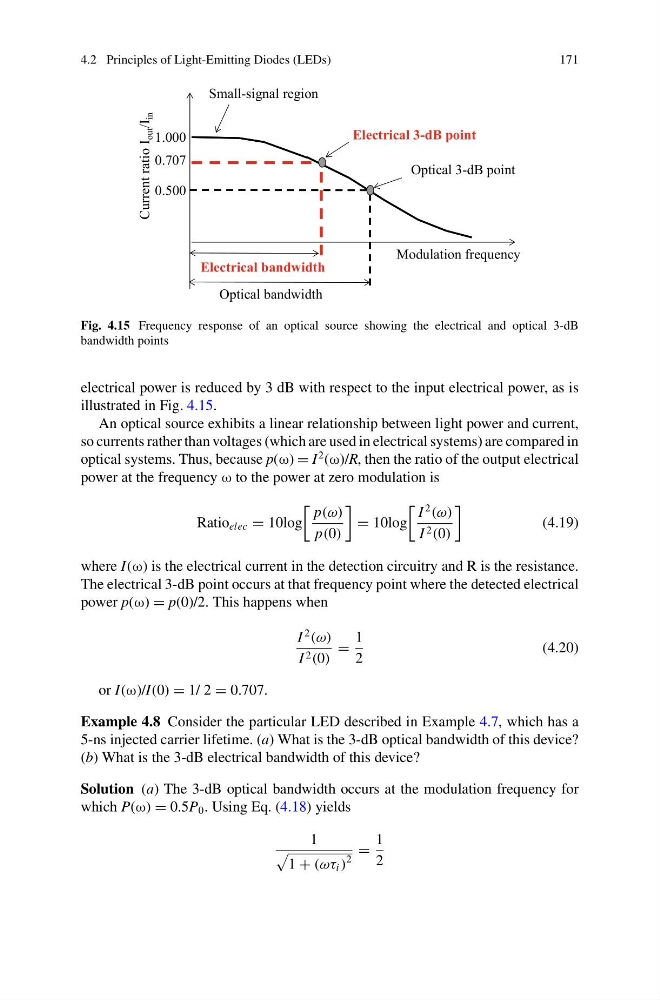
Fig. 4.15 Frequency response of an optical source showing the electrical and optical 3-dB
bandwidth points
electrical power is reduced by 3 dB with respect to the input electrical power, as is
illustrated in Fig. 4.15.
An optical source exhibits a linear relationship between light power and current,
so currents rather than voltages (which are used in electrical systems) are compared in
optical systems. Thus, because p(ω) = I
2 (ω)/R, then the ratio of the output electrical
power at the frequency ω to the power at zero modulation is
Ratio elec = 10log
p(ω)
p(0)
= 10log
I
2
(ω)
I 2 (0)
(4.19)
where I(ω) is the electrical current in the detection circuitry and R is the resistance.
The electrical 3-dB point occurs at that frequency point where the detected electrical
power p(ω) = p(0)/2. This happens when
I
2
(ω)
I 2 (0)
=
1
2
(4.20)
or I(ω)/I(0) = 1/ 2 = 0.707.
Example 4.8 Consider the particular LED described in Example 4.7, which has a
5-ns injected carrier lifetime. (a) What is the 3-dB optical bandwidth of this device?
(b) What is the 3-dB electrical bandwidth of this device?
Solution (a) The 3-dB optical bandwidth occurs at the modulation frequency for
which P(ω) = 0.5P 0 . Using Eq. (4.18) yields
1
1 + (ωτ i )
2
=
1
2
171
Electrical 3-dB point
Optical 3-dB point
Electrical bandwidth
Optical bandwidth
Current ratio I
out /I
in
Modulation frequency
1.000
0.707
0.500
Small-signal region
Fig. 4.15 Frequency response of an optical source showing the electrical and optical 3-dB
bandwidth points
electrical power is reduced by 3 dB with respect to the input electrical power, as is
illustrated in Fig. 4.15.
An optical source exhibits a linear relationship between light power and current,
so currents rather than voltages (which are used in electrical systems) are compared in
optical systems. Thus, because p(ω) = I
2 (ω)/R, then the ratio of the output electrical
power at the frequency ω to the power at zero modulation is
Ratio elec = 10log
p(ω)
p(0)
= 10log
I
2
(ω)
I 2 (0)
(4.19)
where I(ω) is the electrical current in the detection circuitry and R is the resistance.
The electrical 3-dB point occurs at that frequency point where the detected electrical
power p(ω) = p(0)/2. This happens when
I
2
(ω)
I 2 (0)
=
1
2
(4.20)
or I(ω)/I(0) = 1/ 2 = 0.707.
Example 4.8 Consider the particular LED described in Example 4.7, which has a
5-ns injected carrier lifetime. (a) What is the 3-dB optical bandwidth of this device?
(b) What is the 3-dB electrical bandwidth of this device?
Solution (a) The 3-dB optical bandwidth occurs at the modulation frequency for
which P(ω) = 0.5P 0 . Using Eq. (4.18) yields
1
1 + (ωτ i )
2
=
1
2