

4.2 Principles of Light-Emitting Diodes (LEDs)
161
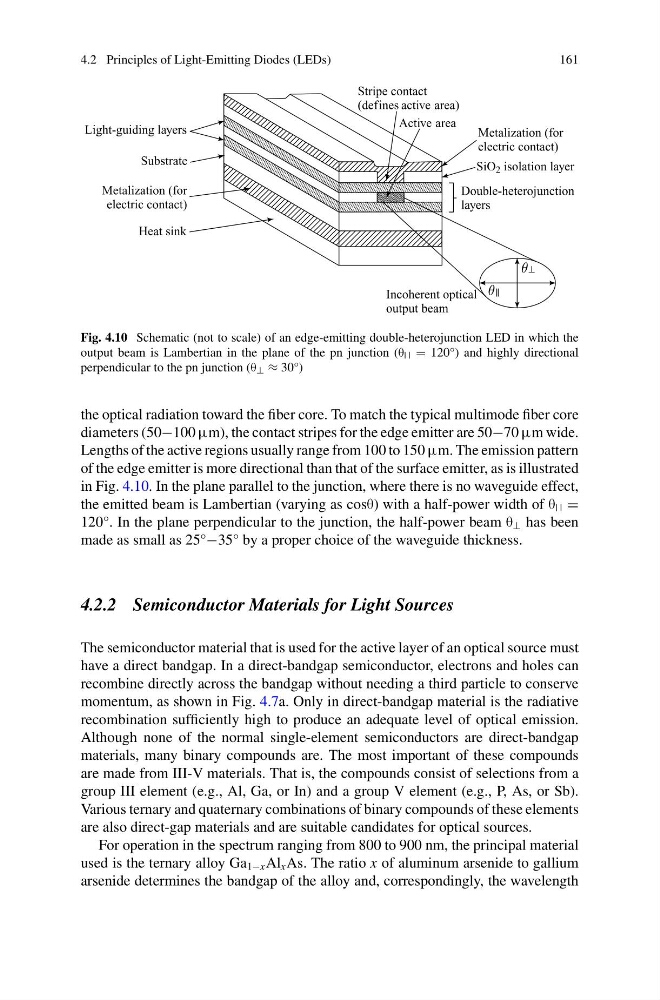
Fig. 4.10 Schematic (not to scale) of an edge-emitting double-heterojunction LED in which the
output beam is Lambertian in the plane of the pn junction (θ | | = 120°) and highly directional
perpendicular to the pn junction (θ ⊥ ≈ 30°)
the optical radiation toward the fiber core. To match the typical multimode fiber core
diameters (50−100 μm), the contact stripes for the edge emitter are 50−70 μm wide.
Lengths of the active regions usually range from 100 to 150 μm. The emission pattern
of the edge emitter is more directional than that of the surface emitter, as is illustrated
in Fig. 4.10. In the plane parallel to the junction, where there is no waveguide effect,
the emitted beam is Lambertian (varying as cosθ) with a half-power width of θ | | =
120°. In the plane perpendicular to the junction, the half-power beam θ ⊥ has been
made as small as 25°−35° by a proper choice of the waveguide thickness.
4.2.2 Semiconductor Materials for Light Sources
The semiconductor material that is used for the active layer of an optical source must
have a direct bandgap. In a direct-bandgap semiconductor, electrons and holes can
recombine directly across the bandgap without needing a third particle to conserve
momentum, as shown in Fig. 4.7a. Only in direct-bandgap material is the radiative
recombination sufficiently high to produce an adequate level of optical emission.
Although none of the normal single-element semiconductors are direct-bandgap
materials, many binary compounds are. The most important of these compounds
are made from III-V materials. That is, the compounds consist of selections from a
group III element (e.g., Al, Ga, or In) and a group V element (e.g., P, As, or Sb).
Various ternary and quaternary combinations of binary compounds of these elements
are also direct-gap materials and are suitable candidates for optical sources.
For operation in the spectrum ranging from 800 to 900 nm, the principal material
used is the ternary alloy Ga 1−x Al x As. The ratio x of aluminum arsenide to gallium
arsenide determines the bandgap of the alloy and, correspondingly, the wavelength
161
Fig. 4.10 Schematic (not to scale) of an edge-emitting double-heterojunction LED in which the
output beam is Lambertian in the plane of the pn junction (θ | | = 120°) and highly directional
perpendicular to the pn junction (θ ⊥ ≈ 30°)
the optical radiation toward the fiber core. To match the typical multimode fiber core
diameters (50−100 μm), the contact stripes for the edge emitter are 50−70 μm wide.
Lengths of the active regions usually range from 100 to 150 μm. The emission pattern
of the edge emitter is more directional than that of the surface emitter, as is illustrated
in Fig. 4.10. In the plane parallel to the junction, where there is no waveguide effect,
the emitted beam is Lambertian (varying as cosθ) with a half-power width of θ | | =
120°. In the plane perpendicular to the junction, the half-power beam θ ⊥ has been
made as small as 25°−35° by a proper choice of the waveguide thickness.
4.2.2 Semiconductor Materials for Light Sources
The semiconductor material that is used for the active layer of an optical source must
have a direct bandgap. In a direct-bandgap semiconductor, electrons and holes can
recombine directly across the bandgap without needing a third particle to conserve
momentum, as shown in Fig. 4.7a. Only in direct-bandgap material is the radiative
recombination sufficiently high to produce an adequate level of optical emission.
Although none of the normal single-element semiconductors are direct-bandgap
materials, many binary compounds are. The most important of these compounds
are made from III-V materials. That is, the compounds consist of selections from a
group III element (e.g., Al, Ga, or In) and a group V element (e.g., P, As, or Sb).
Various ternary and quaternary combinations of binary compounds of these elements
are also direct-gap materials and are suitable candidates for optical sources.
For operation in the spectrum ranging from 800 to 900 nm, the principal material
used is the ternary alloy Ga 1−x Al x As. The ratio x of aluminum arsenide to gallium
arsenide determines the bandgap of the alloy and, correspondingly, the wavelength