

4.1 Basic Concepts of Semiconductor Physics
149
4.1.1 Semiconductor Energy Bands
Semiconductor materials have conduction properties that lie somewhere between
those of metals and insulators. As an example material, consider silicon (Si), which
is located in the fourth column (group IV) of the periodic table of elements. A Si
atom has four electrons in its outer shell, by which it makes covalent bonds with
its neighboring atoms in a crystal. Such outer-shell electrons are called valence
electrons.
The conduction properties of a semiconductor can be interpreted with the aid
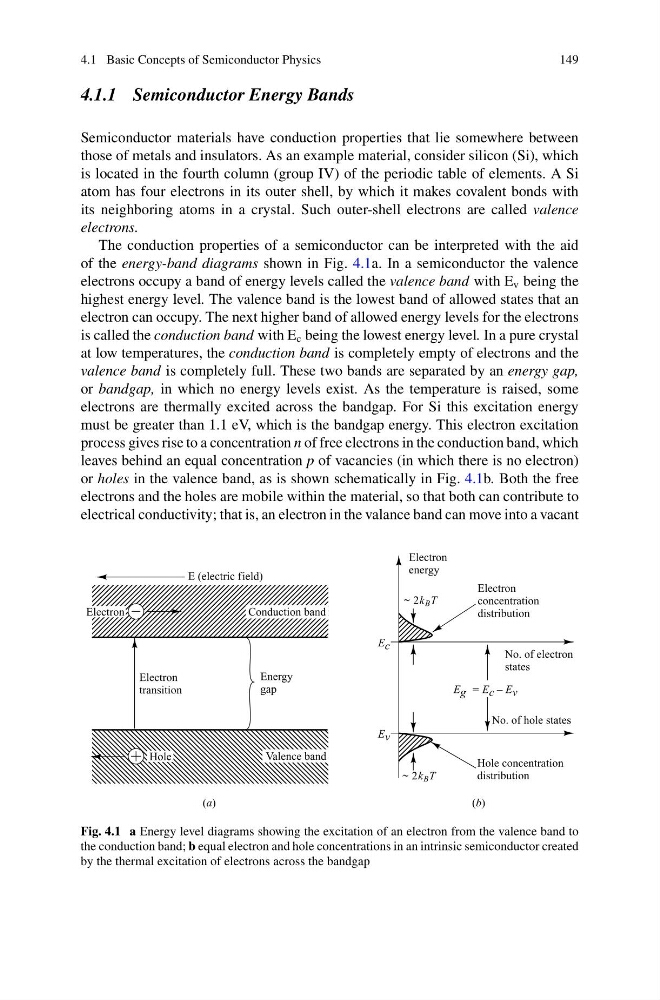
of the energy-band diagrams shown in Fig. 4.1a. In a semiconductor the valence
electrons occupy a band of energy levels called the valence band with E v being the
highest energy level. The valence band is the lowest band of allowed states that an
electron can occupy. The next higher band of allowed energy levels for the electrons
is called the conduction band with E c being the lowest energy level. In a pure crystal
at low temperatures, the conduction band is completely empty of electrons and the
valence band is completely full. These two bands are separated by an energy gap,
or bandgap, in which no energy levels exist. As the temperature is raised, some
electrons are thermally excited across the bandgap. For Si this excitation energy
must be greater than 1.1 eV, which is the bandgap energy. This electron excitation
process gives rise to a concentration n of free electrons in the conduction band, which
leaves behind an equal concentration p of vacancies (in which there is no electron)
or holes in the valence band, as is shown schematically in Fig. 4.1b. Both the free
electrons and the holes are mobile within the material, so that both can contribute to
electrical conductivity; that is, an electron in the valance band can move into a vacant
Fig. 4.1 a Energy level diagrams showing the excitation of an electron from the valence band to
the conduction band; b equal electron and hole concentrations in an intrinsic semiconductor created
by the thermal excitation of electrons across the bandgap
149
4.1.1 Semiconductor Energy Bands
Semiconductor materials have conduction properties that lie somewhere between
those of metals and insulators. As an example material, consider silicon (Si), which
is located in the fourth column (group IV) of the periodic table of elements. A Si
atom has four electrons in its outer shell, by which it makes covalent bonds with
its neighboring atoms in a crystal. Such outer-shell electrons are called valence
electrons.
The conduction properties of a semiconductor can be interpreted with the aid
of the energy-band diagrams shown in Fig. 4.1a. In a semiconductor the valence
electrons occupy a band of energy levels called the valence band with E v being the
highest energy level. The valence band is the lowest band of allowed states that an
electron can occupy. The next higher band of allowed energy levels for the electrons
is called the conduction band with E c being the lowest energy level. In a pure crystal
at low temperatures, the conduction band is completely empty of electrons and the
valence band is completely full. These two bands are separated by an energy gap,
or bandgap, in which no energy levels exist. As the temperature is raised, some
electrons are thermally excited across the bandgap. For Si this excitation energy
must be greater than 1.1 eV, which is the bandgap energy. This electron excitation
process gives rise to a concentration n of free electrons in the conduction band, which
leaves behind an equal concentration p of vacancies (in which there is no electron)
or holes in the valence band, as is shown schematically in Fig. 4.1b. Both the free
electrons and the holes are mobile within the material, so that both can contribute to
electrical conductivity; that is, an electron in the valance band can move into a vacant
Fig. 4.1 a Energy level diagrams showing the excitation of an electron from the valence band to
the conduction band; b equal electron and hole concentrations in an intrinsic semiconductor created
by the thermal excitation of electrons across the bandgap