

140
3 Optical Signal Attenuation and Dispersion
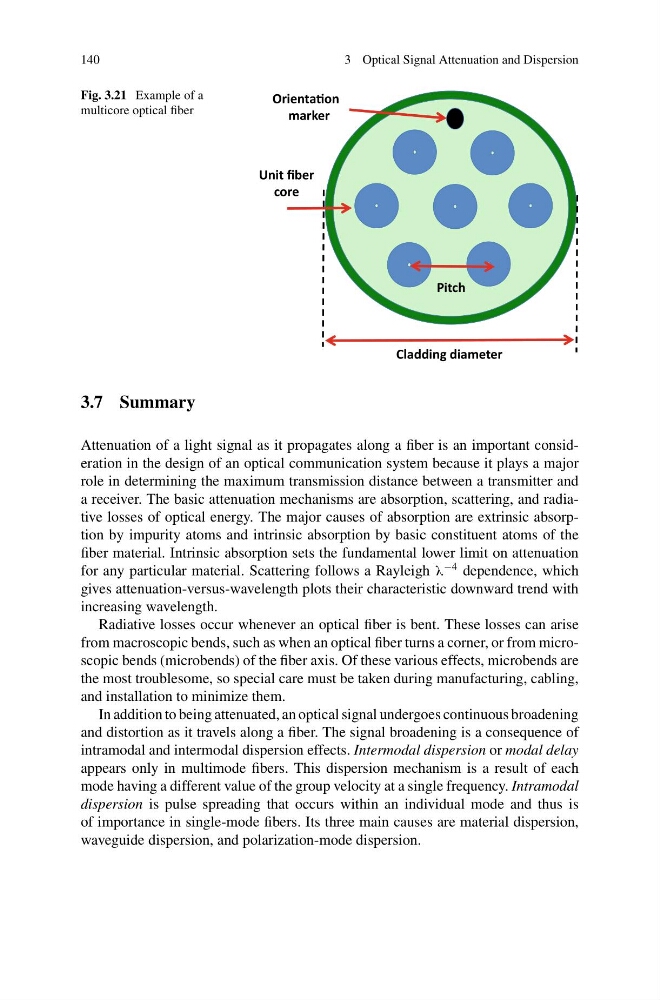
Fig. 3.21 Example of a
multicore optical fiber
OrientaƟon
marker
Cladding diameter
Pitch
Unit fiber
core
3.7 Summary
Attenuation of a light signal as it propagates along a fiber is an important consideration in the design of an optical communication system because it plays a major
role in determining the maximum transmission distance between a transmitter and
a receiver. The basic attenuation mechanisms are absorption, scattering, and radiative losses of optical energy. The major causes of absorption are extrinsic absorption by impurity atoms and intrinsic absorption by basic constituent atoms of the
fiber material. Intrinsic absorption sets the fundamental lower limit on attenuation
for any particular material. Scattering follows a Rayleigh λ
−4 dependence, which
gives attenuation-versus-wavelength plots their characteristic downward trend with
increasing wavelength.
Radiative losses occur whenever an optical fiber is bent. These losses can arise
from macroscopic bends, such as when an optical fiber turns a corner, or from microscopic bends (microbends) of the fiber axis. Of these various effects, microbends are
the most troublesome, so special care must be taken during manufacturing, cabling,
and installation to minimize them.
In addition to being attenuated, an optical signal undergoes continuous broadening
and distortion as it travels along a fiber. The signal broadening is a consequence of
intramodal and intermodal dispersion effects. Intermodal dispersion or modal delay
appears only in multimode fibers. This dispersion mechanism is a result of each
mode having a different value of the group velocity at a single frequency. Intramodal
dispersion is pulse spreading that occurs within an individual mode and thus is
of importance in single-mode fibers. Its three main causes are material dispersion,
waveguide dispersion, and polarization-mode dispersion.
3 Optical Signal Attenuation and Dispersion
Fig. 3.21 Example of a
multicore optical fiber
OrientaƟon
marker
Cladding diameter
Pitch
Unit fiber
core
3.7 Summary
Attenuation of a light signal as it propagates along a fiber is an important consideration in the design of an optical communication system because it plays a major
role in determining the maximum transmission distance between a transmitter and
a receiver. The basic attenuation mechanisms are absorption, scattering, and radiative losses of optical energy. The major causes of absorption are extrinsic absorption by impurity atoms and intrinsic absorption by basic constituent atoms of the
fiber material. Intrinsic absorption sets the fundamental lower limit on attenuation
for any particular material. Scattering follows a Rayleigh λ
−4 dependence, which
gives attenuation-versus-wavelength plots their characteristic downward trend with
increasing wavelength.
Radiative losses occur whenever an optical fiber is bent. These losses can arise
from macroscopic bends, such as when an optical fiber turns a corner, or from microscopic bends (microbends) of the fiber axis. Of these various effects, microbends are
the most troublesome, so special care must be taken during manufacturing, cabling,
and installation to minimize them.
In addition to being attenuated, an optical signal undergoes continuous broadening
and distortion as it travels along a fiber. The signal broadening is a consequence of
intramodal and intermodal dispersion effects. Intermodal dispersion or modal delay
appears only in multimode fibers. This dispersion mechanism is a result of each
mode having a different value of the group velocity at a single frequency. Intramodal
dispersion is pulse spreading that occurs within an individual mode and thus is
of importance in single-mode fibers. Its three main causes are material dispersion,
waveguide dispersion, and polarization-mode dispersion.