

3.2 Optical Signal Dispersion Effects
121
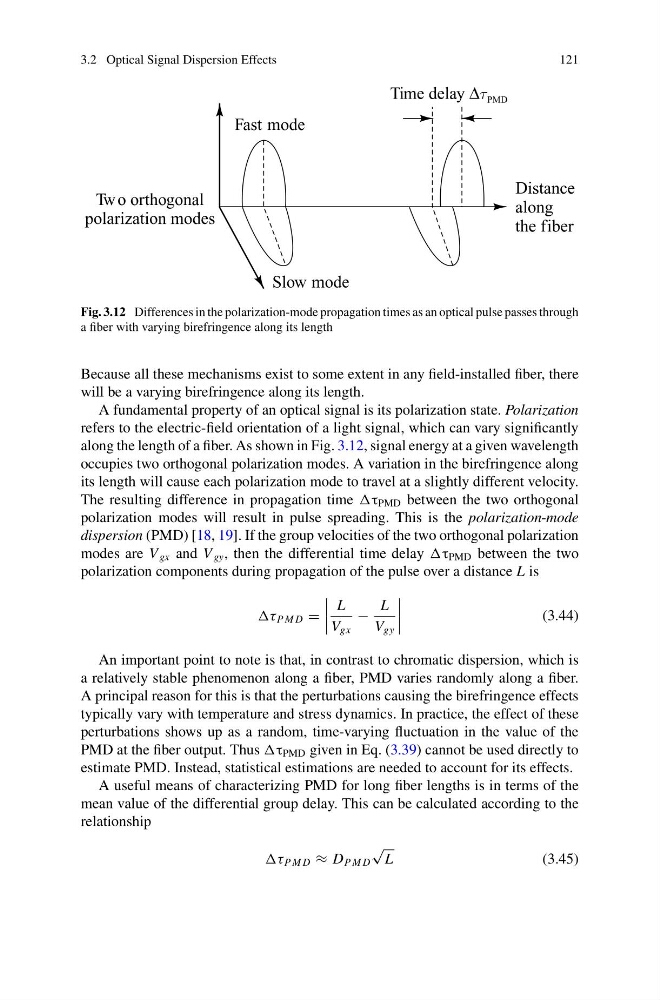
Fig. 3.12 Differences in the polarization-mode propagation times as an optical pulse passes through
a fiber with varying birefringence along its length
Because all these mechanisms exist to some extent in any field-installed fiber, there
will be a varying birefringence along its length.
A fundamental property of an optical signal is its polarization state. Polarization
refers to the electric-field orientation of a light signal, which can vary significantly
along the length of a fiber. As shown in Fig. 3.12, signal energy at a given wavelength
occupies two orthogonal polarization modes. A variation in the birefringence along
its length will cause each polarization mode to travel at a slightly different velocity.
The resulting difference in propagation time PMD between the two orthogonal
polarization modes will result in pulse spreading. This is the polarization-mode
dispersion (PMD) [18, 19]. If the group velocities of the two orthogonal polarization
modes are V gx and V gy , then the differential time delay PMD between the two
polarization components during propagation of the pulse over a distance L is
τ P M D =
L
V gx
−
L
V gy
(3.44)
An important point to note is that, in contrast to chromatic dispersion, which is
a relatively stable phenomenon along a fiber, PMD varies randomly along a fiber.
A principal reason for this is that the perturbations causing the birefringence effects
typically vary with temperature and stress dynamics. In practice, the effect of these
perturbations shows up as a random, time-varying fluctuation in the value of the
PMD at the fiber output. Thus PMD given in Eq. (3.39) cannot be used directly to
estimate PMD. Instead, statistical estimations are needed to account for its effects.
A useful means of characterizing PMD for long fiber lengths is in terms of the
mean value of the differential group delay. This can be calculated according to the
relationship
τ P M D ≈ D P M D
√
L
(3.45)
121
Fig. 3.12 Differences in the polarization-mode propagation times as an optical pulse passes through
a fiber with varying birefringence along its length
Because all these mechanisms exist to some extent in any field-installed fiber, there
will be a varying birefringence along its length.
A fundamental property of an optical signal is its polarization state. Polarization
refers to the electric-field orientation of a light signal, which can vary significantly
along the length of a fiber. As shown in Fig. 3.12, signal energy at a given wavelength
occupies two orthogonal polarization modes. A variation in the birefringence along
its length will cause each polarization mode to travel at a slightly different velocity.
The resulting difference in propagation time PMD between the two orthogonal
polarization modes will result in pulse spreading. This is the polarization-mode
dispersion (PMD) [18, 19]. If the group velocities of the two orthogonal polarization
modes are V gx and V gy , then the differential time delay PMD between the two
polarization components during propagation of the pulse over a distance L is
τ P M D =
L
V gx
−
L
V gy
(3.44)
An important point to note is that, in contrast to chromatic dispersion, which is
a relatively stable phenomenon along a fiber, PMD varies randomly along a fiber.
A principal reason for this is that the perturbations causing the birefringence effects
typically vary with temperature and stress dynamics. In practice, the effect of these
perturbations shows up as a random, time-varying fluctuation in the value of the
PMD at the fiber output. Thus PMD given in Eq. (3.39) cannot be used directly to
estimate PMD. Instead, statistical estimations are needed to account for its effects.
A useful means of characterizing PMD for long fiber lengths is in terms of the
mean value of the differential group delay. This can be calculated according to the
relationship
τ P M D ≈ D P M D
√
L
(3.45)