

104
3 Optical Signal Attenuation and Dispersion
and the core radius a = 25 μm. If the radius of curvature of the fiber is R = 1.0 cm,
what percentage of the modes remain in the fiber at a 1300 nm wavelength?
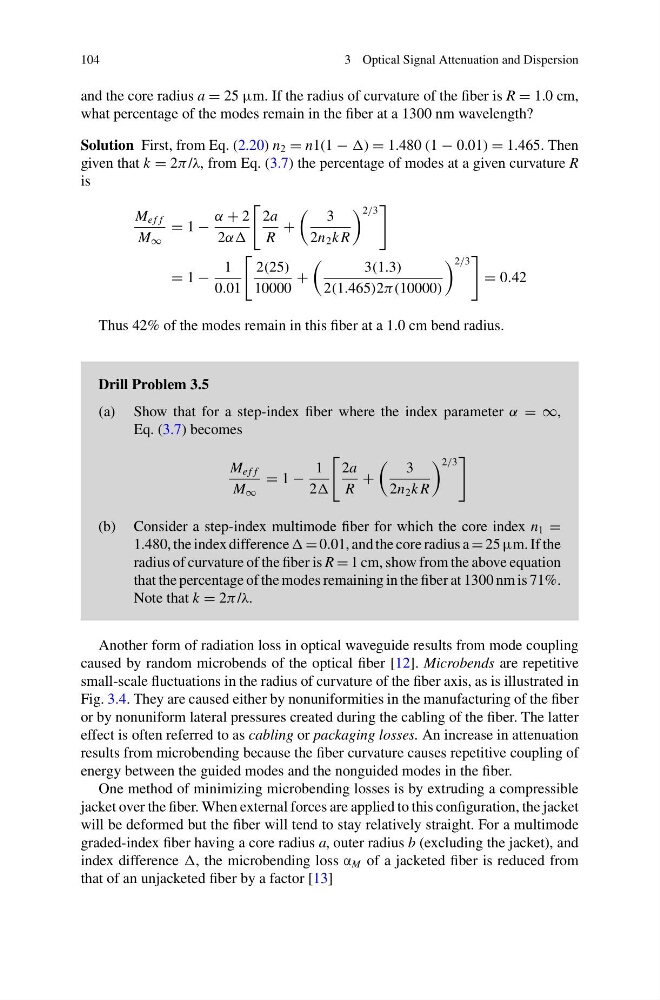
Solution First, from Eq. (2.20) n 2 = n1(1 − ) = 1.480 (1 − 0.01) = 1.465. Then
given that k = 2π /λ, from Eq. (3.7) the percentage of modes at a given curvature R
is
M e f f
M ∞
= 1 −
α + 2
2αα
2a
R
+
3
2n 2 k R
2/3
= 1 −
1
0.01
2(25)
10000
+
3(1.3)
2(1.465)2π(10000)
2/3
= 0.42
Thus 42% of the modes remain in this fiber at a 1.0 cm bend radius.
Drill Problem 3.5
(a) Show that for a step-index fiber where the index parameter α = ∞,
Eq. (3.7) becomes
M e f f
M ∞
= 1 −
1
2
2a
R
+
3
2n 2 k R
2/3
(b) Consider a step-index multimode fiber for which the core index n 1 =
1.480, the index difference = 0.01, and the core radius a = 25 μm. If the
radius of curvature of the fiber is R = 1 cm, show from the above equation
that the percentage of the modes remaining in the fiber at 1300 nm is 71%.
Note that k = 2π /λ.
Another form of radiation loss in optical waveguide results from mode coupling
caused by random microbends of the optical fiber [12]. Microbends are repetitive
small-scale fluctuations in the radius of curvature of the fiber axis, as is illustrated in
Fig. 3.4. They are caused either by nonuniformities in the manufacturing of the fiber
or by nonuniform lateral pressures created during the cabling of the fiber. The latter
effect is often referred to as cabling or packaging losses. An increase in attenuation
results from microbending because the fiber curvature causes repetitive coupling of
energy between the guided modes and the nonguided modes in the fiber.
One method of minimizing microbending losses is by extruding a compressible
jacket over the fiber. When external forces are applied to this configuration, the jacket
will be deformed but the fiber will tend to stay relatively straight. For a multimode
graded-index fiber having a core radius a, outer radius b (excluding the jacket), and
index difference , the microbending loss α M of a jacketed fiber is reduced from
that of an unjacketed fiber by a factor [13]
3 Optical Signal Attenuation and Dispersion
and the core radius a = 25 μm. If the radius of curvature of the fiber is R = 1.0 cm,
what percentage of the modes remain in the fiber at a 1300 nm wavelength?
Solution First, from Eq. (2.20) n 2 = n1(1 − ) = 1.480 (1 − 0.01) = 1.465. Then
given that k = 2π /λ, from Eq. (3.7) the percentage of modes at a given curvature R
is
M e f f
M ∞
= 1 −
α + 2
2αα
2a
R
+
3
2n 2 k R
2/3
= 1 −
1
0.01
2(25)
10000
+
3(1.3)
2(1.465)2π(10000)
2/3
= 0.42
Thus 42% of the modes remain in this fiber at a 1.0 cm bend radius.
Drill Problem 3.5
(a) Show that for a step-index fiber where the index parameter α = ∞,
Eq. (3.7) becomes
M e f f
M ∞
= 1 −
1
2
2a
R
+
3
2n 2 k R
2/3
(b) Consider a step-index multimode fiber for which the core index n 1 =
1.480, the index difference = 0.01, and the core radius a = 25 μm. If the
radius of curvature of the fiber is R = 1 cm, show from the above equation
that the percentage of the modes remaining in the fiber at 1300 nm is 71%.
Note that k = 2π /λ.
Another form of radiation loss in optical waveguide results from mode coupling
caused by random microbends of the optical fiber [12]. Microbends are repetitive
small-scale fluctuations in the radius of curvature of the fiber axis, as is illustrated in
Fig. 3.4. They are caused either by nonuniformities in the manufacturing of the fiber
or by nonuniform lateral pressures created during the cabling of the fiber. The latter
effect is often referred to as cabling or packaging losses. An increase in attenuation
results from microbending because the fiber curvature causes repetitive coupling of
energy between the guided modes and the nonguided modes in the fiber.
One method of minimizing microbending losses is by extruding a compressible
jacket over the fiber. When external forces are applied to this configuration, the jacket
will be deformed but the fiber will tend to stay relatively straight. For a multimode
graded-index fiber having a core radius a, outer radius b (excluding the jacket), and
index difference , the microbending loss α M of a jacketed fiber is reduced from
that of an unjacketed fiber by a factor [13]