

72
J. Zhou and S. Chang
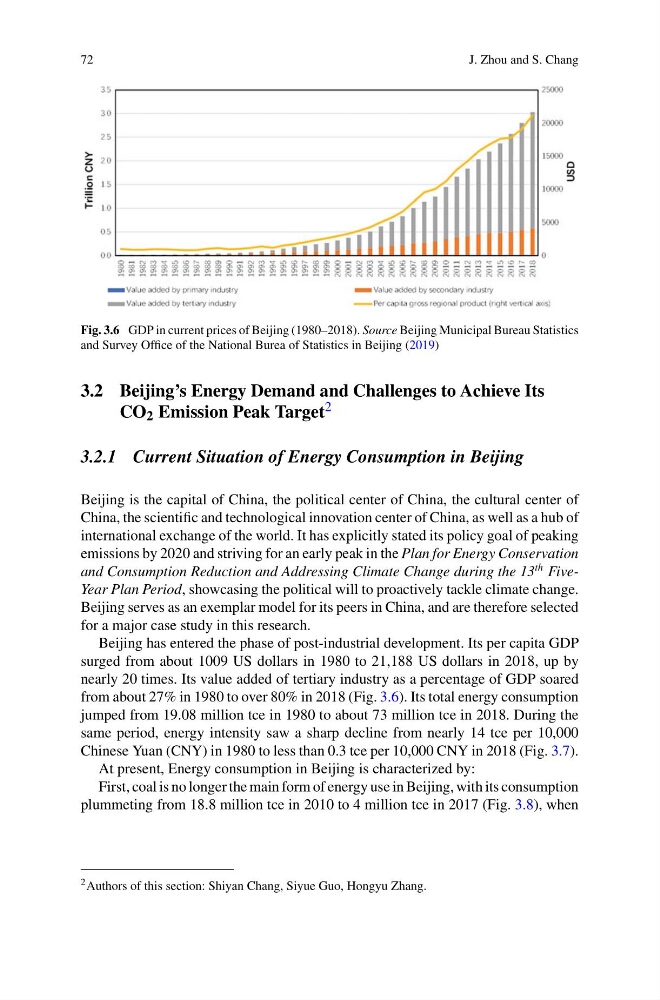
Fig. 3.6 GDP in current prices of Beijing (1980–2018). Source Beijing Municipal Bureau Statistics
and Survey Office of the National Burea of Statistics in Beijing (2019)
3.2 Beijing’s Energy Demand and Challenges to Achieve Its
CO 2 Emission Peak Target 2
3.2.1 Current Situation of Energy Consumption in Beijing
Beijing is the capital of China, the political center of China, the cultural center of
China, the scientific and technological innovation center of China, as well as a hub of
international exchange of the world. It has explicitly stated its policy goal of peaking
emissions by 2020 and striving for an early peak in the Plan for Energy Conservation
and Consumption Reduction and Addressing Climate Change during the 13
th FiveYear Plan Period, showcasing the political will to proactively tackle climate change.
Beijing serves as an exemplar model for its peers in China, and are therefore selected
for a major case study in this research.
Beijing has entered the phase of post-industrial development. Its per capita GDP
surged from about 1009 US dollars in 1980 to 21,188 US dollars in 2018, up by
nearly 20 times. Its value added of tertiary industry as a percentage of GDP soared
from about 27% in 1980 to over 80% in 2018 (Fig. 3.6). Its total energy consumption
jumped from 19.08 million tce in 1980 to about 73 million tce in 2018. During the
same period, energy intensity saw a sharp decline from nearly 14 tce per 10,000
Chinese Yuan (CNY) in 1980 to less than 0.3 tce per 10,000 CNY in 2018 (Fig. 3.7).
At present, Energy consumption in Beijing is characterized by:
First, coal is no longer the main form of energy use in Beijing, with its consumption
plummeting from 18.8 million tce in 2010 to 4 million tce in 2017 (Fig. 3.8), when
2 Authors of this section: Shiyan Chang, Siyue Guo, Hongyu Zhang.
J. Zhou and S. Chang
Fig. 3.6 GDP in current prices of Beijing (1980–2018). Source Beijing Municipal Bureau Statistics
and Survey Office of the National Burea of Statistics in Beijing (2019)
3.2 Beijing’s Energy Demand and Challenges to Achieve Its
CO 2 Emission Peak Target 2
3.2.1 Current Situation of Energy Consumption in Beijing
Beijing is the capital of China, the political center of China, the cultural center of
China, the scientific and technological innovation center of China, as well as a hub of
international exchange of the world. It has explicitly stated its policy goal of peaking
emissions by 2020 and striving for an early peak in the Plan for Energy Conservation
and Consumption Reduction and Addressing Climate Change during the 13
th FiveYear Plan Period, showcasing the political will to proactively tackle climate change.
Beijing serves as an exemplar model for its peers in China, and are therefore selected
for a major case study in this research.
Beijing has entered the phase of post-industrial development. Its per capita GDP
surged from about 1009 US dollars in 1980 to 21,188 US dollars in 2018, up by
nearly 20 times. Its value added of tertiary industry as a percentage of GDP soared
from about 27% in 1980 to over 80% in 2018 (Fig. 3.6). Its total energy consumption
jumped from 19.08 million tce in 1980 to about 73 million tce in 2018. During the
same period, energy intensity saw a sharp decline from nearly 14 tce per 10,000
Chinese Yuan (CNY) in 1980 to less than 0.3 tce per 10,000 CNY in 2018 (Fig. 3.7).
At present, Energy consumption in Beijing is characterized by:
First, coal is no longer the main form of energy use in Beijing, with its consumption
plummeting from 18.8 million tce in 2010 to 4 million tce in 2017 (Fig. 3.8), when
2 Authors of this section: Shiyan Chang, Siyue Guo, Hongyu Zhang.