

3 Low-Carbon Transition (Peaking) of Chinese Cities: The Case …
65
Disaster Risk Reduction 2015–2030, holistic disaster risk management at all
levels.
(10) Support least developed countries, including through financial and technical assistance, in building sustainable and resilient buildings utilizing local
materials.
3.1.2 Peaking or Control of Carbon Emissions at the City
Level Under Global Climate Change Governance
Global climate change governance is rapidly diversifying. The 2015 Paris Agreement
adopted a bottom-up framework for global climate governance, which institutionalized the participation of non-state and sub-state actors in global climate governance
(UNEP 2016). The UNFCCC process has been accompanied by national and regional
initiatives to promote participation of non-state and sub-state actors in global climate
governance in the European Union, Latin America and Asia, among others.
3.1.2.1 The Sub-State Levels of Government: City, State and Region
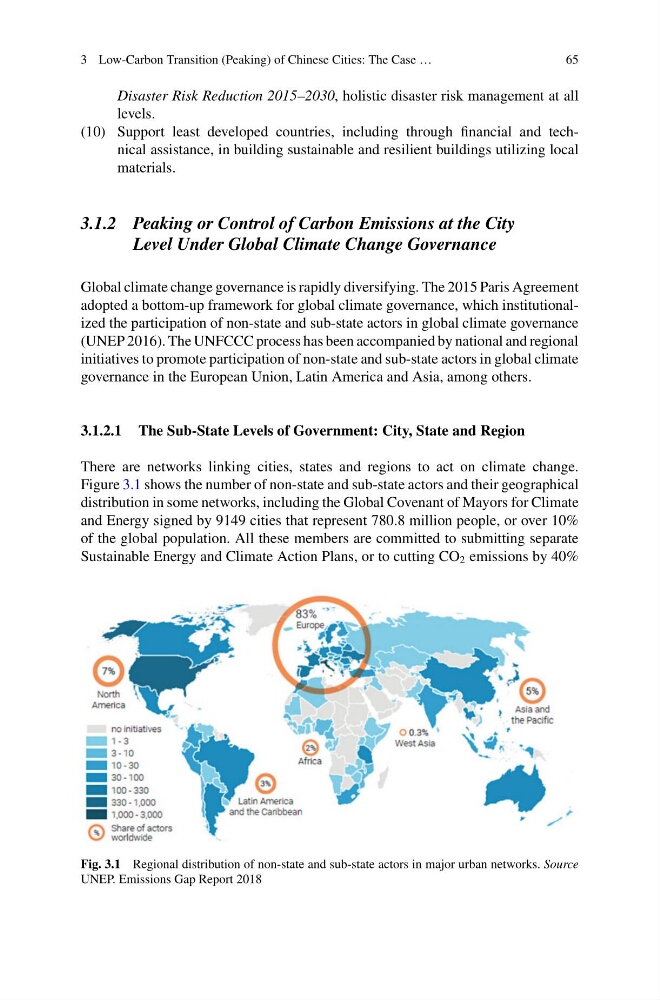
There are networks linking cities, states and regions to act on climate change.
Figure 3.1 shows the number of non-state and sub-state actors and their geographical
distribution in some networks, including the Global Covenant of Mayors for Climate
and Energy signed by 9149 cities that represent 780.8 million people, or over 10%
of the global population. All these members are committed to submitting separate
Sustainable Energy and Climate Action Plans, or to cutting CO 2 emissions by 40%
Fig. 3.1 Regional distribution of non-state and sub-state actors in major urban networks. Source
UNEP. Emissions Gap Report 2018
65
Disaster Risk Reduction 2015–2030, holistic disaster risk management at all
levels.
(10) Support least developed countries, including through financial and technical assistance, in building sustainable and resilient buildings utilizing local
materials.
3.1.2 Peaking or Control of Carbon Emissions at the City
Level Under Global Climate Change Governance
Global climate change governance is rapidly diversifying. The 2015 Paris Agreement
adopted a bottom-up framework for global climate governance, which institutionalized the participation of non-state and sub-state actors in global climate governance
(UNEP 2016). The UNFCCC process has been accompanied by national and regional
initiatives to promote participation of non-state and sub-state actors in global climate
governance in the European Union, Latin America and Asia, among others.
3.1.2.1 The Sub-State Levels of Government: City, State and Region
There are networks linking cities, states and regions to act on climate change.
Figure 3.1 shows the number of non-state and sub-state actors and their geographical
distribution in some networks, including the Global Covenant of Mayors for Climate
and Energy signed by 9149 cities that represent 780.8 million people, or over 10%
of the global population. All these members are committed to submitting separate
Sustainable Energy and Climate Action Plans, or to cutting CO 2 emissions by 40%
Fig. 3.1 Regional distribution of non-state and sub-state actors in major urban networks. Source
UNEP. Emissions Gap Report 2018