

50
J. Wu and H. Zhao
Urban population (ten thousand)
Carbon dioxide emissions per capita
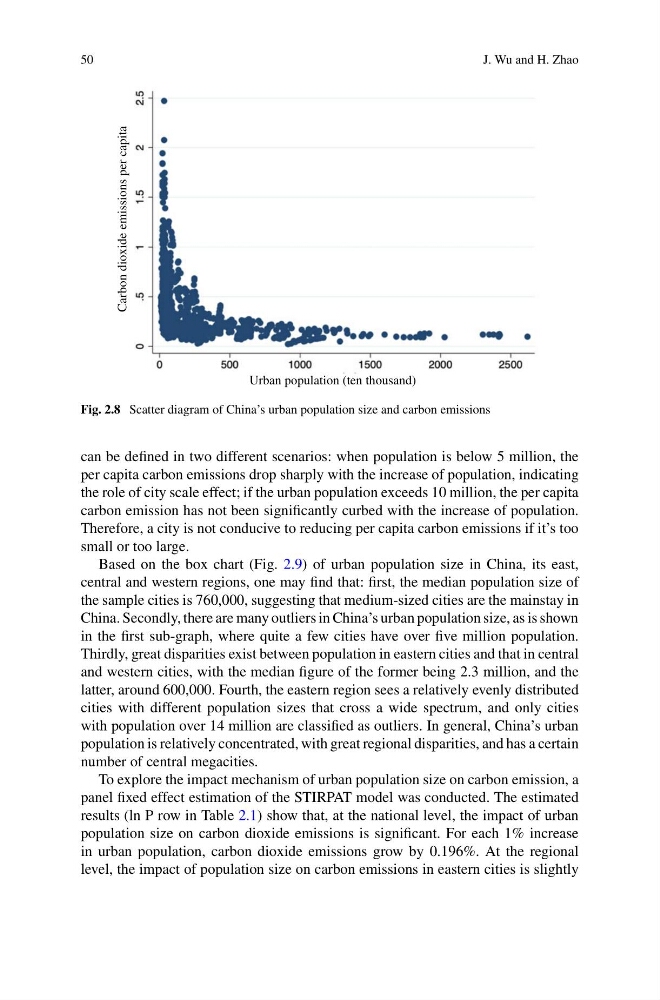
Fig. 2.8 Scatter diagram of China’s urban population size and carbon emissions
can be defined in two different scenarios: when population is below 5 million, the
per capita carbon emissions drop sharply with the increase of population, indicating
the role of city scale effect; if the urban population exceeds 10 million, the per capita
carbon emission has not been significantly curbed with the increase of population.
Therefore, a city is not conducive to reducing per capita carbon emissions if it’s too
small or too large.
Based on the box chart (Fig. 2.9) of urban population size in China, its east,
central and western regions, one may find that: first, the median population size of
the sample cities is 760,000, suggesting that medium-sized cities are the mainstay in
China. Secondly, there are many outliers in China’s urban population size, as is shown
in the first sub-graph, where quite a few cities have over five million population.
Thirdly, great disparities exist between population in eastern cities and that in central
and western cities, with the median figure of the former being 2.3 million, and the
latter, around 600,000. Fourth, the eastern region sees a relatively evenly distributed
cities with different population sizes that cross a wide spectrum, and only cities
with population over 14 million are classified as outliers. In general, China’s urban
population is relatively concentrated, with great regional disparities, and has a certain
number of central megacities.
To explore the impact mechanism of urban population size on carbon emission, a
panel fixed effect estimation of the STIRPAT model was conducted. The estimated
results (ln P row in Table 2.1) show that, at the national level, the impact of urban
population size on carbon dioxide emissions is significant. For each 1% increase
in urban population, carbon dioxide emissions grow by 0.196%. At the regional
level, the impact of population size on carbon emissions in eastern cities is slightly
J. Wu and H. Zhao
Urban population (ten thousand)
Carbon dioxide emissions per capita
Fig. 2.8 Scatter diagram of China’s urban population size and carbon emissions
can be defined in two different scenarios: when population is below 5 million, the
per capita carbon emissions drop sharply with the increase of population, indicating
the role of city scale effect; if the urban population exceeds 10 million, the per capita
carbon emission has not been significantly curbed with the increase of population.
Therefore, a city is not conducive to reducing per capita carbon emissions if it’s too
small or too large.
Based on the box chart (Fig. 2.9) of urban population size in China, its east,
central and western regions, one may find that: first, the median population size of
the sample cities is 760,000, suggesting that medium-sized cities are the mainstay in
China. Secondly, there are many outliers in China’s urban population size, as is shown
in the first sub-graph, where quite a few cities have over five million population.
Thirdly, great disparities exist between population in eastern cities and that in central
and western cities, with the median figure of the former being 2.3 million, and the
latter, around 600,000. Fourth, the eastern region sees a relatively evenly distributed
cities with different population sizes that cross a wide spectrum, and only cities
with population over 14 million are classified as outliers. In general, China’s urban
population is relatively concentrated, with great regional disparities, and has a certain
number of central megacities.
To explore the impact mechanism of urban population size on carbon emission, a
panel fixed effect estimation of the STIRPAT model was conducted. The estimated
results (ln P row in Table 2.1) show that, at the national level, the impact of urban
population size on carbon dioxide emissions is significant. For each 1% increase
in urban population, carbon dioxide emissions grow by 0.196%. At the regional
level, the impact of population size on carbon emissions in eastern cities is slightly