

7 Development of Low Carbon Technology in China’s Iron …
273
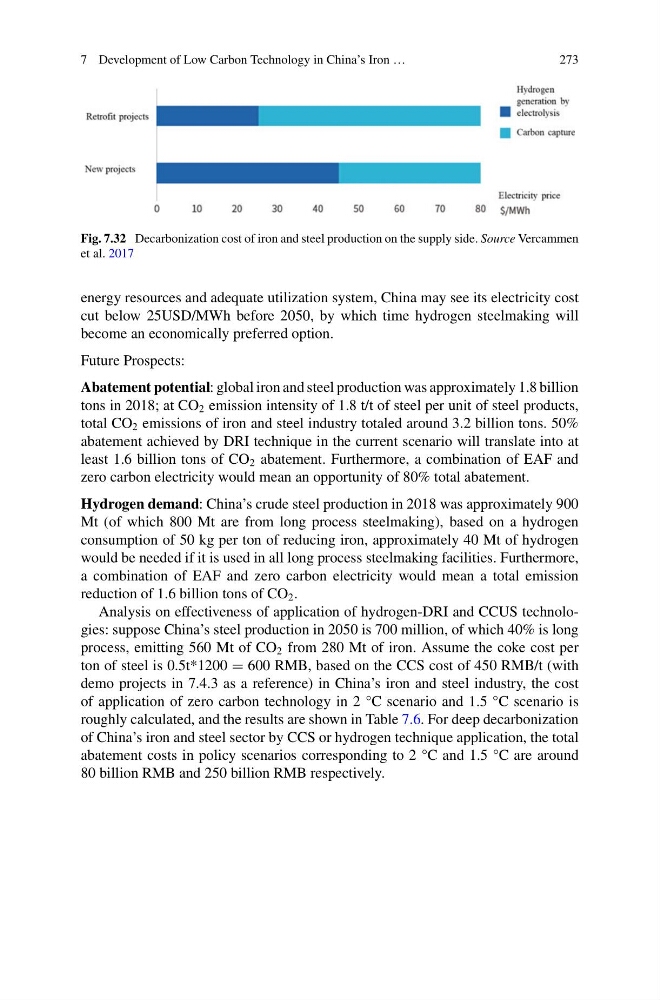
Fig. 7.32 Decarbonization cost of iron and steel production on the supply side. Source Vercammen
et al. 2017
energy resources and adequate utilization system, China may see its electricity cost
cut below 25USD/MWh before 2050, by which time hydrogen steelmaking will
become an economically preferred option.
Future Prospects:
Abatement potential: global iron and steel production was approximately 1.8 billion
tons in 2018; at CO 2 emission intensity of 1.8 t/t of steel per unit of steel products,
total CO 2 emissions of iron and steel industry totaled around 3.2 billion tons. 50%
abatement achieved by DRI technique in the current scenario will translate into at
least 1.6 billion tons of CO 2 abatement. Furthermore, a combination of EAF and
zero carbon electricity would mean an opportunity of 80% total abatement.
Hydrogen demand: China’s crude steel production in 2018 was approximately 900
Mt (of which 800 Mt are from long process steelmaking), based on a hydrogen
consumption of 50 kg per ton of reducing iron, approximately 40 Mt of hydrogen
would be needed if it is used in all long process steelmaking facilities. Furthermore,
a combination of EAF and zero carbon electricity would mean a total emission
reduction of 1.6 billion tons of CO 2 .
Analysis on effectiveness of application of hydrogen-DRI and CCUS technologies: suppose China’s steel production in 2050 is 700 million, of which 40% is long
process, emitting 560 Mt of CO 2 from 280 Mt of iron. Assume the coke cost per
ton of steel is 0.5t*1200 = 600 RMB, based on the CCS cost of 450 RMB/t (with
demo projects in 7.4.3 as a reference) in China’s iron and steel industry, the cost
of application of zero carbon technology in 2 °C scenario and 1.5 °C scenario is
roughly calculated, and the results are shown in Table 7.6. For deep decarbonization
of China’s iron and steel sector by CCS or hydrogen technique application, the total
abatement costs in policy scenarios corresponding to 2 °C and 1.5 °C are around
80 billion RMB and 250 billion RMB respectively.
273
Fig. 7.32 Decarbonization cost of iron and steel production on the supply side. Source Vercammen
et al. 2017
energy resources and adequate utilization system, China may see its electricity cost
cut below 25USD/MWh before 2050, by which time hydrogen steelmaking will
become an economically preferred option.
Future Prospects:
Abatement potential: global iron and steel production was approximately 1.8 billion
tons in 2018; at CO 2 emission intensity of 1.8 t/t of steel per unit of steel products,
total CO 2 emissions of iron and steel industry totaled around 3.2 billion tons. 50%
abatement achieved by DRI technique in the current scenario will translate into at
least 1.6 billion tons of CO 2 abatement. Furthermore, a combination of EAF and
zero carbon electricity would mean an opportunity of 80% total abatement.
Hydrogen demand: China’s crude steel production in 2018 was approximately 900
Mt (of which 800 Mt are from long process steelmaking), based on a hydrogen
consumption of 50 kg per ton of reducing iron, approximately 40 Mt of hydrogen
would be needed if it is used in all long process steelmaking facilities. Furthermore,
a combination of EAF and zero carbon electricity would mean a total emission
reduction of 1.6 billion tons of CO 2 .
Analysis on effectiveness of application of hydrogen-DRI and CCUS technologies: suppose China’s steel production in 2050 is 700 million, of which 40% is long
process, emitting 560 Mt of CO 2 from 280 Mt of iron. Assume the coke cost per
ton of steel is 0.5t*1200 = 600 RMB, based on the CCS cost of 450 RMB/t (with
demo projects in 7.4.3 as a reference) in China’s iron and steel industry, the cost
of application of zero carbon technology in 2 °C scenario and 1.5 °C scenario is
roughly calculated, and the results are shown in Table 7.6. For deep decarbonization
of China’s iron and steel sector by CCS or hydrogen technique application, the total
abatement costs in policy scenarios corresponding to 2 °C and 1.5 °C are around
80 billion RMB and 250 billion RMB respectively.