

272
L. Ren et al.
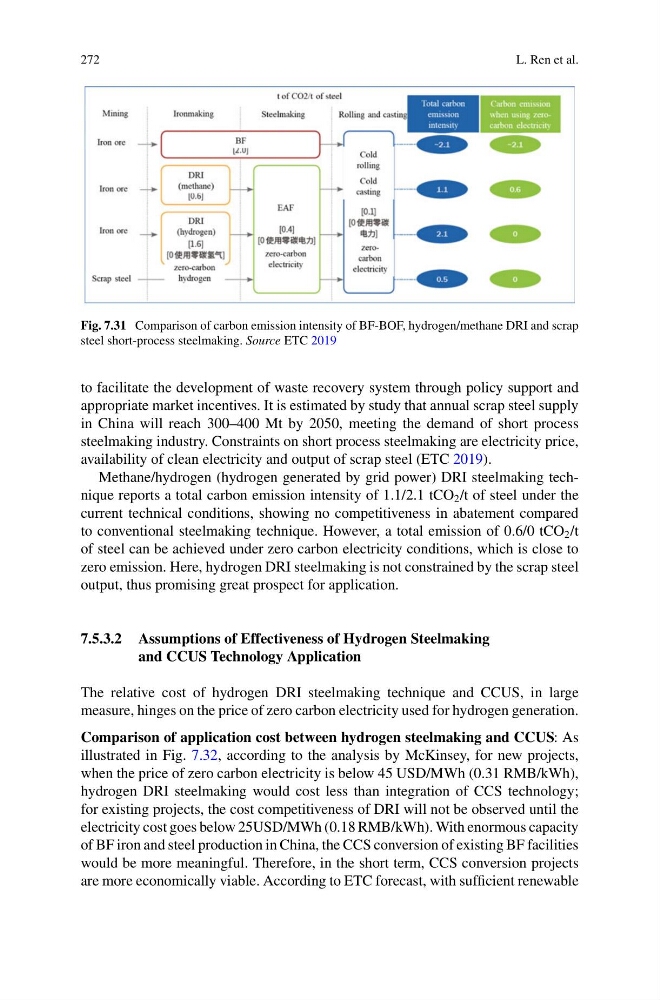
Fig. 7.31 Comparison of carbon emission intensity of BF-BOF, hydrogen/methane DRI and scrap
steel short-process steelmaking. Source ETC 2019
to facilitate the development of waste recovery system through policy support and
appropriate market incentives. It is estimated by study that annual scrap steel supply
in China will reach 300–400 Mt by 2050, meeting the demand of short process
steelmaking industry. Constraints on short process steelmaking are electricity price,
availability of clean electricity and output of scrap steel (ETC 2019).
Methane/hydrogen (hydrogen generated by grid power) DRI steelmaking technique reports a total carbon emission intensity of 1.1/2.1 tCO 2 /t of steel under the
current technical conditions, showing no competitiveness in abatement compared
to conventional steelmaking technique. However, a total emission of 0.6/0 tCO 2 /t
of steel can be achieved under zero carbon electricity conditions, which is close to
zero emission. Here, hydrogen DRI steelmaking is not constrained by the scrap steel
output, thus promising great prospect for application.
7.5.3.2 Assumptions of Effectiveness of Hydrogen Steelmaking
and CCUS Technology Application
The relative cost of hydrogen DRI steelmaking technique and CCUS, in large
measure, hinges on the price of zero carbon electricity used for hydrogen generation.
Comparison of application cost between hydrogen steelmaking and CCUS: As
illustrated in Fig. 7.32, according to the analysis by McKinsey, for new projects,
when the price of zero carbon electricity is below 45 USD/MWh (0.31 RMB/kWh),
hydrogen DRI steelmaking would cost less than integration of CCS technology;
for existing projects, the cost competitiveness of DRI will not be observed until the
electricity cost goes below 25USD/MWh (0.18 RMB/kWh). With enormous capacity
of BF iron and steel production in China, the CCS conversion of existing BF facilities
would be more meaningful. Therefore, in the short term, CCS conversion projects
are more economically viable. According to ETC forecast, with sufficient renewable
L. Ren et al.
Fig. 7.31 Comparison of carbon emission intensity of BF-BOF, hydrogen/methane DRI and scrap
steel short-process steelmaking. Source ETC 2019
to facilitate the development of waste recovery system through policy support and
appropriate market incentives. It is estimated by study that annual scrap steel supply
in China will reach 300–400 Mt by 2050, meeting the demand of short process
steelmaking industry. Constraints on short process steelmaking are electricity price,
availability of clean electricity and output of scrap steel (ETC 2019).
Methane/hydrogen (hydrogen generated by grid power) DRI steelmaking technique reports a total carbon emission intensity of 1.1/2.1 tCO 2 /t of steel under the
current technical conditions, showing no competitiveness in abatement compared
to conventional steelmaking technique. However, a total emission of 0.6/0 tCO 2 /t
of steel can be achieved under zero carbon electricity conditions, which is close to
zero emission. Here, hydrogen DRI steelmaking is not constrained by the scrap steel
output, thus promising great prospect for application.
7.5.3.2 Assumptions of Effectiveness of Hydrogen Steelmaking
and CCUS Technology Application
The relative cost of hydrogen DRI steelmaking technique and CCUS, in large
measure, hinges on the price of zero carbon electricity used for hydrogen generation.
Comparison of application cost between hydrogen steelmaking and CCUS: As
illustrated in Fig. 7.32, according to the analysis by McKinsey, for new projects,
when the price of zero carbon electricity is below 45 USD/MWh (0.31 RMB/kWh),
hydrogen DRI steelmaking would cost less than integration of CCS technology;
for existing projects, the cost competitiveness of DRI will not be observed until the
electricity cost goes below 25USD/MWh (0.18 RMB/kWh). With enormous capacity
of BF iron and steel production in China, the CCS conversion of existing BF facilities
would be more meaningful. Therefore, in the short term, CCS conversion projects
are more economically viable. According to ETC forecast, with sufficient renewable