

262
L. Ren et al.
be applied in at least 30 projects of various sectors by 2020, including coal- and gasfired power plants, natural gas processing and treatment, bioethanol and chemicals,
hydrogen production in refining industry, etc. This means that all projects currently
in the planning phase should be implemented on time and other projects should see
major breakthroughs, with the annual CO 2 storage reaching 50 Mt. By 2030, CCS
shall become a regular emission reduction technology in power industry and other
industrial sectors with successful demo projects in multiple areas such as cement
production, steelmaking BF, paper and pulp, secondary biofuel, etc. Such momentum
shall drive CO 2 capture up to 2 billion tons/year. By 2050, CCS technology shall
be a prevailing solution for carbon emission treatment in the power industry and all
other industrial sectors worldwide, with over 7 billion tons of CO 2 stored.
7.4.2.3 Utilization
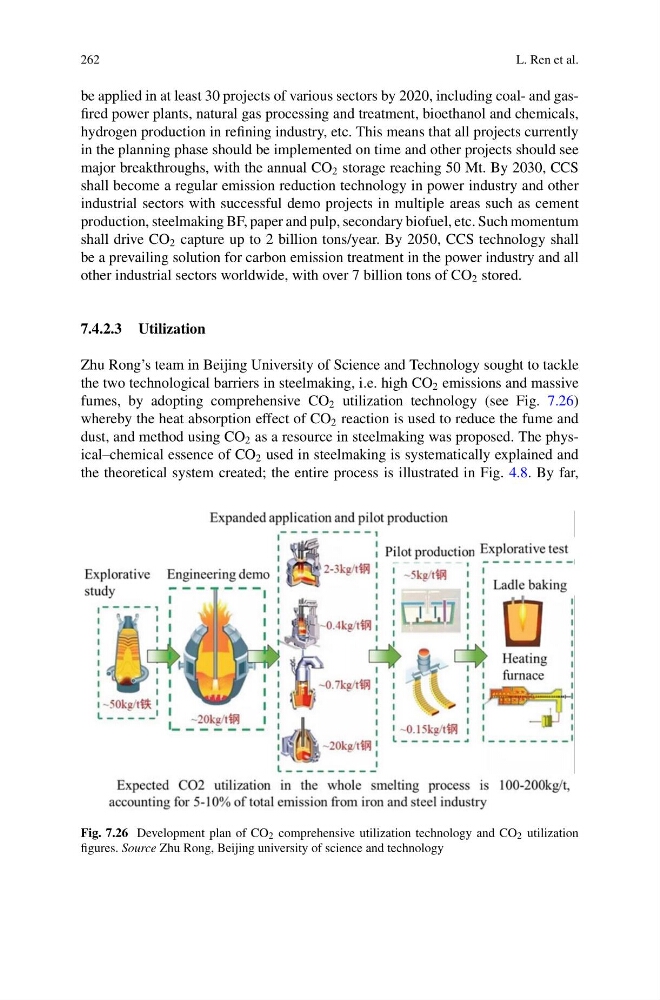
Zhu Rong’s team in Beijing University of Science and Technology sought to tackle
the two technological barriers in steelmaking, i.e. high CO 2 emissions and massive
fumes, by adopting comprehensive CO 2 utilization technology (see Fig. 7.26)
whereby the heat absorption effect of CO 2 reaction is used to reduce the fume and
dust, and method using CO 2 as a resource in steelmaking was proposed. The physical–chemical essence of CO 2 used in steelmaking is systematically explained and
the theoretical system created; the entire process is illustrated in Fig. 4.8. By far,
Fig. 7.26 Development plan of CO 2 comprehensive utilization technology and CO 2 utilization
figures. Source Zhu Rong, Beijing university of science and technology
L. Ren et al.
be applied in at least 30 projects of various sectors by 2020, including coal- and gasfired power plants, natural gas processing and treatment, bioethanol and chemicals,
hydrogen production in refining industry, etc. This means that all projects currently
in the planning phase should be implemented on time and other projects should see
major breakthroughs, with the annual CO 2 storage reaching 50 Mt. By 2030, CCS
shall become a regular emission reduction technology in power industry and other
industrial sectors with successful demo projects in multiple areas such as cement
production, steelmaking BF, paper and pulp, secondary biofuel, etc. Such momentum
shall drive CO 2 capture up to 2 billion tons/year. By 2050, CCS technology shall
be a prevailing solution for carbon emission treatment in the power industry and all
other industrial sectors worldwide, with over 7 billion tons of CO 2 stored.
7.4.2.3 Utilization
Zhu Rong’s team in Beijing University of Science and Technology sought to tackle
the two technological barriers in steelmaking, i.e. high CO 2 emissions and massive
fumes, by adopting comprehensive CO 2 utilization technology (see Fig. 7.26)
whereby the heat absorption effect of CO 2 reaction is used to reduce the fume and
dust, and method using CO 2 as a resource in steelmaking was proposed. The physical–chemical essence of CO 2 used in steelmaking is systematically explained and
the theoretical system created; the entire process is illustrated in Fig. 4.8. By far,
Fig. 7.26 Development plan of CO 2 comprehensive utilization technology and CO 2 utilization
figures. Source Zhu Rong, Beijing university of science and technology