

7 Development of Low Carbon Technology in China’s Iron …
261
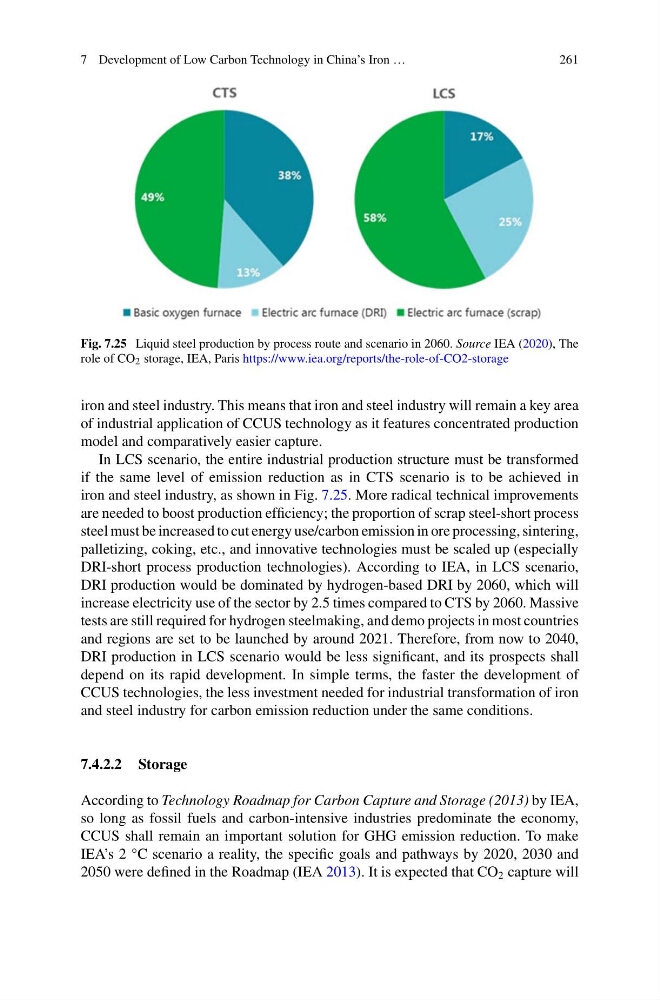
Fig. 7.25 Liquid steel production by process route and scenario in 2060. Source IEA (2020), The
role of CO 2 storage, IEA, Paris https://www.iea.org/reports/the-role-of-CO2-storage
iron and steel industry. This means that iron and steel industry will remain a key area
of industrial application of CCUS technology as it features concentrated production
model and comparatively easier capture.
In LCS scenario, the entire industrial production structure must be transformed
if the same level of emission reduction as in CTS scenario is to be achieved in
iron and steel industry, as shown in Fig. 7.25. More radical technical improvements
are needed to boost production efficiency; the proportion of scrap steel-short process
steel must be increased to cut energy use/carbon emission in ore processing, sintering,
palletizing, coking, etc., and innovative technologies must be scaled up (especially
DRI-short process production technologies). According to IEA, in LCS scenario,
DRI production would be dominated by hydrogen-based DRI by 2060, which will
increase electricity use of the sector by 2.5 times compared to CTS by 2060. Massive
tests are still required for hydrogen steelmaking, and demo projects in most countries
and regions are set to be launched by around 2021. Therefore, from now to 2040,
DRI production in LCS scenario would be less significant, and its prospects shall
depend on its rapid development. In simple terms, the faster the development of
CCUS technologies, the less investment needed for industrial transformation of iron
and steel industry for carbon emission reduction under the same conditions.
7.4.2.2 Storage
According to Technology Roadmap for Carbon Capture and Storage (2013) by IEA,
so long as fossil fuels and carbon-intensive industries predominate the economy,
CCUS shall remain an important solution for GHG emission reduction. To make
IEA’s 2 °C scenario a reality, the specific goals and pathways by 2020, 2030 and
2050 were defined in the Roadmap (IEA 2013). It is expected that CO 2 capture will
261
Fig. 7.25 Liquid steel production by process route and scenario in 2060. Source IEA (2020), The
role of CO 2 storage, IEA, Paris https://www.iea.org/reports/the-role-of-CO2-storage
iron and steel industry. This means that iron and steel industry will remain a key area
of industrial application of CCUS technology as it features concentrated production
model and comparatively easier capture.
In LCS scenario, the entire industrial production structure must be transformed
if the same level of emission reduction as in CTS scenario is to be achieved in
iron and steel industry, as shown in Fig. 7.25. More radical technical improvements
are needed to boost production efficiency; the proportion of scrap steel-short process
steel must be increased to cut energy use/carbon emission in ore processing, sintering,
palletizing, coking, etc., and innovative technologies must be scaled up (especially
DRI-short process production technologies). According to IEA, in LCS scenario,
DRI production would be dominated by hydrogen-based DRI by 2060, which will
increase electricity use of the sector by 2.5 times compared to CTS by 2060. Massive
tests are still required for hydrogen steelmaking, and demo projects in most countries
and regions are set to be launched by around 2021. Therefore, from now to 2040,
DRI production in LCS scenario would be less significant, and its prospects shall
depend on its rapid development. In simple terms, the faster the development of
CCUS technologies, the less investment needed for industrial transformation of iron
and steel industry for carbon emission reduction under the same conditions.
7.4.2.2 Storage
According to Technology Roadmap for Carbon Capture and Storage (2013) by IEA,
so long as fossil fuels and carbon-intensive industries predominate the economy,
CCUS shall remain an important solution for GHG emission reduction. To make
IEA’s 2 °C scenario a reality, the specific goals and pathways by 2020, 2030 and
2050 were defined in the Roadmap (IEA 2013). It is expected that CO 2 capture will