

218
L. Ren et al.
7.1 Current Development of China’s Steel Industry and Its
Carbon Emission Trend
7.1.1 Steel Production and Consumption
As one of the biggest industrial sources of CO 2 emissions, iron and steel industry
contributes approximately 28% of direct GHG emissions from industrial sectors
globally. China’s growing industrialization and urbanization mean that its iron and
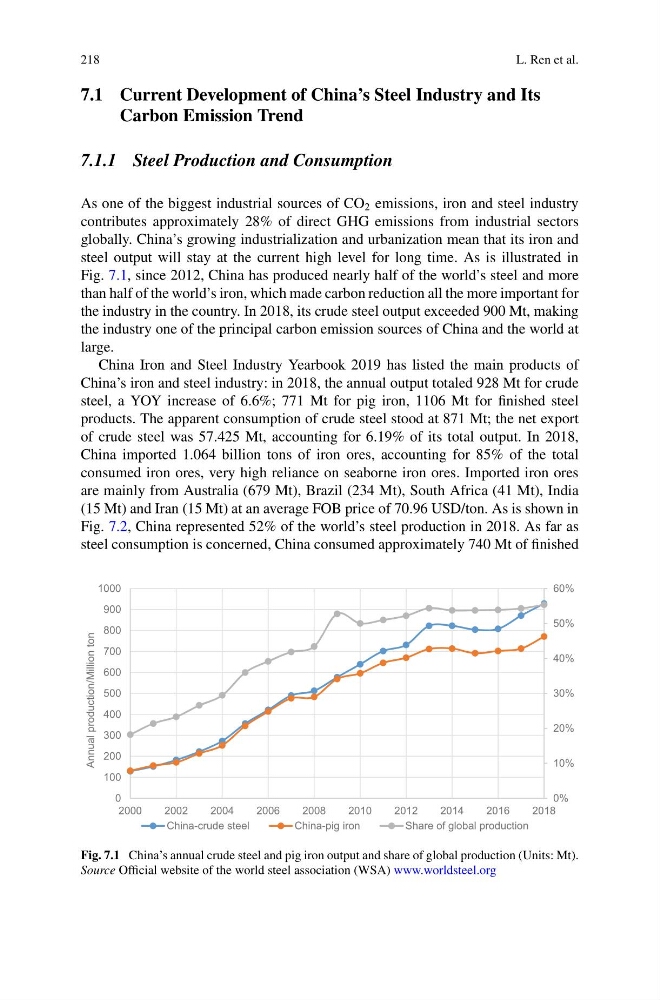
steel output will stay at the current high level for long time. As is illustrated in
Fig. 7.1, since 2012, China has produced nearly half of the world’s steel and more
than half of the world’s iron, which made carbon reduction all the more important for
the industry in the country. In 2018, its crude steel output exceeded 900 Mt, making
the industry one of the principal carbon emission sources of China and the world at
large.
China Iron and Steel Industry Yearbook 2019 has listed the main products of
China’s iron and steel industry: in 2018, the annual output totaled 928 Mt for crude
steel, a YOY increase of 6.6%; 771 Mt for pig iron, 1106 Mt for finished steel
products. The apparent consumption of crude steel stood at 871 Mt; the net export
of crude steel was 57.425 Mt, accounting for 6.19% of its total output. In 2018,
China imported 1.064 billion tons of iron ores, accounting for 85% of the total
consumed iron ores, very high reliance on seaborne iron ores. Imported iron ores
are mainly from Australia (679 Mt), Brazil (234 Mt), South Africa (41 Mt), India
(15 Mt) and Iran (15 Mt) at an average FOB price of 70.96 USD/ton. As is shown in
Fig. 7.2, China represented 52% of the world’s steel production in 2018. As far as
steel consumption is concerned, China consumed approximately 740 Mt of finished
0%
10%
20%
30%
40%
50%
60%
0
100
200
300
400
500
600
700
800
900
1000
2000
2002
2004
2006
2008
2010
2012
2014
2016
2018
Annual production/Million ton
China-crude steel
China-pig iron
Share of global production
Fig. 7.1 China’s annual crude steel and pig iron output and share of global production (Units: Mt).
Source Official website of the world steel association (WSA) www.worldsteel.org
L. Ren et al.
7.1 Current Development of China’s Steel Industry and Its
Carbon Emission Trend
7.1.1 Steel Production and Consumption
As one of the biggest industrial sources of CO 2 emissions, iron and steel industry
contributes approximately 28% of direct GHG emissions from industrial sectors
globally. China’s growing industrialization and urbanization mean that its iron and
steel output will stay at the current high level for long time. As is illustrated in
Fig. 7.1, since 2012, China has produced nearly half of the world’s steel and more
than half of the world’s iron, which made carbon reduction all the more important for
the industry in the country. In 2018, its crude steel output exceeded 900 Mt, making
the industry one of the principal carbon emission sources of China and the world at
large.
China Iron and Steel Industry Yearbook 2019 has listed the main products of
China’s iron and steel industry: in 2018, the annual output totaled 928 Mt for crude
steel, a YOY increase of 6.6%; 771 Mt for pig iron, 1106 Mt for finished steel
products. The apparent consumption of crude steel stood at 871 Mt; the net export
of crude steel was 57.425 Mt, accounting for 6.19% of its total output. In 2018,
China imported 1.064 billion tons of iron ores, accounting for 85% of the total
consumed iron ores, very high reliance on seaborne iron ores. Imported iron ores
are mainly from Australia (679 Mt), Brazil (234 Mt), South Africa (41 Mt), India
(15 Mt) and Iran (15 Mt) at an average FOB price of 70.96 USD/ton. As is shown in
Fig. 7.2, China represented 52% of the world’s steel production in 2018. As far as
steel consumption is concerned, China consumed approximately 740 Mt of finished
0%
10%
20%
30%
40%
50%
60%
0
100
200
300
400
500
600
700
800
900
1000
2000
2002
2004
2006
2008
2010
2012
2014
2016
2018
Annual production/Million ton
China-crude steel
China-pig iron
Share of global production
Fig. 7.1 China’s annual crude steel and pig iron output and share of global production (Units: Mt).
Source Official website of the world steel association (WSA) www.worldsteel.org