

4 The Transition of China’s Power System
151
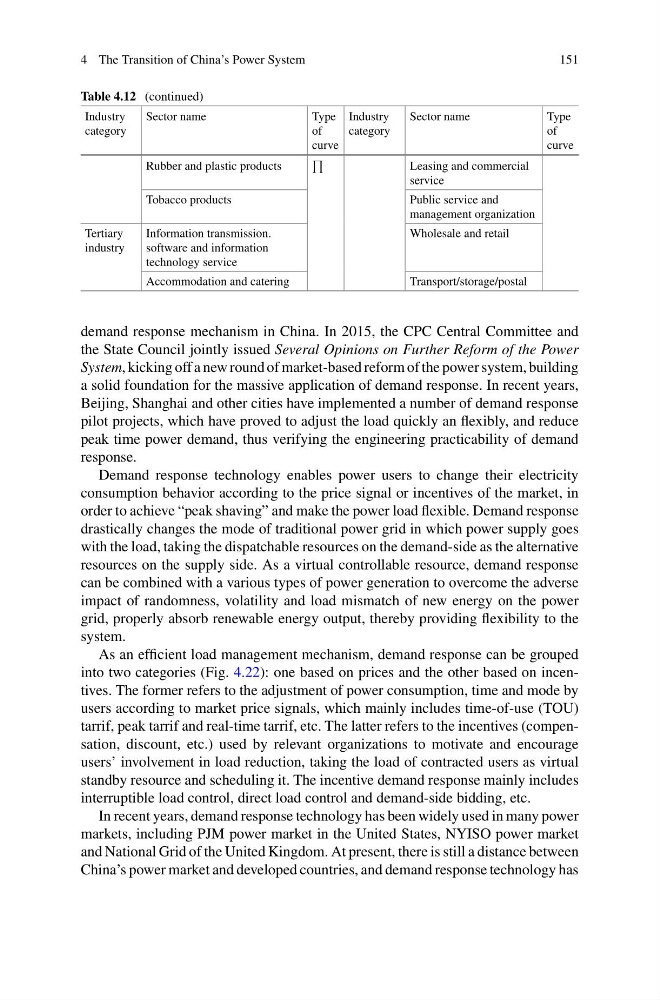
Table 4.12 (continued)
Industry
category
Sector name
Type
of
curve
Industry
category
Sector name
Type
of
curve
Rubber and plastic products
Leasing and commercial
service
Tobacco products
Public service and
management organization
Tertiary
industry
Information transmission.
software and information
technology service
Wholesale and retail
Accommodation and catering
Transport/storage/postal
demand response mechanism in China. In 2015, the CPC Central Committee and
the State Council jointly issued Several Opinions on Further Reform of the Power
System, kicking off a new round of market-based reform of the power system, building
a solid foundation for the massive application of demand response. In recent years,
Beijing, Shanghai and other cities have implemented a number of demand response
pilot projects, which have proved to adjust the load quickly an flexibly, and reduce
peak time power demand, thus verifying the engineering practicability of demand
response.
Demand response technology enables power users to change their electricity
consumption behavior according to the price signal or incentives of the market, in
order to achieve “peak shaving” and make the power load flexible. Demand response
drastically changes the mode of traditional power grid in which power supply goes
with the load, taking the dispatchable resources on the demand-side as the alternative
resources on the supply side. As a virtual controllable resource, demand response
can be combined with a various types of power generation to overcome the adverse
impact of randomness, volatility and load mismatch of new energy on the power
grid, properly absorb renewable energy output, thereby providing flexibility to the
system.
As an efficient load management mechanism, demand response can be grouped
into two categories (Fig. 4.22): one based on prices and the other based on incentives. The former refers to the adjustment of power consumption, time and mode by
users according to market price signals, which mainly includes time-of-use (TOU)
tarrif, peak tarrif and real-time tarrif, etc. The latter refers to the incentives (compensation, discount, etc.) used by relevant organizations to motivate and encourage
users’ involvement in load reduction, taking the load of contracted users as virtual
standby resource and scheduling it. The incentive demand response mainly includes
interruptible load control, direct load control and demand-side bidding, etc.
In recent years, demand response technology has been widely used in many power
markets, including PJM power market in the United States, NYISO power market
and National Grid of the United Kingdom. At present, there is still a distance between
China’s power market and developed countries, and demand response technology has
151
Table 4.12 (continued)
Industry
category
Sector name
Type
of
curve
Industry
category
Sector name
Type
of
curve
Rubber and plastic products
Leasing and commercial
service
Tobacco products
Public service and
management organization
Tertiary
industry
Information transmission.
software and information
technology service
Wholesale and retail
Accommodation and catering
Transport/storage/postal
demand response mechanism in China. In 2015, the CPC Central Committee and
the State Council jointly issued Several Opinions on Further Reform of the Power
System, kicking off a new round of market-based reform of the power system, building
a solid foundation for the massive application of demand response. In recent years,
Beijing, Shanghai and other cities have implemented a number of demand response
pilot projects, which have proved to adjust the load quickly an flexibly, and reduce
peak time power demand, thus verifying the engineering practicability of demand
response.
Demand response technology enables power users to change their electricity
consumption behavior according to the price signal or incentives of the market, in
order to achieve “peak shaving” and make the power load flexible. Demand response
drastically changes the mode of traditional power grid in which power supply goes
with the load, taking the dispatchable resources on the demand-side as the alternative
resources on the supply side. As a virtual controllable resource, demand response
can be combined with a various types of power generation to overcome the adverse
impact of randomness, volatility and load mismatch of new energy on the power
grid, properly absorb renewable energy output, thereby providing flexibility to the
system.
As an efficient load management mechanism, demand response can be grouped
into two categories (Fig. 4.22): one based on prices and the other based on incentives. The former refers to the adjustment of power consumption, time and mode by
users according to market price signals, which mainly includes time-of-use (TOU)
tarrif, peak tarrif and real-time tarrif, etc. The latter refers to the incentives (compensation, discount, etc.) used by relevant organizations to motivate and encourage
users’ involvement in load reduction, taking the load of contracted users as virtual
standby resource and scheduling it. The incentive demand response mainly includes
interruptible load control, direct load control and demand-side bidding, etc.
In recent years, demand response technology has been widely used in many power
markets, including PJM power market in the United States, NYISO power market
and National Grid of the United Kingdom. At present, there is still a distance between
China’s power market and developed countries, and demand response technology has