

94
S. Shimizu
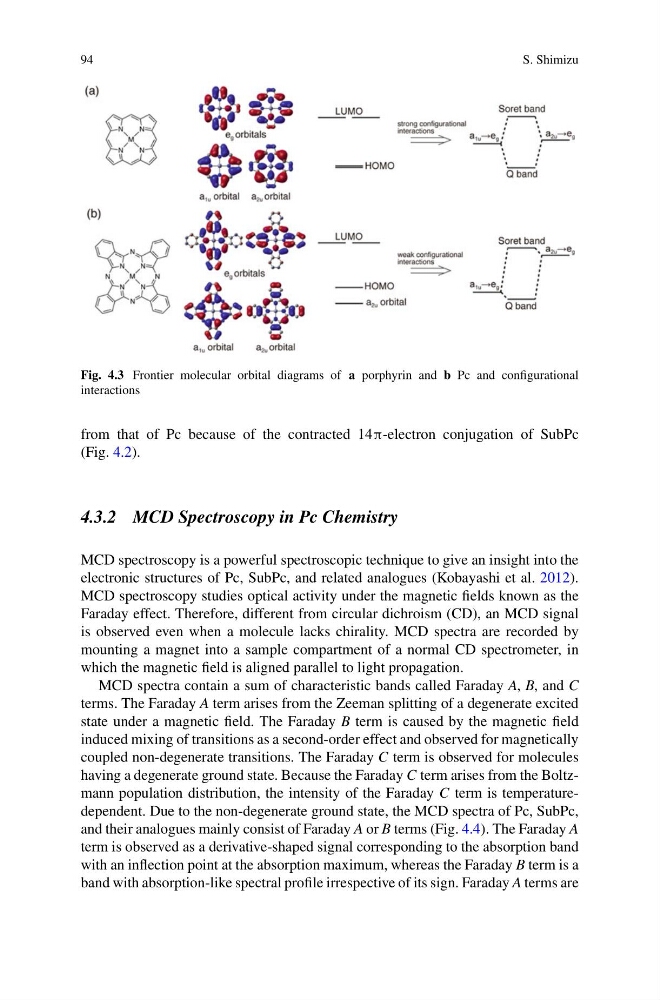
Fig. 4.3 Frontier molecular orbital diagrams of a porphyrin and b Pc and configurational
interactions
from that of Pc because of the contracted 14π-electron conjugation of SubPc
(Fig. 4.2).
4.3.2 MCD Spectroscopy in Pc Chemistry
MCD spectroscopy is a powerful spectroscopic technique to give an insight into the
electronic structures of Pc, SubPc, and related analogues (Kobayashi et al. 2012).
MCD spectroscopy studies optical activity under the magnetic fields known as the
Faraday effect. Therefore, different from circular dichroism (CD), an MCD signal
is observed even when a molecule lacks chirality. MCD spectra are recorded by
mounting a magnet into a sample compartment of a normal CD spectrometer, in
which the magnetic field is aligned parallel to light propagation.
MCD spectra contain a sum of characteristic bands called Faraday A, B, and C
terms. The Faraday A term arises from the Zeeman splitting of a degenerate excited
state under a magnetic field. The Faraday B term is caused by the magnetic field
induced mixing of transitions as a second-order effect and observed for magnetically
coupled non-degenerate transitions. The Faraday C term is observed for molecules
having a degenerate ground state. Because the Faraday C term arises from the Boltzmann population distribution, the intensity of the Faraday C term is temperaturedependent. Due to the non-degenerate ground state, the MCD spectra of Pc, SubPc,
and their analogues mainly consist of Faraday A or B terms (Fig. 4.4). The Faraday A
term is observed as a derivative-shaped signal corresponding to the absorption band
with an inflection point at the absorption maximum, whereas the Faraday B term is a
band with absorption-like spectral profile irrespective of its sign. Faraday A terms are
S. Shimizu
Fig. 4.3 Frontier molecular orbital diagrams of a porphyrin and b Pc and configurational
interactions
from that of Pc because of the contracted 14π-electron conjugation of SubPc
(Fig. 4.2).
4.3.2 MCD Spectroscopy in Pc Chemistry
MCD spectroscopy is a powerful spectroscopic technique to give an insight into the
electronic structures of Pc, SubPc, and related analogues (Kobayashi et al. 2012).
MCD spectroscopy studies optical activity under the magnetic fields known as the
Faraday effect. Therefore, different from circular dichroism (CD), an MCD signal
is observed even when a molecule lacks chirality. MCD spectra are recorded by
mounting a magnet into a sample compartment of a normal CD spectrometer, in
which the magnetic field is aligned parallel to light propagation.
MCD spectra contain a sum of characteristic bands called Faraday A, B, and C
terms. The Faraday A term arises from the Zeeman splitting of a degenerate excited
state under a magnetic field. The Faraday B term is caused by the magnetic field
induced mixing of transitions as a second-order effect and observed for magnetically
coupled non-degenerate transitions. The Faraday C term is observed for molecules
having a degenerate ground state. Because the Faraday C term arises from the Boltzmann population distribution, the intensity of the Faraday C term is temperaturedependent. Due to the non-degenerate ground state, the MCD spectra of Pc, SubPc,
and their analogues mainly consist of Faraday A or B terms (Fig. 4.4). The Faraday A
term is observed as a derivative-shaped signal corresponding to the absorption band
with an inflection point at the absorption maximum, whereas the Faraday B term is a
band with absorption-like spectral profile irrespective of its sign. Faraday A terms are