

3 Porphyrins: Syntheses and Properties
79
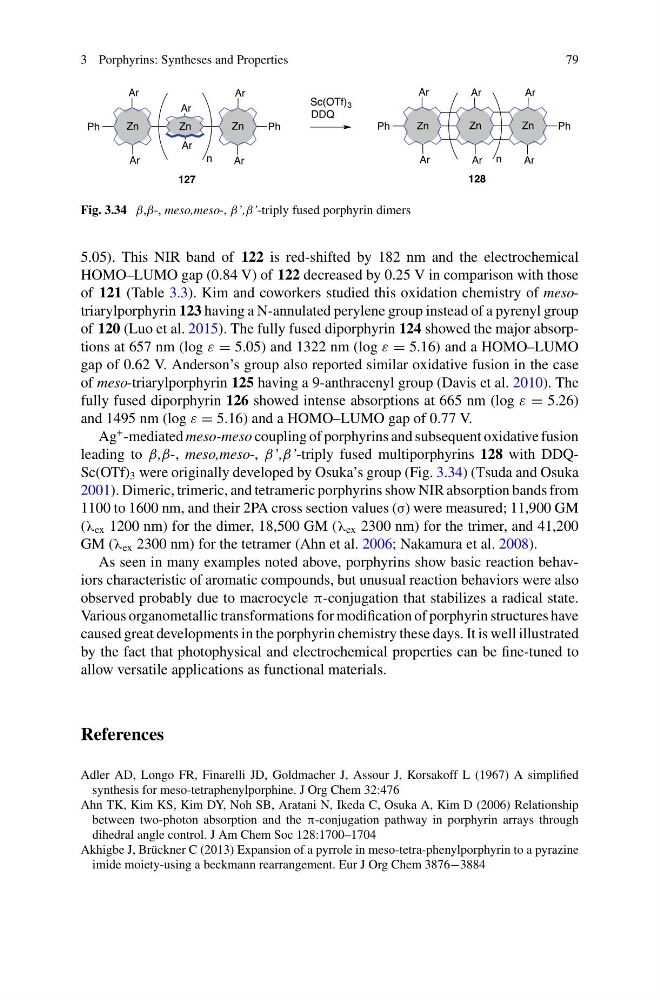
Fig. 3.34 β,β-, meso,meso-, β’,β’-triply fused porphyrin dimers
5.05). This NIR band of 122 is red-shifted by 182 nm and the electrochemical
HOMO–LUMO gap (0.84 V) of 122 decreased by 0.25 V in comparison with those
of 121 (Table 3.3). Kim and coworkers studied this oxidation chemistry of mesotriarylporphyrin 123 having a N-annulated perylene group instead of a pyrenyl group
of 120 (Luo et al. 2015). The fully fused diporphyrin 124 showed the major absorptions at 657 nm (log ε = 5.05) and 1322 nm (log ε = 5.16) and a HOMO–LUMO
gap of 0.62 V. Anderson’s group also reported similar oxidative fusion in the case
of meso-triarylporphyrin 125 having a 9-anthracenyl group (Davis et al. 2010). The
fully fused diporphyrin 126 showed intense absorptions at 665 nm (log ε = 5.26)
and 1495 nm (log ε = 5.16) and a HOMO–LUMO gap of 0.77 V.
Ag
+ -mediated meso-meso coupling of porphyrins and subsequent oxidative fusion
leading to β,β-, meso,meso-, β’,β’-triply fused multiporphyrins 128 with DDQSc(OTf) 3 were originally developed by Osuka’s group (Fig. 3.34) (Tsuda and Osuka
2001). Dimeric, trimeric, and tetrameric porphyrins show NIR absorption bands from
1100 to 1600 nm, and their 2PA cross section values (σ) were measured; 11,900 GM
(λ ex 1200 nm) for the dimer, 18,500 GM (λ ex 2300 nm) for the trimer, and 41,200
GM (λ ex 2300 nm) for the tetramer (Ahn et al. 2006; Nakamura et al. 2008).
As seen in many examples noted above, porphyrins show basic reaction behaviors characteristic of aromatic compounds, but unusual reaction behaviors were also
observed probably due to macrocycle π-conjugation that stabilizes a radical state.
Various organometallic transformations for modification of porphyrin structures have
caused great developments in the porphyrin chemistry these days. It is well illustrated
by the fact that photophysical and electrochemical properties can be fine-tuned to
allow versatile applications as functional materials.
References
Adler AD, Longo FR, Finarelli JD, Goldmacher J, Assour J, Korsakoff L (1967) A simplified
synthesis for meso-tetraphenylporphine. J Org Chem 32:476
Ahn TK, Kim KS, Kim DY, Noh SB, Aratani N, Ikeda C, Osuka A, Kim D (2006) Relationship
between two-photon absorption and the π-conjugation pathway in porphyrin arrays through
dihedral angle control. J Am Chem Soc 128:1700–1704
Akhigbe J, Brückner C (2013) Expansion of a pyrrole in meso-tetra-phenylporphyrin to a pyrazine
imide moiety-using a beckmann rearrangement. Eur J Org Chem 3876−3884
79
Fig. 3.34 β,β-, meso,meso-, β’,β’-triply fused porphyrin dimers
5.05). This NIR band of 122 is red-shifted by 182 nm and the electrochemical
HOMO–LUMO gap (0.84 V) of 122 decreased by 0.25 V in comparison with those
of 121 (Table 3.3). Kim and coworkers studied this oxidation chemistry of mesotriarylporphyrin 123 having a N-annulated perylene group instead of a pyrenyl group
of 120 (Luo et al. 2015). The fully fused diporphyrin 124 showed the major absorptions at 657 nm (log ε = 5.05) and 1322 nm (log ε = 5.16) and a HOMO–LUMO
gap of 0.62 V. Anderson’s group also reported similar oxidative fusion in the case
of meso-triarylporphyrin 125 having a 9-anthracenyl group (Davis et al. 2010). The
fully fused diporphyrin 126 showed intense absorptions at 665 nm (log ε = 5.26)
and 1495 nm (log ε = 5.16) and a HOMO–LUMO gap of 0.77 V.
Ag
+ -mediated meso-meso coupling of porphyrins and subsequent oxidative fusion
leading to β,β-, meso,meso-, β’,β’-triply fused multiporphyrins 128 with DDQSc(OTf) 3 were originally developed by Osuka’s group (Fig. 3.34) (Tsuda and Osuka
2001). Dimeric, trimeric, and tetrameric porphyrins show NIR absorption bands from
1100 to 1600 nm, and their 2PA cross section values (σ) were measured; 11,900 GM
(λ ex 1200 nm) for the dimer, 18,500 GM (λ ex 2300 nm) for the trimer, and 41,200
GM (λ ex 2300 nm) for the tetramer (Ahn et al. 2006; Nakamura et al. 2008).
As seen in many examples noted above, porphyrins show basic reaction behaviors characteristic of aromatic compounds, but unusual reaction behaviors were also
observed probably due to macrocycle π-conjugation that stabilizes a radical state.
Various organometallic transformations for modification of porphyrin structures have
caused great developments in the porphyrin chemistry these days. It is well illustrated
by the fact that photophysical and electrochemical properties can be fine-tuned to
allow versatile applications as functional materials.
References
Adler AD, Longo FR, Finarelli JD, Goldmacher J, Assour J, Korsakoff L (1967) A simplified
synthesis for meso-tetraphenylporphine. J Org Chem 32:476
Ahn TK, Kim KS, Kim DY, Noh SB, Aratani N, Ikeda C, Osuka A, Kim D (2006) Relationship
between two-photon absorption and the π-conjugation pathway in porphyrin arrays through
dihedral angle control. J Am Chem Soc 128:1700–1704
Akhigbe J, Brückner C (2013) Expansion of a pyrrole in meso-tetra-phenylporphyrin to a pyrazine
imide moiety-using a beckmann rearrangement. Eur J Org Chem 3876−3884