

78
J. Setsune
Ni(II) meso-tetraazulenylporphyrin 116 and then it was successfully converted to
the fully azulene-fused porphyrin 117 by FeCl 3 -mediated oxidation. The special
ester substituents (2,4,6-tri-t-butylphenyl ester) allowed clean oxidation in 60% yield
(Kurotobi et al. 2006). The Ni complex 117 showed strong absorption bands at 684 nm
(log ε = 4.8) and 1136 nm (log ε = 4.7) (Table 3.3). This significantly red-shifted
spectrum, and the well diminished electrochemical HOMO–LUMO gap (1.01 V)
illustrate the great effect of azulene fusion. The 2PA cross section value (σ = 7170
GM) of 117 measured at 1380 nm excitation was very high as a monomeric porphyrin
(Pawlicki et al. 2009). The quadruply fused Ni porphyrin 119 was also prepared by
Anderson and coworkers (Davis et al. 2011). The eightfold oxidative ring closure
occurred at the pyrrole-β-positions of Ni(II) meso-tetra-9-anthracenylporphyrin 118
that was prepared by condensation of 9-anthracenyl-2-pyrrylmethanol. It is remarkable that the Q band of 119 appeared at extremely long wavelength (1417 nm) with
a remarkable intensity (log ε = 5.07) that is greater than the Soret-like absorption
at 842 nm (log ε = 4.85) (Table 3.3). The electrochemical HOMO–LUMO gap of
0.61 V was very small.
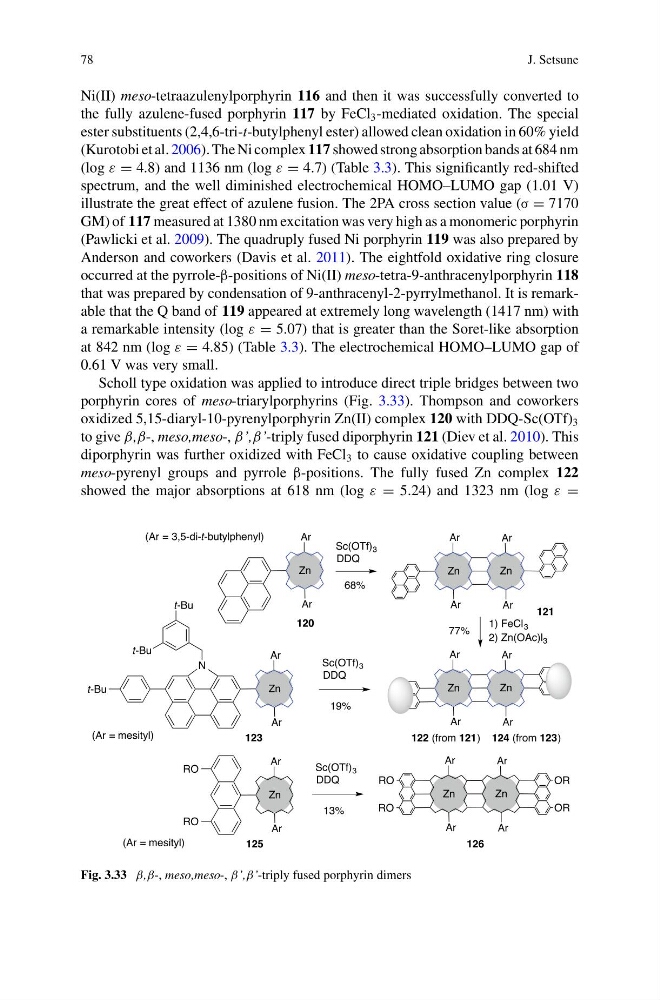
Scholl type oxidation was applied to introduce direct triple bridges between two
porphyrin cores of meso-triarylporphyrins (Fig. 3.33). Thompson and coworkers
oxidized 5,15-diaryl-10-pyrenylporphyrin Zn(II) complex 120 with DDQ-Sc(OTf) 3
to give β,β-, meso,meso-, β’,β’-triply fused diporphyrin 121 (Diev et al. 2010). This
diporphyrin was further oxidized with FeCl 3 to cause oxidative coupling between
meso-pyrenyl groups and pyrrole β-positions. The fully fused Zn complex 122
showed the major absorptions at 618 nm (log ε = 5.24) and 1323 nm (log ε =
Fig. 3.33 β,β-, meso,meso-, β’,β’-triply fused porphyrin dimers
J. Setsune
Ni(II) meso-tetraazulenylporphyrin 116 and then it was successfully converted to
the fully azulene-fused porphyrin 117 by FeCl 3 -mediated oxidation. The special
ester substituents (2,4,6-tri-t-butylphenyl ester) allowed clean oxidation in 60% yield
(Kurotobi et al. 2006). The Ni complex 117 showed strong absorption bands at 684 nm
(log ε = 4.8) and 1136 nm (log ε = 4.7) (Table 3.3). This significantly red-shifted
spectrum, and the well diminished electrochemical HOMO–LUMO gap (1.01 V)
illustrate the great effect of azulene fusion. The 2PA cross section value (σ = 7170
GM) of 117 measured at 1380 nm excitation was very high as a monomeric porphyrin
(Pawlicki et al. 2009). The quadruply fused Ni porphyrin 119 was also prepared by
Anderson and coworkers (Davis et al. 2011). The eightfold oxidative ring closure
occurred at the pyrrole-β-positions of Ni(II) meso-tetra-9-anthracenylporphyrin 118
that was prepared by condensation of 9-anthracenyl-2-pyrrylmethanol. It is remarkable that the Q band of 119 appeared at extremely long wavelength (1417 nm) with
a remarkable intensity (log ε = 5.07) that is greater than the Soret-like absorption
at 842 nm (log ε = 4.85) (Table 3.3). The electrochemical HOMO–LUMO gap of
0.61 V was very small.
Scholl type oxidation was applied to introduce direct triple bridges between two
porphyrin cores of meso-triarylporphyrins (Fig. 3.33). Thompson and coworkers
oxidized 5,15-diaryl-10-pyrenylporphyrin Zn(II) complex 120 with DDQ-Sc(OTf) 3
to give β,β-, meso,meso-, β’,β’-triply fused diporphyrin 121 (Diev et al. 2010). This
diporphyrin was further oxidized with FeCl 3 to cause oxidative coupling between
meso-pyrenyl groups and pyrrole β-positions. The fully fused Zn complex 122
showed the major absorptions at 618 nm (log ε = 5.24) and 1323 nm (log ε =
Fig. 3.33 β,β-, meso,meso-, β’,β’-triply fused porphyrin dimers