

3 Porphyrins: Syntheses and Properties
71
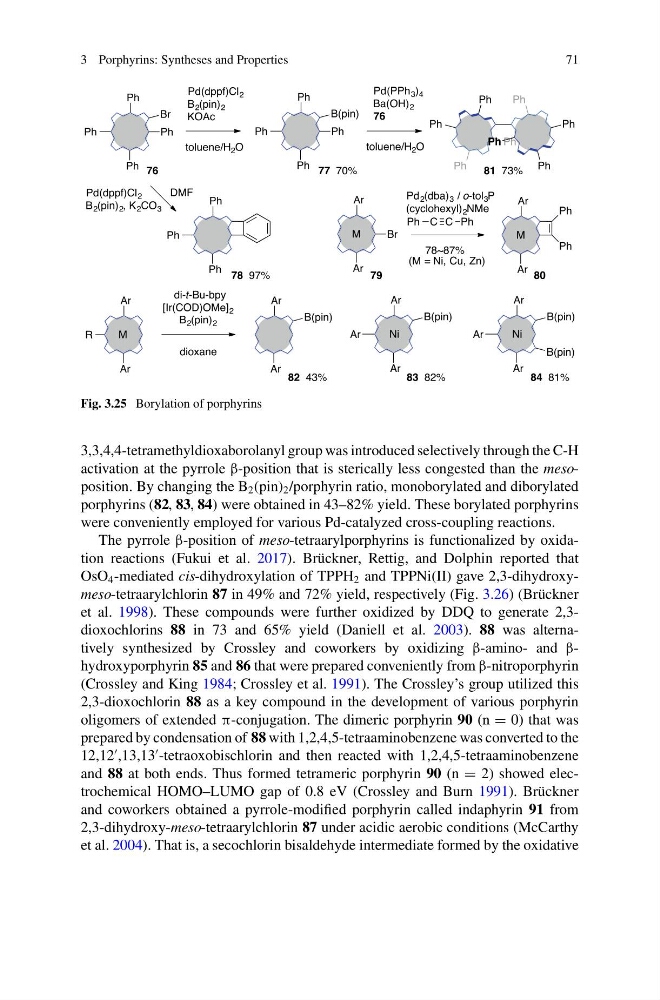
Fig. 3.25 Borylation of porphyrins
3,3,4,4-tetramethyldioxaborolanyl group was introduced selectively through the C-H
activation at the pyrrole β-position that is sterically less congested than the mesoposition. By changing the B 2 (pin) 2 /porphyrin ratio, monoborylated and diborylated
porphyrins (82, 83, 84) were obtained in 43–82% yield. These borylated porphyrins
were conveniently employed for various Pd-catalyzed cross-coupling reactions.
The pyrrole β-position of meso-tetraarylporphyrins is functionalized by oxidation reactions (Fukui et al. 2017). Brückner, Rettig, and Dolphin reported that
OsO 4 -mediated cis-dihydroxylation of TPPH 2 and TPPNi(II) gave 2,3-dihydroxymeso-tetraarylchlorin 87 in 49% and 72% yield, respectively (Fig. 3.26) (Brückner
et al. 1998). These compounds were further oxidized by DDQ to generate 2,3dioxochlorins 88 in 73 and 65% yield (Daniell et al. 2003). 88 was alternatively synthesized by Crossley and coworkers by oxidizing β-amino- and βhydroxyporphyrin 85 and 86 that were prepared conveniently from β-nitroporphyrin
(Crossley and King 1984; Crossley et al. 1991). The Crossley’s group utilized this
2,3-dioxochlorin 88 as a key compound in the development of various porphyrin
oligomers of extended π-conjugation. The dimeric porphyrin 90 (n = 0) that was
prepared by condensation of 88 with 1,2,4,5-tetraaminobenzene was converted to the
12,12
,13,13
-tetraoxobischlorin and then reacted with 1,2,4,5-tetraaminobenzene
and 88 at both ends. Thus formed tetrameric porphyrin 90 (n = 2) showed electrochemical HOMO–LUMO gap of 0.8 eV (Crossley and Burn 1991). Brückner
and coworkers obtained a pyrrole-modified porphyrin called indaphyrin 91 from
2,3-dihydroxy-meso-tetraarylchlorin 87 under acidic aerobic conditions (McCarthy
et al. 2004). That is, a secochlorin bisaldehyde intermediate formed by the oxidative
71
Fig. 3.25 Borylation of porphyrins
3,3,4,4-tetramethyldioxaborolanyl group was introduced selectively through the C-H
activation at the pyrrole β-position that is sterically less congested than the mesoposition. By changing the B 2 (pin) 2 /porphyrin ratio, monoborylated and diborylated
porphyrins (82, 83, 84) were obtained in 43–82% yield. These borylated porphyrins
were conveniently employed for various Pd-catalyzed cross-coupling reactions.
The pyrrole β-position of meso-tetraarylporphyrins is functionalized by oxidation reactions (Fukui et al. 2017). Brückner, Rettig, and Dolphin reported that
OsO 4 -mediated cis-dihydroxylation of TPPH 2 and TPPNi(II) gave 2,3-dihydroxymeso-tetraarylchlorin 87 in 49% and 72% yield, respectively (Fig. 3.26) (Brückner
et al. 1998). These compounds were further oxidized by DDQ to generate 2,3dioxochlorins 88 in 73 and 65% yield (Daniell et al. 2003). 88 was alternatively synthesized by Crossley and coworkers by oxidizing β-amino- and βhydroxyporphyrin 85 and 86 that were prepared conveniently from β-nitroporphyrin
(Crossley and King 1984; Crossley et al. 1991). The Crossley’s group utilized this
2,3-dioxochlorin 88 as a key compound in the development of various porphyrin
oligomers of extended π-conjugation. The dimeric porphyrin 90 (n = 0) that was
prepared by condensation of 88 with 1,2,4,5-tetraaminobenzene was converted to the
12,12
,13,13
-tetraoxobischlorin and then reacted with 1,2,4,5-tetraaminobenzene
and 88 at both ends. Thus formed tetrameric porphyrin 90 (n = 2) showed electrochemical HOMO–LUMO gap of 0.8 eV (Crossley and Burn 1991). Brückner
and coworkers obtained a pyrrole-modified porphyrin called indaphyrin 91 from
2,3-dihydroxy-meso-tetraarylchlorin 87 under acidic aerobic conditions (McCarthy
et al. 2004). That is, a secochlorin bisaldehyde intermediate formed by the oxidative