

3 Porphyrins: Syntheses and Properties
63
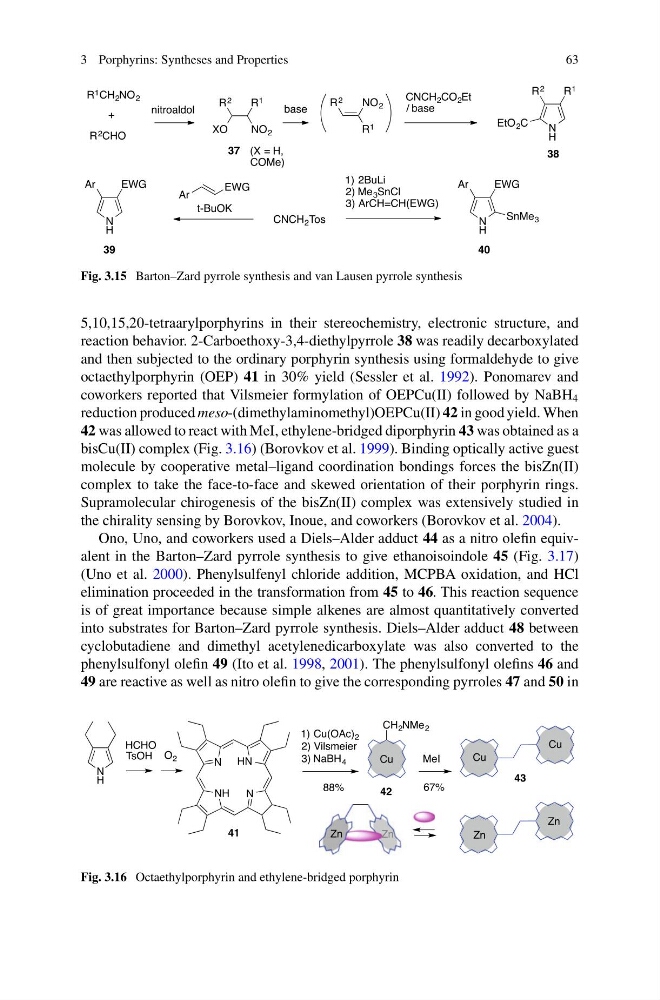
Fig. 3.15 Barton–Zard pyrrole synthesis and van Lausen pyrrole synthesis
5,10,15,20-tetraarylporphyrins in their stereochemistry, electronic structure, and
reaction behavior. 2-Carboethoxy-3,4-diethylpyrrole 38 was readily decarboxylated
and then subjected to the ordinary porphyrin synthesis using formaldehyde to give
octaethylporphyrin (OEP) 41 in 30% yield (Sessler et al. 1992). Ponomarev and
coworkers reported that Vilsmeier formylation of OEPCu(II) followed by NaBH 4
reduction produced meso-(dimethylaminomethyl)OEPCu(II) 42 in good yield. When
42 was allowed to react with MeI, ethylene-bridged diporphyrin 43 was obtained as a
bisCu(II) complex (Fig. 3.16) (Borovkov et al. 1999). Binding optically active guest
molecule by cooperative metal–ligand coordination bondings forces the bisZn(II)
complex to take the face-to-face and skewed orientation of their porphyrin rings.
Supramolecular chirogenesis of the bisZn(II) complex was extensively studied in
the chirality sensing by Borovkov, Inoue, and coworkers (Borovkov et al. 2004).
Ono, Uno, and coworkers used a Diels–Alder adduct 44 as a nitro olefin equivalent in the Barton–Zard pyrrole synthesis to give ethanoisoindole 45 (Fig. 3.17)
(Uno et al. 2000). Phenylsulfenyl chloride addition, MCPBA oxidation, and HCl
elimination proceeded in the transformation from 45 to 46. This reaction sequence
is of great importance because simple alkenes are almost quantitatively converted
into substrates for Barton–Zard pyrrole synthesis. Diels–Alder adduct 48 between
cyclobutadiene and dimethyl acetylenedicarboxylate was also converted to the
phenylsulfonyl olefin 49 (Ito et al. 1998, 2001). The phenylsulfonyl olefins 46 and
49 are reactive as well as nitro olefin to give the corresponding pyrroles 47 and 50 in
Fig. 3.16 Octaethylporphyrin and ethylene-bridged porphyrin
63
Fig. 3.15 Barton–Zard pyrrole synthesis and van Lausen pyrrole synthesis
5,10,15,20-tetraarylporphyrins in their stereochemistry, electronic structure, and
reaction behavior. 2-Carboethoxy-3,4-diethylpyrrole 38 was readily decarboxylated
and then subjected to the ordinary porphyrin synthesis using formaldehyde to give
octaethylporphyrin (OEP) 41 in 30% yield (Sessler et al. 1992). Ponomarev and
coworkers reported that Vilsmeier formylation of OEPCu(II) followed by NaBH 4
reduction produced meso-(dimethylaminomethyl)OEPCu(II) 42 in good yield. When
42 was allowed to react with MeI, ethylene-bridged diporphyrin 43 was obtained as a
bisCu(II) complex (Fig. 3.16) (Borovkov et al. 1999). Binding optically active guest
molecule by cooperative metal–ligand coordination bondings forces the bisZn(II)
complex to take the face-to-face and skewed orientation of their porphyrin rings.
Supramolecular chirogenesis of the bisZn(II) complex was extensively studied in
the chirality sensing by Borovkov, Inoue, and coworkers (Borovkov et al. 2004).
Ono, Uno, and coworkers used a Diels–Alder adduct 44 as a nitro olefin equivalent in the Barton–Zard pyrrole synthesis to give ethanoisoindole 45 (Fig. 3.17)
(Uno et al. 2000). Phenylsulfenyl chloride addition, MCPBA oxidation, and HCl
elimination proceeded in the transformation from 45 to 46. This reaction sequence
is of great importance because simple alkenes are almost quantitatively converted
into substrates for Barton–Zard pyrrole synthesis. Diels–Alder adduct 48 between
cyclobutadiene and dimethyl acetylenedicarboxylate was also converted to the
phenylsulfonyl olefin 49 (Ito et al. 1998, 2001). The phenylsulfonyl olefins 46 and
49 are reactive as well as nitro olefin to give the corresponding pyrroles 47 and 50 in
Fig. 3.16 Octaethylporphyrin and ethylene-bridged porphyrin