

60
J. Setsune
C
C
C C
C
Zn
C
CC
C
Zn
N
N
C
C
C
Zn
C
C
C
N
N
O
OMe
Ar
3
twisted-31
planar-31
:
780 nm emission
710 nm emission
473 nm irradiation
more viscous
environment
less viscous
environment
1 O 2
3 O 2
1 O 2
3 O 2
Ar
Ar
Zn
Ar
Ar
Ar
Ar
Ar
Ar
C
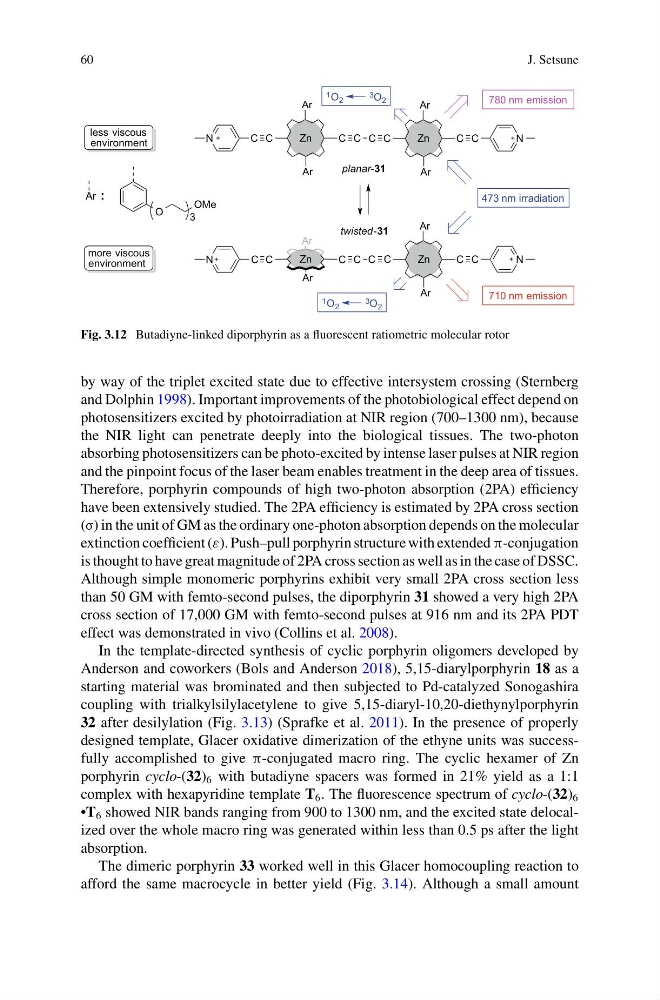
Fig. 3.12 Butadiyne-linked diporphyrin as a fluorescent ratiometric molecular rotor
by way of the triplet excited state due to effective intersystem crossing (Sternberg
and Dolphin 1998). Important improvements of the photobiological effect depend on
photosensitizers excited by photoirradiation at NIR region (700–1300 nm), because
the NIR light can penetrate deeply into the biological tissues. The two-photon
absorbing photosensitizers can be photo-excited by intense laser pulses at NIR region
and the pinpoint focus of the laser beam enables treatment in the deep area of tissues.
Therefore, porphyrin compounds of high two-photon absorption (2PA) efficiency
have been extensively studied. The 2PA efficiency is estimated by 2PA cross section
(σ) in the unit of GM as the ordinary one-photon absorption depends on the molecular
extinction coefficient (ε). Push–pull porphyrin structure with extended π-conjugation
is thought to have great magnitude of 2PA cross section as well as in the case of DSSC.
Although simple monomeric porphyrins exhibit very small 2PA cross section less
than 50 GM with femto-second pulses, the diporphyrin 31 showed a very high 2PA
cross section of 17,000 GM with femto-second pulses at 916 nm and its 2PA PDT
effect was demonstrated in vivo (Collins et al. 2008).
In the template-directed synthesis of cyclic porphyrin oligomers developed by
Anderson and coworkers (Bols and Anderson 2018), 5,15-diarylporphyrin 18 as a
starting material was brominated and then subjected to Pd-catalyzed Sonogashira
coupling with trialkylsilylacetylene to give 5,15-diaryl-10,20-diethynylporphyrin
32 after desilylation (Fig. 3.13) (Sprafke et al. 2011). In the presence of properly
designed template, Glacer oxidative dimerization of the ethyne units was successfully accomplished to give π-conjugated macro ring. The cyclic hexamer of Zn
porphyrin cyclo-(32) 6 with butadiyne spacers was formed in 21% yield as a 1:1
complex with hexapyridine template T 6 . The fluorescence spectrum of cyclo-(32) 6
•T 6 showed NIR bands ranging from 900 to 1300 nm, and the excited state delocalized over the whole macro ring was generated within less than 0.5 ps after the light
absorption.
The dimeric porphyrin 33 worked well in this Glacer homocoupling reaction to
afford the same macrocycle in better yield (Fig. 3.14). Although a small amount
J. Setsune
C
C
C C
C
Zn
C
CC
C
Zn
N
N
C
C
C
Zn
C
C
C
N
N
O
OMe
Ar
3
twisted-31
planar-31
:
780 nm emission
710 nm emission
473 nm irradiation
more viscous
environment
less viscous
environment
1 O 2
3 O 2
1 O 2
3 O 2
Ar
Ar
Zn
Ar
Ar
Ar
Ar
Ar
Ar
C
Fig. 3.12 Butadiyne-linked diporphyrin as a fluorescent ratiometric molecular rotor
by way of the triplet excited state due to effective intersystem crossing (Sternberg
and Dolphin 1998). Important improvements of the photobiological effect depend on
photosensitizers excited by photoirradiation at NIR region (700–1300 nm), because
the NIR light can penetrate deeply into the biological tissues. The two-photon
absorbing photosensitizers can be photo-excited by intense laser pulses at NIR region
and the pinpoint focus of the laser beam enables treatment in the deep area of tissues.
Therefore, porphyrin compounds of high two-photon absorption (2PA) efficiency
have been extensively studied. The 2PA efficiency is estimated by 2PA cross section
(σ) in the unit of GM as the ordinary one-photon absorption depends on the molecular
extinction coefficient (ε). Push–pull porphyrin structure with extended π-conjugation
is thought to have great magnitude of 2PA cross section as well as in the case of DSSC.
Although simple monomeric porphyrins exhibit very small 2PA cross section less
than 50 GM with femto-second pulses, the diporphyrin 31 showed a very high 2PA
cross section of 17,000 GM with femto-second pulses at 916 nm and its 2PA PDT
effect was demonstrated in vivo (Collins et al. 2008).
In the template-directed synthesis of cyclic porphyrin oligomers developed by
Anderson and coworkers (Bols and Anderson 2018), 5,15-diarylporphyrin 18 as a
starting material was brominated and then subjected to Pd-catalyzed Sonogashira
coupling with trialkylsilylacetylene to give 5,15-diaryl-10,20-diethynylporphyrin
32 after desilylation (Fig. 3.13) (Sprafke et al. 2011). In the presence of properly
designed template, Glacer oxidative dimerization of the ethyne units was successfully accomplished to give π-conjugated macro ring. The cyclic hexamer of Zn
porphyrin cyclo-(32) 6 with butadiyne spacers was formed in 21% yield as a 1:1
complex with hexapyridine template T 6 . The fluorescence spectrum of cyclo-(32) 6
•T 6 showed NIR bands ranging from 900 to 1300 nm, and the excited state delocalized over the whole macro ring was generated within less than 0.5 ps after the light
absorption.
The dimeric porphyrin 33 worked well in this Glacer homocoupling reaction to
afford the same macrocycle in better yield (Fig. 3.14). Although a small amount