

594
S. Yagi
et al. 2016). This aromatic system contains nitrogen and boron atoms showing electron donating and withdrawing mesomeric effects, respectively, and shows effective
HOMO–LUMO separation. Indeed, the E ST of 0.20 eV is achieved, enough small
for triplet-to-singlet up-conversion. In addition, DABNA possesses rigid structural
framework which suppresses structural relaxation upon electronic excitation, and the
PL spectrum with a narrow bandwidth was expected. The 1 wt% doped m-CBP films
of DABNA-1 and DABNA-2 (Fig. 16.29b) exhibit highly efficient blue PL at 460
and 469 nm with Φ PL s of 0.88 and 0.90, respectively, containing prompt and delayed
fluorescent emissions. The half bandwidths of their PL spectra are 28–30 nm, much
smaller than those of the donor–acceptor type TADF emitters. The OLEDs with
these TADF emitters were fabricated (device structure; ITO/α-NPD (40 nm)/tris(4carbazolyl-9-ylphenyl)amine (TCTA, 15 nm)/mCP (15 nm)/1 wt% emitter-doped mCBP (20 nm)/diphenyl-4-triphenylsilylphenylphosphine oxide (TSPO1, 40 nm)/LiF
(1 nm)/Al (100 nm)), and the device with DABNA-1 exhibited pure blue EL (λ PL ;
459 nm) with the maximum η ext of 13.5%. The CIE coordinate was (0.13, 0.09),
comparable to CIE (0.14, 0.08) for the NTSC standard for blue. It is undoubted
that this excellent chromaticity coordinate is due to the narrow half bandwidth of
28 nm. The device with DABNA-2 exhibited slightly red-shifted EL at 467 nm,
but the half bandwidth of 28 nm is still narrow, affording CIE (0.12, 0.11). The
maximum η ext of 20.2% was achieved, and the internal quantum efficiency is estimated as approximately 100%, assuming the light out-coupling efficiency of 20%. In
general, donor–acceptor type pure blue TADF emitters are difficult to obtain because
the molecular design to elevate the singlet and triplet charge-transfer excited states
(
1 CT and
3 CT) brings the low-lying triplet locally excited state (
3 LE) giving rise to
trapping the triplet excitons from
1 CT and
3 CT to
3 LE (Zhang et al. 2014). Taking
this into consideration, the present molecular design based on the multiple resonance
effect is beneficial to develop blue TADF emitters.
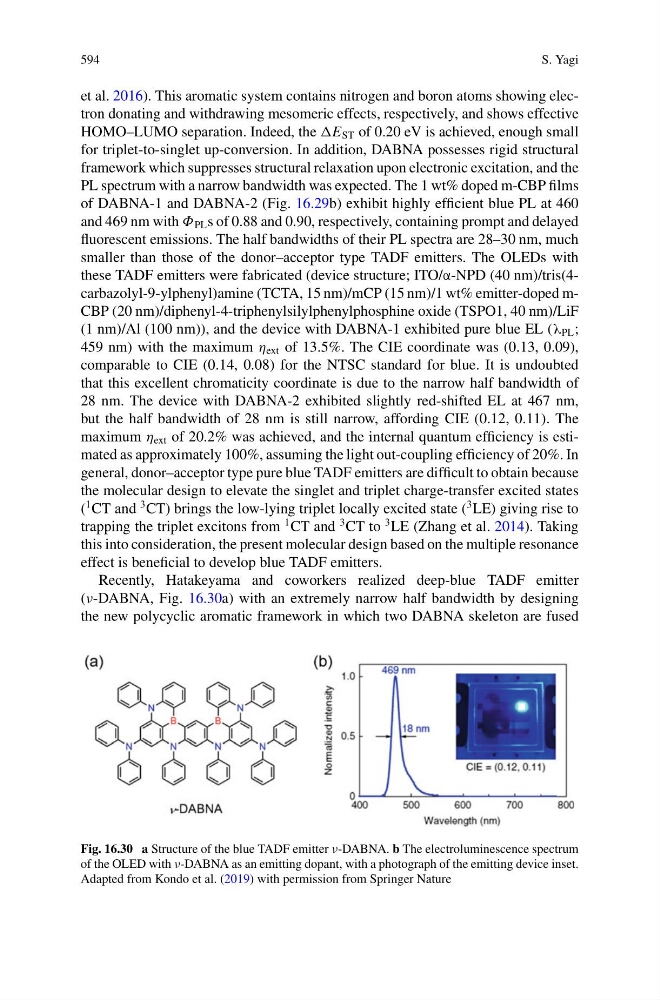
Recently, Hatakeyama and coworkers realized deep-blue TADF emitter
(ν-DABNA, Fig. 16.30a) with an extremely narrow half bandwidth by designing
the new polycyclic aromatic framework in which two DABNA skeleton are fused
Fig. 16.30 a Structure of the blue TADF emitter ν-DABNA. b The electroluminescence spectrum
of the OLED with ν-DABNA as an emitting dopant, with a photograph of the emitting device inset.
Adapted from Kondo et al. (2019) with permission from Springer Nature