

16 Luminescent Materials for Organic Light-Emitting Diodes
593
shapes of PL with large half bandwidths of 70–100 nm. From the viewpoint of
application to flat displays, this spectral feature is disadvantageous to tune precisely
chromaticity coordinates of EL. Thus, another type of molecular design to achieve
E ST has been required.
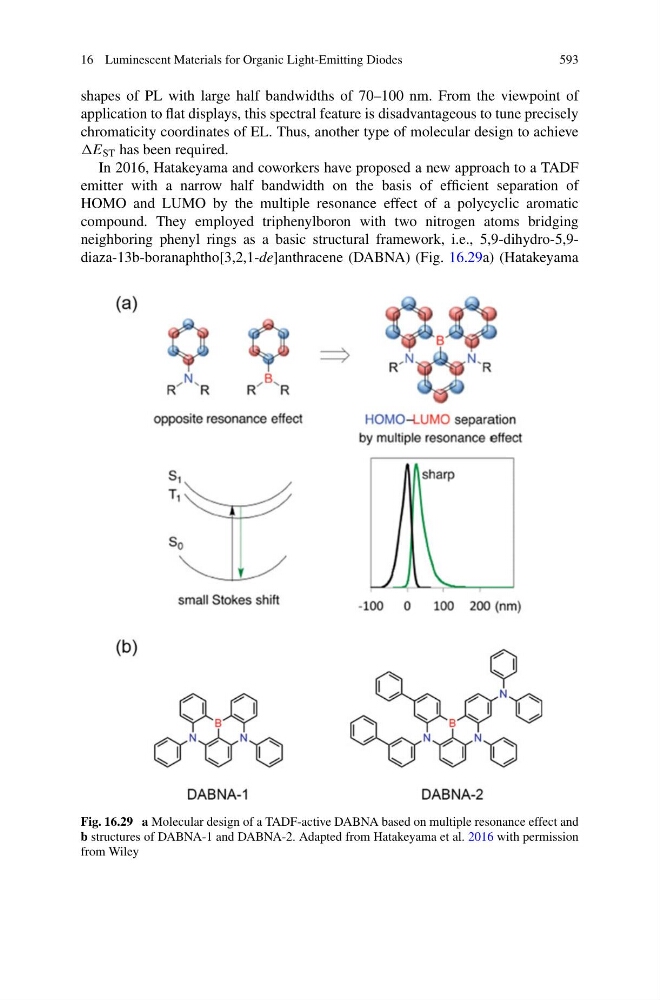
In 2016, Hatakeyama and coworkers have proposed a new approach to a TADF
emitter with a narrow half bandwidth on the basis of efficient separation of
HOMO and LUMO by the multiple resonance effect of a polycyclic aromatic
compound. They employed triphenylboron with two nitrogen atoms bridging
neighboring phenyl rings as a basic structural framework, i.e., 5,9-dihydro-5,9diaza-13b-boranaphtho[3,2,1-de]anthracene (DABNA) (Fig. 16.29a) (Hatakeyama
Fig. 16.29 a Molecular design of a TADF-active DABNA based on multiple resonance effect and
b structures of DABNA-1 and DABNA-2. Adapted from Hatakeyama et al. 2016 with permission
from Wiley