

3 Porphyrins: Syntheses and Properties
53
moments in a skewed orientation. Thus, chirality of the guest molecule is translated
into the helicity of the host molecule.
3.2.2 Lindsey Synthesis Using Dipyrrylmethanes
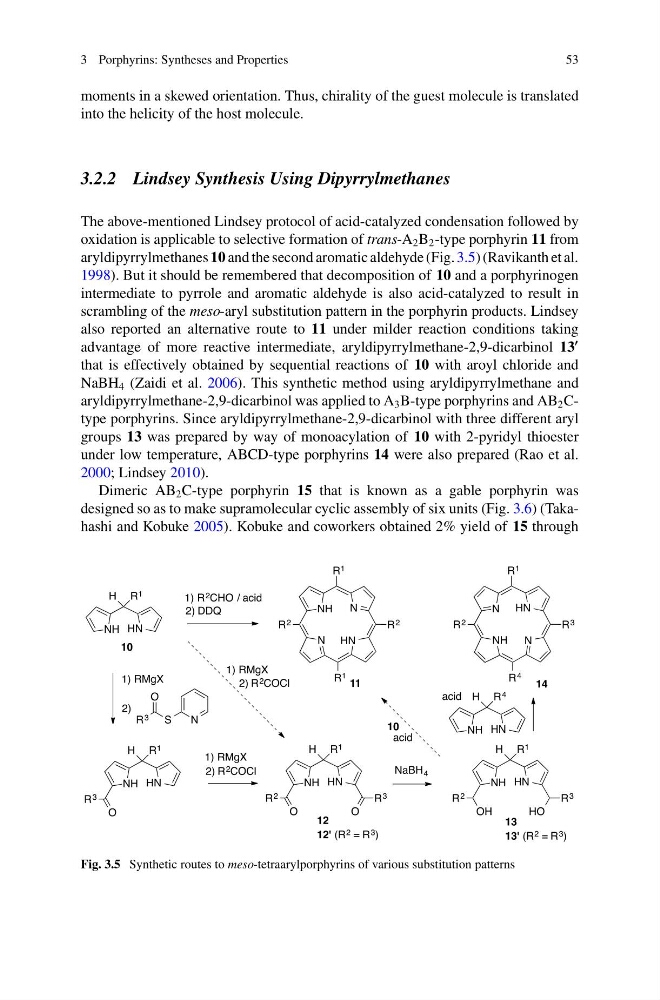
The above-mentioned Lindsey protocol of acid-catalyzed condensation followed by
oxidation is applicable to selective formation of trans-A 2 B 2 -type porphyrin 11 from
aryldipyrrylmethanes 10 and the second aromatic aldehyde (Fig. 3.5) (Ravikanth et al.
1998). But it should be remembered that decomposition of 10 and a porphyrinogen
intermediate to pyrrole and aromatic aldehyde is also acid-catalyzed to result in
scrambling of the meso-aryl substitution pattern in the porphyrin products. Lindsey
also reported an alternative route to 11 under milder reaction conditions taking
advantage of more reactive intermediate, aryldipyrrylmethane-2,9-dicarbinol 13
that is effectively obtained by sequential reactions of 10 with aroyl chloride and
NaBH 4 (Zaidi et al. 2006). This synthetic method using aryldipyrrylmethane and
aryldipyrrylmethane-2,9-dicarbinol was applied to A 3 B-type porphyrins and AB 2 Ctype porphyrins. Since aryldipyrrylmethane-2,9-dicarbinol with three different aryl
groups 13 was prepared by way of monoacylation of 10 with 2-pyridyl thioester
under low temperature, ABCD-type porphyrins 14 were also prepared (Rao et al.
2000; Lindsey 2010).
Dimeric AB 2 C-type porphyrin 15 that is known as a gable porphyrin was
designed so as to make supramolecular cyclic assembly of six units (Fig. 3.6) (Takahashi and Kobuke 2005). Kobuke and coworkers obtained 2% yield of 15 through
Fig. 3.5 Synthetic routes to meso-tetraarylporphyrins of various substitution patterns
53
moments in a skewed orientation. Thus, chirality of the guest molecule is translated
into the helicity of the host molecule.
3.2.2 Lindsey Synthesis Using Dipyrrylmethanes
The above-mentioned Lindsey protocol of acid-catalyzed condensation followed by
oxidation is applicable to selective formation of trans-A 2 B 2 -type porphyrin 11 from
aryldipyrrylmethanes 10 and the second aromatic aldehyde (Fig. 3.5) (Ravikanth et al.
1998). But it should be remembered that decomposition of 10 and a porphyrinogen
intermediate to pyrrole and aromatic aldehyde is also acid-catalyzed to result in
scrambling of the meso-aryl substitution pattern in the porphyrin products. Lindsey
also reported an alternative route to 11 under milder reaction conditions taking
advantage of more reactive intermediate, aryldipyrrylmethane-2,9-dicarbinol 13
that is effectively obtained by sequential reactions of 10 with aroyl chloride and
NaBH 4 (Zaidi et al. 2006). This synthetic method using aryldipyrrylmethane and
aryldipyrrylmethane-2,9-dicarbinol was applied to A 3 B-type porphyrins and AB 2 Ctype porphyrins. Since aryldipyrrylmethane-2,9-dicarbinol with three different aryl
groups 13 was prepared by way of monoacylation of 10 with 2-pyridyl thioester
under low temperature, ABCD-type porphyrins 14 were also prepared (Rao et al.
2000; Lindsey 2010).
Dimeric AB 2 C-type porphyrin 15 that is known as a gable porphyrin was
designed so as to make supramolecular cyclic assembly of six units (Fig. 3.6) (Takahashi and Kobuke 2005). Kobuke and coworkers obtained 2% yield of 15 through
Fig. 3.5 Synthetic routes to meso-tetraarylporphyrins of various substitution patterns