

566
S. Yagi
required because OLEDs have been intended for application as picture elements for
flat panel displays. To obtain a target emission color, one can tune the π-conjugation
length of the chromophore. That is, if red-shifted emission is required, the extended
π-conjugation system leading to a narrow HOMO–LUMO energy gap should be
obtained to lower the energy level of S 1 . On the contrary, shortening the π-conjugation
system brings about the high-lying S 1 , affording blue-shifted emission. Nowadays,
with the help of progress of theoretical calculations, it is relatively easy to carry
out molecular designs of fluorescent emitters focusing on the emission wavelengths.
Here, the author summarizes representative fluorescent dyes for OLED applications.
As red fluorescent emitters, pyran-based merocyanine dyes like a DCM series
have been intensely developed, which consist of the aminophenyl donor and
dicyanomethylene acceptor groups. Although DCM-1 and DCM-2 were adopted by
Tang and coworkers to fabricate OLEDs with a doped EML (Tang and VanSlyke
1989), they tend to suffer from self-aggregation lowering the device efficiency.
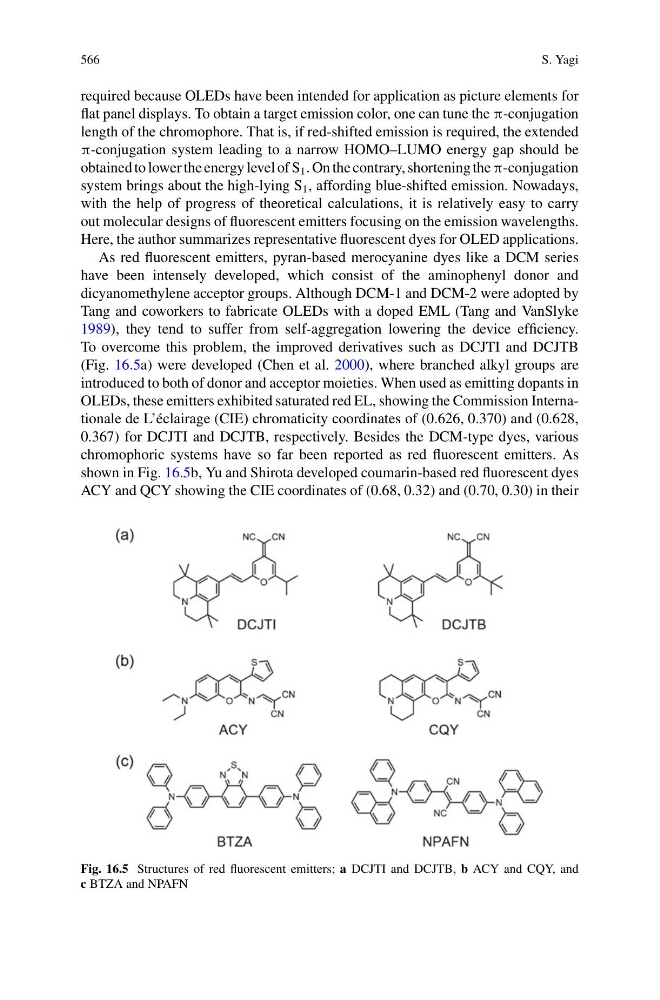
To overcome this problem, the improved derivatives such as DCJTI and DCJTB
(Fig. 16.5a) were developed (Chen et al. 2000), where branched alkyl groups are
introduced to both of donor and acceptor moieties. When used as emitting dopants in
OLEDs, these emitters exhibited saturated red EL, showing the Commission Internationale de L’éclairage (CIE) chromaticity coordinates of (0.626, 0.370) and (0.628,
0.367) for DCJTI and DCJTB, respectively. Besides the DCM-type dyes, various
chromophoric systems have so far been reported as red fluorescent emitters. As
shown in Fig. 16.5b, Yu and Shirota developed coumarin-based red fluorescent dyes
ACY and QCY showing the CIE coordinates of (0.68, 0.32) and (0.70, 0.30) in their
Fig. 16.5 Structures of red fluorescent emitters; a DCJTI and DCJTB, b ACY and CQY, and
c BTZA and NPAFN
S. Yagi
required because OLEDs have been intended for application as picture elements for
flat panel displays. To obtain a target emission color, one can tune the π-conjugation
length of the chromophore. That is, if red-shifted emission is required, the extended
π-conjugation system leading to a narrow HOMO–LUMO energy gap should be
obtained to lower the energy level of S 1 . On the contrary, shortening the π-conjugation
system brings about the high-lying S 1 , affording blue-shifted emission. Nowadays,
with the help of progress of theoretical calculations, it is relatively easy to carry
out molecular designs of fluorescent emitters focusing on the emission wavelengths.
Here, the author summarizes representative fluorescent dyes for OLED applications.
As red fluorescent emitters, pyran-based merocyanine dyes like a DCM series
have been intensely developed, which consist of the aminophenyl donor and
dicyanomethylene acceptor groups. Although DCM-1 and DCM-2 were adopted by
Tang and coworkers to fabricate OLEDs with a doped EML (Tang and VanSlyke
1989), they tend to suffer from self-aggregation lowering the device efficiency.
To overcome this problem, the improved derivatives such as DCJTI and DCJTB
(Fig. 16.5a) were developed (Chen et al. 2000), where branched alkyl groups are
introduced to both of donor and acceptor moieties. When used as emitting dopants in
OLEDs, these emitters exhibited saturated red EL, showing the Commission Internationale de L’éclairage (CIE) chromaticity coordinates of (0.626, 0.370) and (0.628,
0.367) for DCJTI and DCJTB, respectively. Besides the DCM-type dyes, various
chromophoric systems have so far been reported as red fluorescent emitters. As
shown in Fig. 16.5b, Yu and Shirota developed coumarin-based red fluorescent dyes
ACY and QCY showing the CIE coordinates of (0.68, 0.32) and (0.70, 0.30) in their
Fig. 16.5 Structures of red fluorescent emitters; a DCJTI and DCJTB, b ACY and CQY, and
c BTZA and NPAFN