

16 Luminescent Materials for Organic Light-Emitting Diodes
565
excited one (i.e., reverse intersystem crossing) leads to the singlet exciton generation with η ph more than the theoretical limit of conventional fluorescent OLEDs
(Fig. 16.3) (Endo et al. 2011). Thus, TADF-based OLED can theoretically provide
η ext comparable to phosphorescent OLED. Nowadays, TADF materials are regarded
as excellent candidates for development of high-efficiency OLEDs. It is noteworthy
that TADF materials are beneficial in regards to production cost as well as influence on environment: they do not involve any precious metal elements, and thus
can be developed relatively at low cost. Nowadays, from the viewpoint of historical background, fluorescent and phosphorescent materials are called the first and
second generation emitters, respectively, and TADF materials are regarded as the
third generation emitters.
This chapter reviews development of emitting materials for OLED applications,
where the classification is based on the mechanism of photon generation; fluorescence, phosphorescence, and TADF materials. Recent advances of OLED emitters are
also described, especially focusing on the aspects to overcome the technical problems
such as optimization of chromaticity coordinates of emission colors, improvement
of Φ PL , and so on.
16.2 Fluorescent Materials: First-Generation Emitters
16.2.1 Fluorescent Emitters Based on Low-Mass Molecular
Systems
At the early stage, traditional fluorescent dyes such as coumarins (e.g., C540 (or
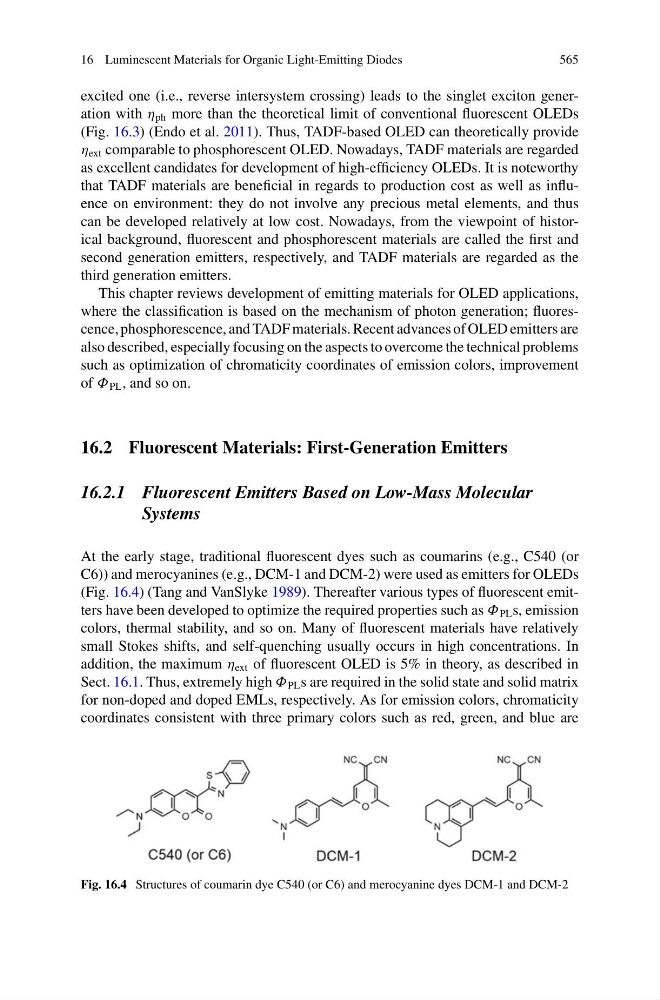
C6)) and merocyanines (e.g., DCM-1 and DCM-2) were used as emitters for OLEDs
(Fig. 16.4) (Tang and VanSlyke 1989). Thereafter various types of fluorescent emitters have been developed to optimize the required properties such as Φ PL s, emission
colors, thermal stability, and so on. Many of fluorescent materials have relatively
small Stokes shifts, and self-quenching usually occurs in high concentrations. In
addition, the maximum η ext of fluorescent OLED is 5% in theory, as described in
Sect. 16.1. Thus, extremely high Φ PL s are required in the solid state and solid matrix
for non-doped and doped EMLs, respectively. As for emission colors, chromaticity
coordinates consistent with three primary colors such as red, green, and blue are
Fig. 16.4 Structures of coumarin dye C540 (or C6) and merocyanine dyes DCM-1 and DCM-2
565
excited one (i.e., reverse intersystem crossing) leads to the singlet exciton generation with η ph more than the theoretical limit of conventional fluorescent OLEDs
(Fig. 16.3) (Endo et al. 2011). Thus, TADF-based OLED can theoretically provide
η ext comparable to phosphorescent OLED. Nowadays, TADF materials are regarded
as excellent candidates for development of high-efficiency OLEDs. It is noteworthy
that TADF materials are beneficial in regards to production cost as well as influence on environment: they do not involve any precious metal elements, and thus
can be developed relatively at low cost. Nowadays, from the viewpoint of historical background, fluorescent and phosphorescent materials are called the first and
second generation emitters, respectively, and TADF materials are regarded as the
third generation emitters.
This chapter reviews development of emitting materials for OLED applications,
where the classification is based on the mechanism of photon generation; fluorescence, phosphorescence, and TADF materials. Recent advances of OLED emitters are
also described, especially focusing on the aspects to overcome the technical problems
such as optimization of chromaticity coordinates of emission colors, improvement
of Φ PL , and so on.
16.2 Fluorescent Materials: First-Generation Emitters
16.2.1 Fluorescent Emitters Based on Low-Mass Molecular
Systems
At the early stage, traditional fluorescent dyes such as coumarins (e.g., C540 (or
C6)) and merocyanines (e.g., DCM-1 and DCM-2) were used as emitters for OLEDs
(Fig. 16.4) (Tang and VanSlyke 1989). Thereafter various types of fluorescent emitters have been developed to optimize the required properties such as Φ PL s, emission
colors, thermal stability, and so on. Many of fluorescent materials have relatively
small Stokes shifts, and self-quenching usually occurs in high concentrations. In
addition, the maximum η ext of fluorescent OLED is 5% in theory, as described in
Sect. 16.1. Thus, extremely high Φ PL s are required in the solid state and solid matrix
for non-doped and doped EMLs, respectively. As for emission colors, chromaticity
coordinates consistent with three primary colors such as red, green, and blue are
Fig. 16.4 Structures of coumarin dye C540 (or C6) and merocyanine dyes DCM-1 and DCM-2