

16 Luminescent Materials for Organic Light-Emitting Diodes
563
Fig. 16.1b (Tang and VanSlyke 1989). Employing a dye-doped EML led to achievement of an external quantum efficiency (η ext ) of 0.023–0.025, about two times
larger than the undoped device (η ext ; 0.013). To obtain EL from the doped dye
via energy transfer from the Alq3 host, it is essential to place the dye-doped layer
in less than 5 nm from the diamine/Alq3 interface, indicating that the efficient
energy transfer occurs in the charge recombination zone. After that, the emitterdoped device fabrication has been widely utilized as a general technique to achieve
high-performance OLEDs. The importance of fabrication of the multilayer device
structure was demonstrated by Saito and coworkers (Adachi et al. 1990). They fabricated a device consisting of stacked organic thin films of hole-transporting layer
(HTL)/EML/electron-transporting layer (ETL) between the anode and the cathode.
To obtain a high EL efficiency, it is important to achieve efficient exciton generation
at EML through hole–electron recombination. In the case of the HTL/EML/ETL
device structure, confinement of holes and electrons in EML by blocking at the
EML/ETL and HTL/EML boundaries, respectively, leads to efficient charge carrier
recombination.
At the early period of OLED development, sublimable materials were mainly
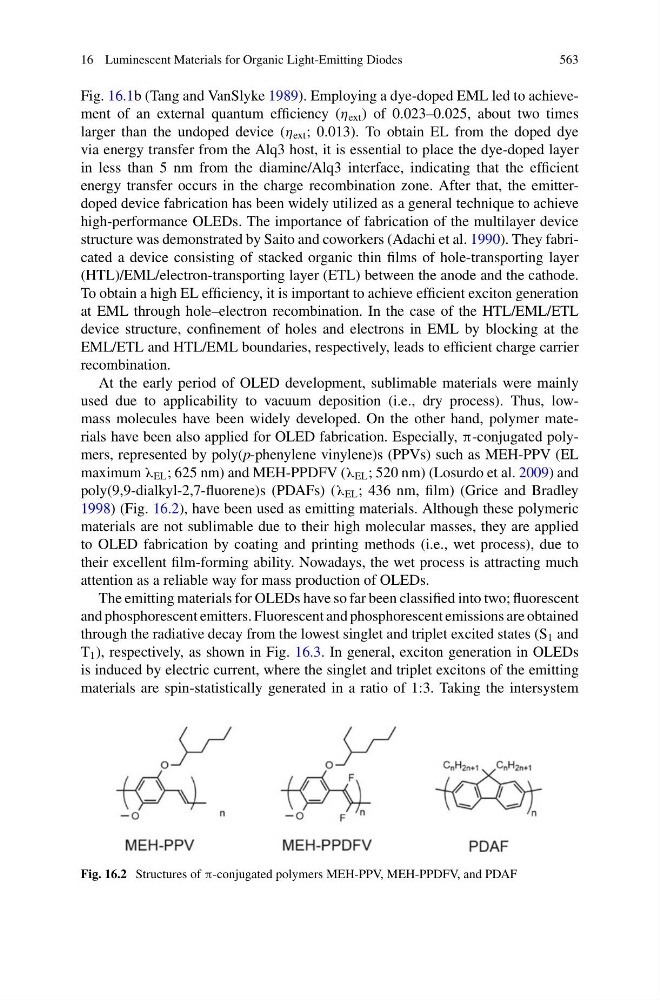
used due to applicability to vacuum deposition (i.e., dry process). Thus, lowmass molecules have been widely developed. On the other hand, polymer materials have been also applied for OLED fabrication. Especially, π-conjugated polymers, represented by poly(p-phenylene vinylene)s (PPVs) such as MEH-PPV (EL
maximum λ EL ; 625 nm) and MEH-PPDFV (λ EL ; 520 nm) (Losurdo et al. 2009) and
poly(9,9-dialkyl-2,7-fluorene)s (PDAFs) (λ EL ; 436 nm, film) (Grice and Bradley
1998) (Fig. 16.2), have been used as emitting materials. Although these polymeric
materials are not sublimable due to their high molecular masses, they are applied
to OLED fabrication by coating and printing methods (i.e., wet process), due to
their excellent film-forming ability. Nowadays, the wet process is attracting much
attention as a reliable way for mass production of OLEDs.
The emitting materials for OLEDs have so far been classified into two; fluorescent
and phosphorescent emitters. Fluorescent and phosphorescent emissions are obtained
through the radiative decay from the lowest singlet and triplet excited states (S 1 and
T 1 ), respectively, as shown in Fig. 16.3. In general, exciton generation in OLEDs
is induced by electric current, where the singlet and triplet excitons of the emitting
materials are spin-statistically generated in a ratio of 1:3. Taking the intersystem
Fig. 16.2 Structures of π-conjugated polymers MEH-PPV, MEH-PPDFV, and PDAF
563
Fig. 16.1b (Tang and VanSlyke 1989). Employing a dye-doped EML led to achievement of an external quantum efficiency (η ext ) of 0.023–0.025, about two times
larger than the undoped device (η ext ; 0.013). To obtain EL from the doped dye
via energy transfer from the Alq3 host, it is essential to place the dye-doped layer
in less than 5 nm from the diamine/Alq3 interface, indicating that the efficient
energy transfer occurs in the charge recombination zone. After that, the emitterdoped device fabrication has been widely utilized as a general technique to achieve
high-performance OLEDs. The importance of fabrication of the multilayer device
structure was demonstrated by Saito and coworkers (Adachi et al. 1990). They fabricated a device consisting of stacked organic thin films of hole-transporting layer
(HTL)/EML/electron-transporting layer (ETL) between the anode and the cathode.
To obtain a high EL efficiency, it is important to achieve efficient exciton generation
at EML through hole–electron recombination. In the case of the HTL/EML/ETL
device structure, confinement of holes and electrons in EML by blocking at the
EML/ETL and HTL/EML boundaries, respectively, leads to efficient charge carrier
recombination.
At the early period of OLED development, sublimable materials were mainly
used due to applicability to vacuum deposition (i.e., dry process). Thus, lowmass molecules have been widely developed. On the other hand, polymer materials have been also applied for OLED fabrication. Especially, π-conjugated polymers, represented by poly(p-phenylene vinylene)s (PPVs) such as MEH-PPV (EL
maximum λ EL ; 625 nm) and MEH-PPDFV (λ EL ; 520 nm) (Losurdo et al. 2009) and
poly(9,9-dialkyl-2,7-fluorene)s (PDAFs) (λ EL ; 436 nm, film) (Grice and Bradley
1998) (Fig. 16.2), have been used as emitting materials. Although these polymeric
materials are not sublimable due to their high molecular masses, they are applied
to OLED fabrication by coating and printing methods (i.e., wet process), due to
their excellent film-forming ability. Nowadays, the wet process is attracting much
attention as a reliable way for mass production of OLEDs.
The emitting materials for OLEDs have so far been classified into two; fluorescent
and phosphorescent emitters. Fluorescent and phosphorescent emissions are obtained
through the radiative decay from the lowest singlet and triplet excited states (S 1 and
T 1 ), respectively, as shown in Fig. 16.3. In general, exciton generation in OLEDs
is induced by electric current, where the singlet and triplet excitons of the emitting
materials are spin-statistically generated in a ratio of 1:3. Taking the intersystem
Fig. 16.2 Structures of π-conjugated polymers MEH-PPV, MEH-PPDFV, and PDAF