

50
J. Setsune
properties caused by structural diversity. Although some aspects of application to
material science and medicine will be mentioned here, they are arbitrarily selected
just for examples. A large number of porphyrin analogues (expanded, contracted,
and isomeric porphyrins) have been developed these days and their unusual structure
and properties have been adding great insights into the porphyrin chemistry. These
subjects have recently been reviewed (Sessler et al. 2017), and not included here.
3.2 meso-Tetra-substituted Porphyrins
3.2.1 Condensation of Pyrrole and Aldehyde
meso-Tetraarylporphyrins are produced by simple procedures known as a Rothemund method and a Longo-Adler method (Rothemund 1935; Adler et al. 1967).
After heating a mixture of pyrrole and aromatic aldehyde in acetic acid or propionic acid under aerobic conditions, the reaction mixture was left overnight at room
temperature to generate crystalline A 4 -type porphyrins with D 4h symmetry usually
in the yields more or less 20%. Since rotation of meso-aryl groups with orthosubstituents is limited, conformational isomers called atropisomers are separated and
their stability is dependent on the bulkiness of the ortho-substituents. Collman’s group
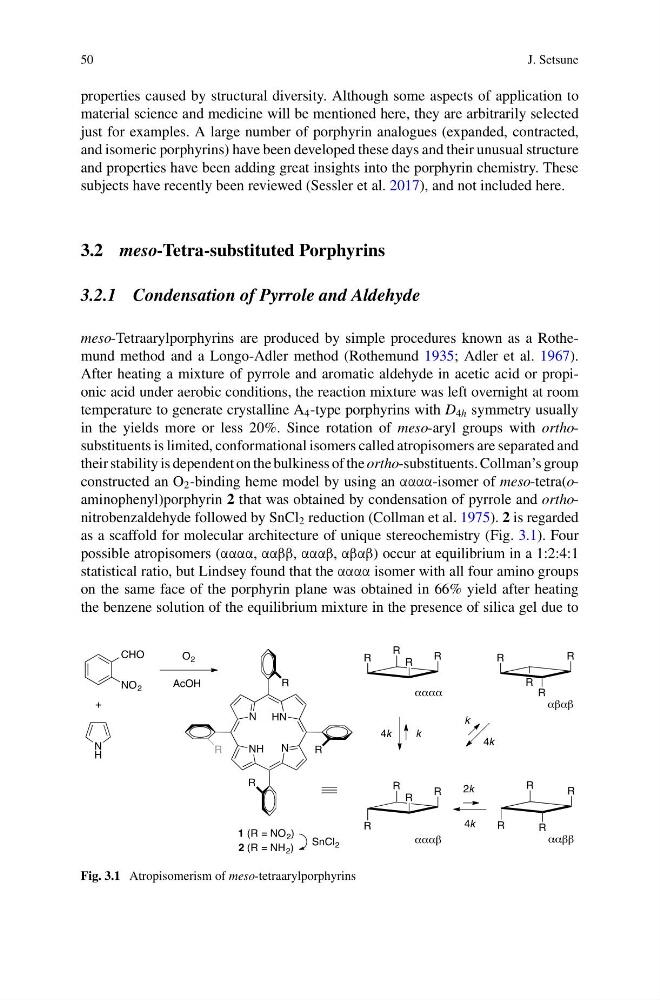
constructed an O 2 -binding heme model by using an αααα-isomer of meso-tetra(oaminophenyl)porphyrin 2 that was obtained by condensation of pyrrole and orthonitrobenzaldehyde followed by SnCl 2 reduction (Collman et al. 1975). 2 is regarded
as a scaffold for molecular architecture of unique stereochemistry (Fig. 3.1). Four
possible atropisomers (αααα, ααββ, αααβ, αβαβ) occur at equilibrium in a 1:2:4:1
statistical ratio, but Lindsey found that the αααα isomer with all four amino groups
on the same face of the porphyrin plane was obtained in 66% yield after heating
the benzene solution of the equilibrium mixture in the presence of silica gel due to
Fig. 3.1 Atropisomerism of meso-tetraarylporphyrins
J. Setsune
properties caused by structural diversity. Although some aspects of application to
material science and medicine will be mentioned here, they are arbitrarily selected
just for examples. A large number of porphyrin analogues (expanded, contracted,
and isomeric porphyrins) have been developed these days and their unusual structure
and properties have been adding great insights into the porphyrin chemistry. These
subjects have recently been reviewed (Sessler et al. 2017), and not included here.
3.2 meso-Tetra-substituted Porphyrins
3.2.1 Condensation of Pyrrole and Aldehyde
meso-Tetraarylporphyrins are produced by simple procedures known as a Rothemund method and a Longo-Adler method (Rothemund 1935; Adler et al. 1967).
After heating a mixture of pyrrole and aromatic aldehyde in acetic acid or propionic acid under aerobic conditions, the reaction mixture was left overnight at room
temperature to generate crystalline A 4 -type porphyrins with D 4h symmetry usually
in the yields more or less 20%. Since rotation of meso-aryl groups with orthosubstituents is limited, conformational isomers called atropisomers are separated and
their stability is dependent on the bulkiness of the ortho-substituents. Collman’s group
constructed an O 2 -binding heme model by using an αααα-isomer of meso-tetra(oaminophenyl)porphyrin 2 that was obtained by condensation of pyrrole and orthonitrobenzaldehyde followed by SnCl 2 reduction (Collman et al. 1975). 2 is regarded
as a scaffold for molecular architecture of unique stereochemistry (Fig. 3.1). Four
possible atropisomers (αααα, ααββ, αααβ, αβαβ) occur at equilibrium in a 1:2:4:1
statistical ratio, but Lindsey found that the αααα isomer with all four amino groups
on the same face of the porphyrin plane was obtained in 66% yield after heating
the benzene solution of the equilibrium mixture in the presence of silica gel due to
Fig. 3.1 Atropisomerism of meso-tetraarylporphyrins