

524
Y. Ooyama
(NDI) or fullerene (C 60 ) as an electron-accepting moiety were designed and developed for NiO DSSCs. PMI-based dyes were chosen as chromophores because of their
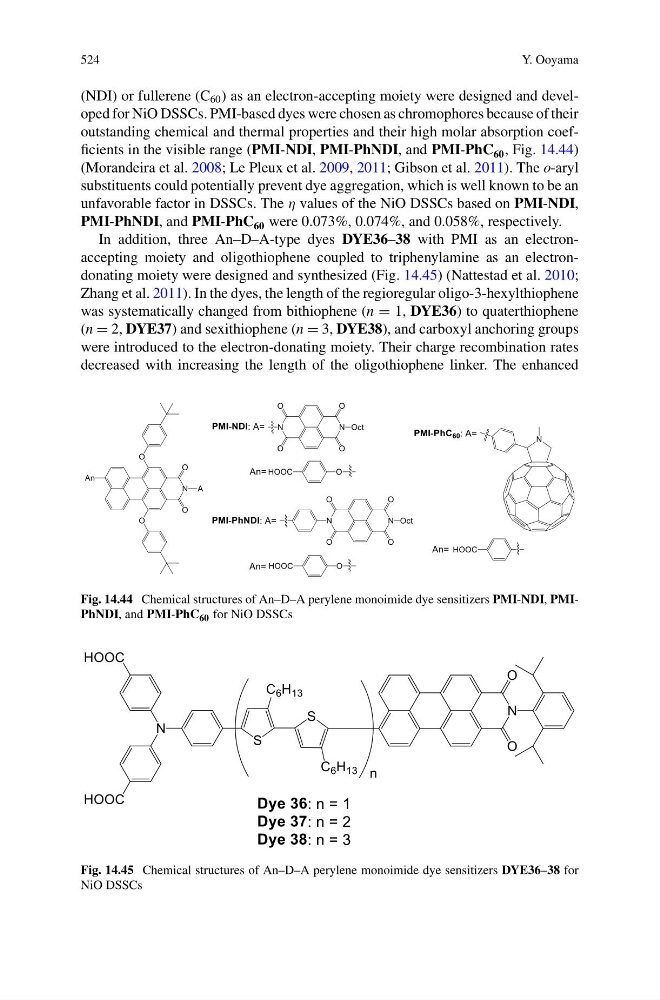
outstanding chemical and thermal properties and their high molar absorption coefficients in the visible range (PMI-NDI, PMI-PhNDI, and PMI-PhC 60 , Fig. 14.44)
(Morandeira et al. 2008; Le Pleux et al. 2009, 2011; Gibson et al. 2011). The o-aryl
substituents could potentially prevent dye aggregation, which is well known to be an
unfavorable factor in DSSCs. The η values of the NiO DSSCs based on PMI-NDI,
PMI-PhNDI, and PMI-PhC 60 were 0.073%, 0.074%, and 0.058%, respectively.
In addition, three An–D–A-type dyes DYE36–38 with PMI as an electronaccepting moiety and oligothiophene coupled to triphenylamine as an electrondonating moiety were designed and synthesized (Fig. 14.45) (Nattestad et al. 2010;
Zhang et al. 2011). In the dyes, the length of the regioregular oligo-3-hexylthiophene
was systematically changed from bithiophene (n = 1, DYE36) to quaterthiophene
(n = 2, DYE37) and sexithiophene (n = 3, DYE38), and carboxyl anchoring groups
were introduced to the electron-donating moiety. Their charge recombination rates
decreased with increasing the length of the oligothiophene linker. The enhanced
Fig. 14.44 Chemical structures of An–D–A perylene monoimide dye sensitizers PMI-NDI, PMIPhNDI, and PMI-PhC 60 for NiO DSSCs
Fig. 14.45 Chemical structures of An–D–A perylene monoimide dye sensitizers DYE36–38 for
NiO DSSCs
Y. Ooyama
(NDI) or fullerene (C 60 ) as an electron-accepting moiety were designed and developed for NiO DSSCs. PMI-based dyes were chosen as chromophores because of their
outstanding chemical and thermal properties and their high molar absorption coefficients in the visible range (PMI-NDI, PMI-PhNDI, and PMI-PhC 60 , Fig. 14.44)
(Morandeira et al. 2008; Le Pleux et al. 2009, 2011; Gibson et al. 2011). The o-aryl
substituents could potentially prevent dye aggregation, which is well known to be an
unfavorable factor in DSSCs. The η values of the NiO DSSCs based on PMI-NDI,
PMI-PhNDI, and PMI-PhC 60 were 0.073%, 0.074%, and 0.058%, respectively.
In addition, three An–D–A-type dyes DYE36–38 with PMI as an electronaccepting moiety and oligothiophene coupled to triphenylamine as an electrondonating moiety were designed and synthesized (Fig. 14.45) (Nattestad et al. 2010;
Zhang et al. 2011). In the dyes, the length of the regioregular oligo-3-hexylthiophene
was systematically changed from bithiophene (n = 1, DYE36) to quaterthiophene
(n = 2, DYE37) and sexithiophene (n = 3, DYE38), and carboxyl anchoring groups
were introduced to the electron-donating moiety. Their charge recombination rates
decreased with increasing the length of the oligothiophene linker. The enhanced
Fig. 14.44 Chemical structures of An–D–A perylene monoimide dye sensitizers PMI-NDI, PMIPhNDI, and PMI-PhC 60 for NiO DSSCs
Fig. 14.45 Chemical structures of An–D–A perylene monoimide dye sensitizers DYE36–38 for
NiO DSSCs