

14 Photoenergy Conversion (Dye-Sensitized Solar Cells)
523
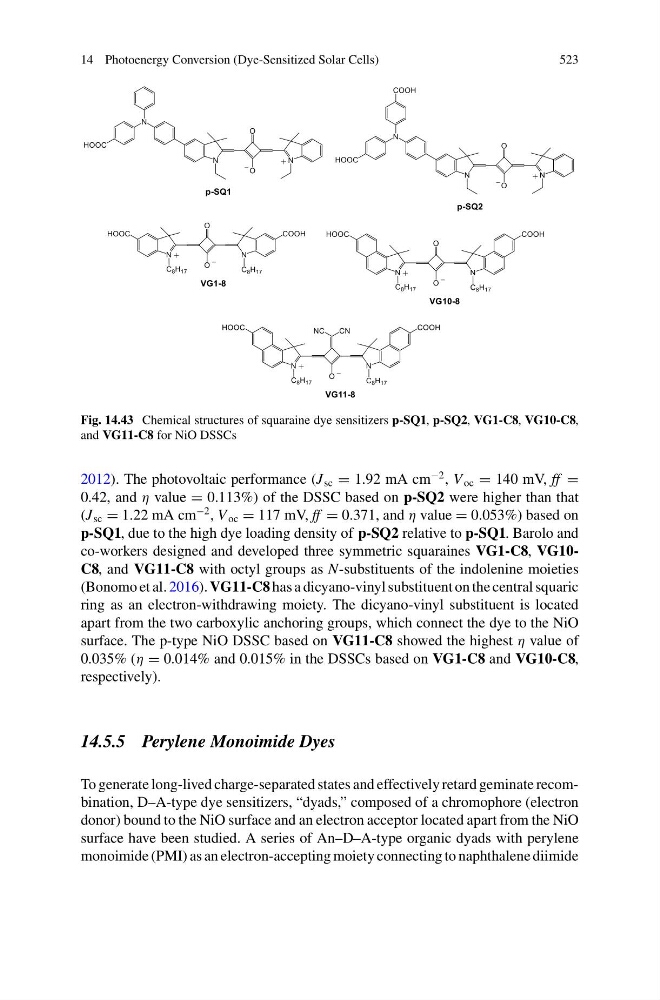
Fig. 14.43 Chemical structures of squaraine dye sensitizers p-SQ1, p-SQ2, VG1-C8, VG10-C8,
and VG11-C8 for NiO DSSCs
2012). The photovoltaic performance (J sc = 1.92 mA cm
−2 , V oc = 140 mV, ff =
0.42, and η value = 0.113%) of the DSSC based on p-SQ2 were higher than that
(J sc = 1.22 mA cm
−2 , V oc = 117 mV, ff = 0.371, and η value = 0.053%) based on
p-SQ1, due to the high dye loading density of p-SQ2 relative to p-SQ1. Barolo and
co-workers designed and developed three symmetric squaraines VG1-C8, VG10C8, and VG11-C8 with octyl groups as N-substituents of the indolenine moieties
(Bonomo et al. 2016). VG11-C8 has a dicyano-vinyl substituent on the central squaric
ring as an electron-withdrawing moiety. The dicyano-vinyl substituent is located
apart from the two carboxylic anchoring groups, which connect the dye to the NiO
surface. The p-type NiO DSSC based on VG11-C8 showed the highest η value of
0.035% (η = 0.014% and 0.015% in the DSSCs based on VG1-C8 and VG10-C8,
respectively).
14.5.5 Perylene Monoimide Dyes
To generate long-lived charge-separated states and effectively retard geminate recombination, D–A-type dye sensitizers, “dyads,” composed of a chromophore (electron
donor) bound to the NiO surface and an electron acceptor located apart from the NiO
surface have been studied. A series of An–D–A-type organic dyads with perylene
monoimide (PMI) as an electron-accepting moiety connecting to naphthalene diimide
523
Fig. 14.43 Chemical structures of squaraine dye sensitizers p-SQ1, p-SQ2, VG1-C8, VG10-C8,
and VG11-C8 for NiO DSSCs
2012). The photovoltaic performance (J sc = 1.92 mA cm
−2 , V oc = 140 mV, ff =
0.42, and η value = 0.113%) of the DSSC based on p-SQ2 were higher than that
(J sc = 1.22 mA cm
−2 , V oc = 117 mV, ff = 0.371, and η value = 0.053%) based on
p-SQ1, due to the high dye loading density of p-SQ2 relative to p-SQ1. Barolo and
co-workers designed and developed three symmetric squaraines VG1-C8, VG10C8, and VG11-C8 with octyl groups as N-substituents of the indolenine moieties
(Bonomo et al. 2016). VG11-C8 has a dicyano-vinyl substituent on the central squaric
ring as an electron-withdrawing moiety. The dicyano-vinyl substituent is located
apart from the two carboxylic anchoring groups, which connect the dye to the NiO
surface. The p-type NiO DSSC based on VG11-C8 showed the highest η value of
0.035% (η = 0.014% and 0.015% in the DSSCs based on VG1-C8 and VG10-C8,
respectively).
14.5.5 Perylene Monoimide Dyes
To generate long-lived charge-separated states and effectively retard geminate recombination, D–A-type dye sensitizers, “dyads,” composed of a chromophore (electron
donor) bound to the NiO surface and an electron acceptor located apart from the NiO
surface have been studied. A series of An–D–A-type organic dyads with perylene
monoimide (PMI) as an electron-accepting moiety connecting to naphthalene diimide