

502
Y. Ooyama
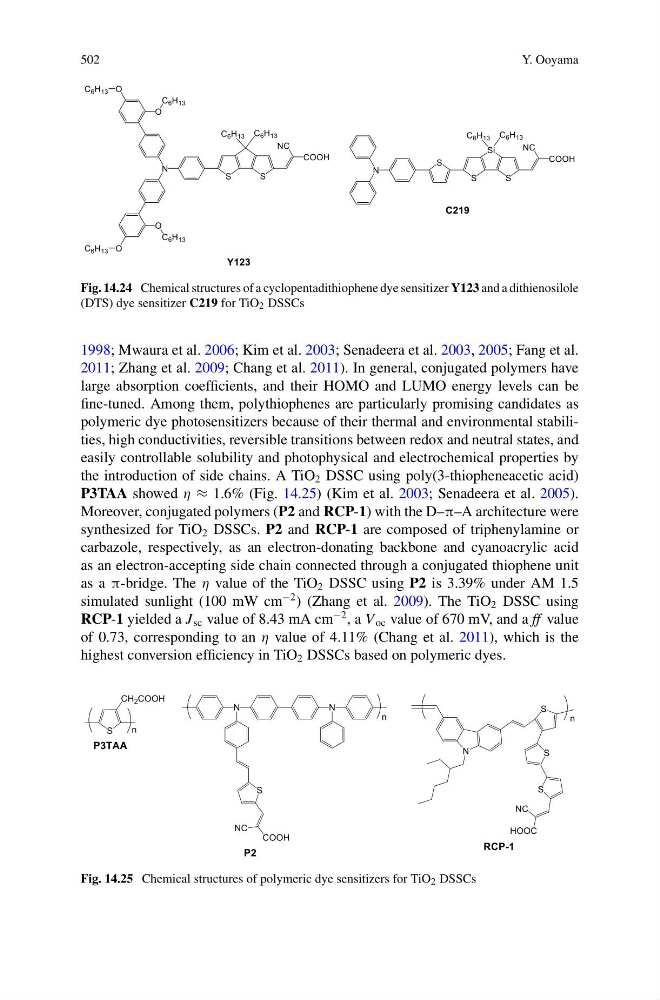
Fig. 14.24 Chemical structures of a cyclopentadithiophene dye sensitizer Y123 and a dithienosilole
(DTS) dye sensitizer C219 for TiO 2 DSSCs
1998; Mwaura et al. 2006; Kim et al. 2003; Senadeera et al. 2003, 2005; Fang et al.
2011; Zhang et al. 2009; Chang et al. 2011). In general, conjugated polymers have
large absorption coefficients, and their HOMO and LUMO energy levels can be
fine-tuned. Among them, polythiophenes are particularly promising candidates as
polymeric dye photosensitizers because of their thermal and environmental stabilities, high conductivities, reversible transitions between redox and neutral states, and
easily controllable solubility and photophysical and electrochemical properties by
the introduction of side chains. A TiO 2 DSSC using poly(3-thiopheneacetic acid)
P3TAA showed η ≈ 1.6% (Fig. 14.25) (Kim et al. 2003; Senadeera et al. 2005).
Moreover, conjugated polymers (P2 and RCP-1) with the D–π–A architecture were
synthesized for TiO 2 DSSCs. P2 and RCP-1 are composed of triphenylamine or
carbazole, respectively, as an electron-donating backbone and cyanoacrylic acid
as an electron-accepting side chain connected through a conjugated thiophene unit
as a π-bridge. The η value of the TiO 2 DSSC using P2 is 3.39% under AM 1.5
simulated sunlight (100 mW cm
−2 ) (Zhang et al. 2009). The TiO 2 DSSC using
RCP-1 yielded a J sc value of 8.43 mA cm
−2 , a V oc value of 670 mV, and a ff value
of 0.73, corresponding to an η value of 4.11% (Chang et al. 2011), which is the
highest conversion efficiency in TiO 2 DSSCs based on polymeric dyes.
Fig. 14.25 Chemical structures of polymeric dye sensitizers for TiO 2 DSSCs
Y. Ooyama
Fig. 14.24 Chemical structures of a cyclopentadithiophene dye sensitizer Y123 and a dithienosilole
(DTS) dye sensitizer C219 for TiO 2 DSSCs
1998; Mwaura et al. 2006; Kim et al. 2003; Senadeera et al. 2003, 2005; Fang et al.
2011; Zhang et al. 2009; Chang et al. 2011). In general, conjugated polymers have
large absorption coefficients, and their HOMO and LUMO energy levels can be
fine-tuned. Among them, polythiophenes are particularly promising candidates as
polymeric dye photosensitizers because of their thermal and environmental stabilities, high conductivities, reversible transitions between redox and neutral states, and
easily controllable solubility and photophysical and electrochemical properties by
the introduction of side chains. A TiO 2 DSSC using poly(3-thiopheneacetic acid)
P3TAA showed η ≈ 1.6% (Fig. 14.25) (Kim et al. 2003; Senadeera et al. 2005).
Moreover, conjugated polymers (P2 and RCP-1) with the D–π–A architecture were
synthesized for TiO 2 DSSCs. P2 and RCP-1 are composed of triphenylamine or
carbazole, respectively, as an electron-donating backbone and cyanoacrylic acid
as an electron-accepting side chain connected through a conjugated thiophene unit
as a π-bridge. The η value of the TiO 2 DSSC using P2 is 3.39% under AM 1.5
simulated sunlight (100 mW cm
−2 ) (Zhang et al. 2009). The TiO 2 DSSC using
RCP-1 yielded a J sc value of 8.43 mA cm
−2 , a V oc value of 670 mV, and a ff value
of 0.73, corresponding to an η value of 4.11% (Chang et al. 2011), which is the
highest conversion efficiency in TiO 2 DSSCs based on polymeric dyes.
Fig. 14.25 Chemical structures of polymeric dye sensitizers for TiO 2 DSSCs