

14 Photoenergy Conversion (Dye-Sensitized Solar Cells)
501
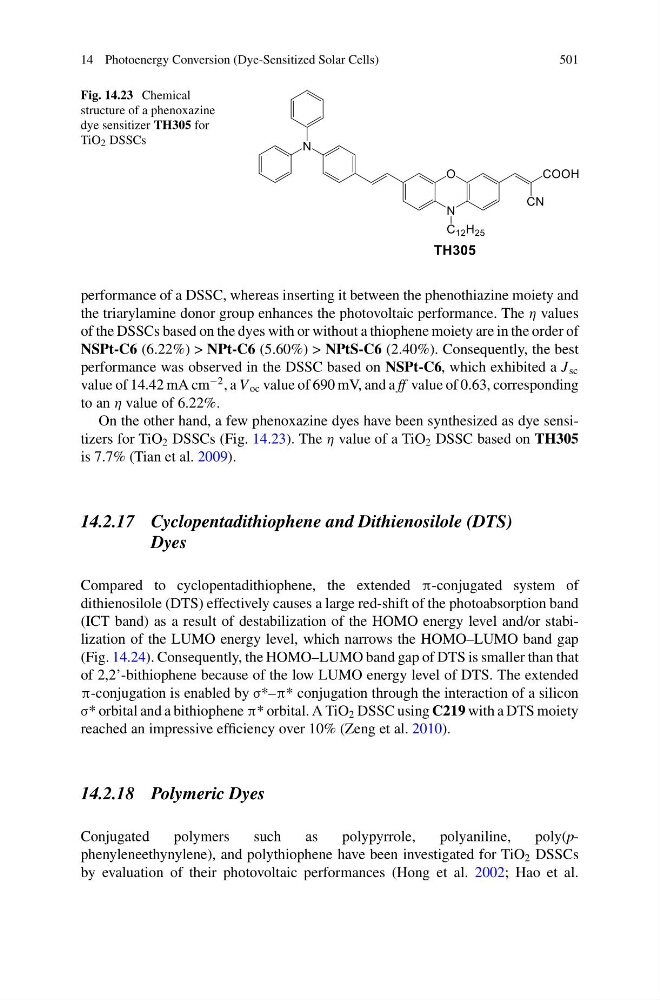
Fig. 14.23 Chemical
structure of a phenoxazine
dye sensitizer TH305 for
TiO 2 DSSCs
performance of a DSSC, whereas inserting it between the phenothiazine moiety and
the triarylamine donor group enhances the photovoltaic performance. The η values
of the DSSCs based on the dyes with or without a thiophene moiety are in the order of
NSPt-C6 (6.22%) > NPt-C6 (5.60%) > NPtS-C6 (2.40%). Consequently, the best
performance was observed in the DSSC based on NSPt-C6, which exhibited a J sc
value of 14.42 mA cm
−2 , a V oc value of 690 mV, and a ff value of 0.63, corresponding
to an η value of 6.22%.
On the other hand, a few phenoxazine dyes have been synthesized as dye sensitizers for TiO 2 DSSCs (Fig. 14.23). The η value of a TiO 2 DSSC based on TH305
is 7.7% (Tian et al. 2009).
14.2.17 Cyclopentadithiophene and Dithienosilole (DTS)
Dyes
Compared to cyclopentadithiophene, the extended π-conjugated system of
dithienosilole (DTS) effectively causes a large red-shift of the photoabsorption band
(ICT band) as a result of destabilization of the HOMO energy level and/or stabilization of the LUMO energy level, which narrows the HOMO–LUMO band gap
(Fig. 14.24). Consequently, the HOMO–LUMO band gap of DTS is smaller than that
of 2,2’-bithiophene because of the low LUMO energy level of DTS. The extended
π-conjugation is enabled by σ*–π* conjugation through the interaction of a silicon
σ* orbital and a bithiophene π* orbital. A TiO 2 DSSC using C219 with a DTS moiety
reached an impressive efficiency over 10% (Zeng et al. 2010).
14.2.18 Polymeric Dyes
Conjugated
polymers
such
as
polypyrrole,
polyaniline,
poly(pphenyleneethynylene), and polythiophene have been investigated for TiO 2 DSSCs
by evaluation of their photovoltaic performances (Hong et al. 2002; Hao et al.
501
Fig. 14.23 Chemical
structure of a phenoxazine
dye sensitizer TH305 for
TiO 2 DSSCs
performance of a DSSC, whereas inserting it between the phenothiazine moiety and
the triarylamine donor group enhances the photovoltaic performance. The η values
of the DSSCs based on the dyes with or without a thiophene moiety are in the order of
NSPt-C6 (6.22%) > NPt-C6 (5.60%) > NPtS-C6 (2.40%). Consequently, the best
performance was observed in the DSSC based on NSPt-C6, which exhibited a J sc
value of 14.42 mA cm
−2 , a V oc value of 690 mV, and a ff value of 0.63, corresponding
to an η value of 6.22%.
On the other hand, a few phenoxazine dyes have been synthesized as dye sensitizers for TiO 2 DSSCs (Fig. 14.23). The η value of a TiO 2 DSSC based on TH305
is 7.7% (Tian et al. 2009).
14.2.17 Cyclopentadithiophene and Dithienosilole (DTS)
Dyes
Compared to cyclopentadithiophene, the extended π-conjugated system of
dithienosilole (DTS) effectively causes a large red-shift of the photoabsorption band
(ICT band) as a result of destabilization of the HOMO energy level and/or stabilization of the LUMO energy level, which narrows the HOMO–LUMO band gap
(Fig. 14.24). Consequently, the HOMO–LUMO band gap of DTS is smaller than that
of 2,2’-bithiophene because of the low LUMO energy level of DTS. The extended
π-conjugation is enabled by σ*–π* conjugation through the interaction of a silicon
σ* orbital and a bithiophene π* orbital. A TiO 2 DSSC using C219 with a DTS moiety
reached an impressive efficiency over 10% (Zeng et al. 2010).
14.2.18 Polymeric Dyes
Conjugated
polymers
such
as
polypyrrole,
polyaniline,
poly(pphenyleneethynylene), and polythiophene have been investigated for TiO 2 DSSCs
by evaluation of their photovoltaic performances (Hong et al. 2002; Hao et al.