

14 Photoenergy Conversion (Dye-Sensitized Solar Cells)
489
cm
−1 ). The DSSC based on SM371 with the Co
II/III tris(2,2
-bipyridine) electrolyte
yielded a high V oc value of 960 mV, a J sc value of 15.9 mA cm
−2 , and a ff value of
0.79 and achieved an overall η value of 12.0%, which is slightly improved compared
to a similar porphyrin sensitizer YD2-o-C8. The DSSC based on SM315 with the
Co
II/III tris(2,2
-bipyridine) electrolyte showed a high J sc value of 18.1 mA cm
−2 , a ff
value of 0.78, and an η value of 13%, outperforming SM371 in spite of a slightly lower
V oc value of 910 mV, as a result of the improvement of the light-harvesting property
in the visible and NIR regions. In fact, the DSSC using SM315 demonstrated impressively high IPCE values across the whole visible wavelength region, 80% from 450
to 750 nm, demonstrating the utility of the BTD-functionalized anchoring moiety to
improve light-harvesting properties in the visible and NIR regions.
14.2.11 Merocyanine Dyes
Merocyanine dyes can form J- and H-aggregates on the TiO 2 electrode surface. The
photoabsorption of J-aggregates is observed in a longer wavelength region while that
of the H-aggregates observed in a shorter wavelength region, with reference to the
photoabsorption of the monomeric form. The relationship between dye aggregation
on the TiO 2 surface and the photoelectrochemical properties has been investigated
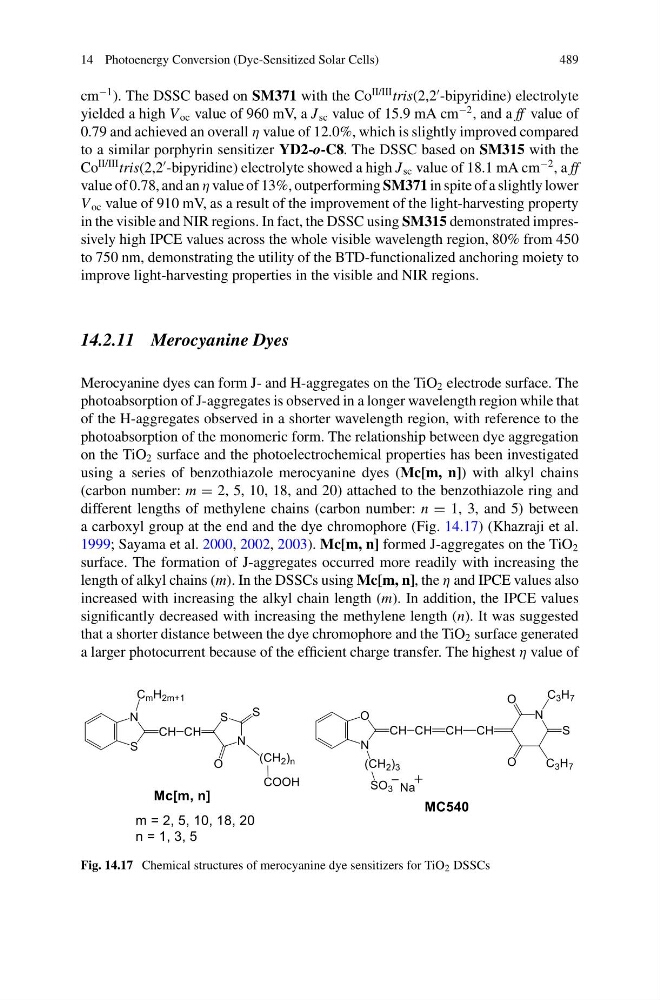
using a series of benzothiazole merocyanine dyes (Mc[m, n]) with alkyl chains
(carbon number: m = 2, 5, 10, 18, and 20) attached to the benzothiazole ring and
different lengths of methylene chains (carbon number: n = 1, 3, and 5) between
a carboxyl group at the end and the dye chromophore (Fig. 14.17) (Khazraji et al.
1999; Sayama et al. 2000, 2002, 2003). Mc[m, n] formed J-aggregates on the TiO 2
surface. The formation of J-aggregates occurred more readily with increasing the
length of alkyl chains (m). In the DSSCs using Mc[m, n], the η and IPCE values also
increased with increasing the alkyl chain length (m). In addition, the IPCE values
significantly decreased with increasing the methylene length (n). It was suggested
that a shorter distance between the dye chromophore and the TiO 2 surface generated
a larger photocurrent because of the efficient charge transfer. The highest η value of
Fig. 14.17 Chemical structures of merocyanine dye sensitizers for TiO 2 DSSCs
489
cm
−1 ). The DSSC based on SM371 with the Co
II/III tris(2,2
-bipyridine) electrolyte
yielded a high V oc value of 960 mV, a J sc value of 15.9 mA cm
−2 , and a ff value of
0.79 and achieved an overall η value of 12.0%, which is slightly improved compared
to a similar porphyrin sensitizer YD2-o-C8. The DSSC based on SM315 with the
Co
II/III tris(2,2
-bipyridine) electrolyte showed a high J sc value of 18.1 mA cm
−2 , a ff
value of 0.78, and an η value of 13%, outperforming SM371 in spite of a slightly lower
V oc value of 910 mV, as a result of the improvement of the light-harvesting property
in the visible and NIR regions. In fact, the DSSC using SM315 demonstrated impressively high IPCE values across the whole visible wavelength region, 80% from 450
to 750 nm, demonstrating the utility of the BTD-functionalized anchoring moiety to
improve light-harvesting properties in the visible and NIR regions.
14.2.11 Merocyanine Dyes
Merocyanine dyes can form J- and H-aggregates on the TiO 2 electrode surface. The
photoabsorption of J-aggregates is observed in a longer wavelength region while that
of the H-aggregates observed in a shorter wavelength region, with reference to the
photoabsorption of the monomeric form. The relationship between dye aggregation
on the TiO 2 surface and the photoelectrochemical properties has been investigated
using a series of benzothiazole merocyanine dyes (Mc[m, n]) with alkyl chains
(carbon number: m = 2, 5, 10, 18, and 20) attached to the benzothiazole ring and
different lengths of methylene chains (carbon number: n = 1, 3, and 5) between
a carboxyl group at the end and the dye chromophore (Fig. 14.17) (Khazraji et al.
1999; Sayama et al. 2000, 2002, 2003). Mc[m, n] formed J-aggregates on the TiO 2
surface. The formation of J-aggregates occurred more readily with increasing the
length of alkyl chains (m). In the DSSCs using Mc[m, n], the η and IPCE values also
increased with increasing the alkyl chain length (m). In addition, the IPCE values
significantly decreased with increasing the methylene length (n). It was suggested
that a shorter distance between the dye chromophore and the TiO 2 surface generated
a larger photocurrent because of the efficient charge transfer. The highest η value of
Fig. 14.17 Chemical structures of merocyanine dye sensitizers for TiO 2 DSSCs