

488
Y. Ooyama
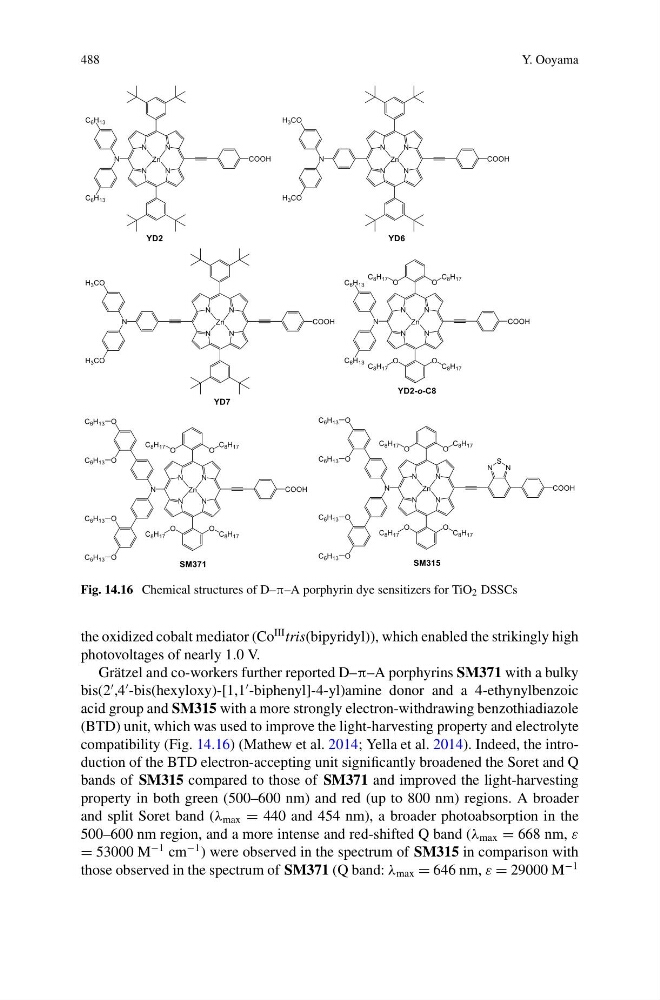
Fig. 14.16 Chemical structures of D–π–A porphyrin dye sensitizers for TiO 2 DSSCs
the oxidized cobalt mediator (Co
III tris(bipyridyl)), which enabled the strikingly high
photovoltages of nearly 1.0 V.
Grätzel and co-workers further reported D–π–A porphyrins SM371 with a bulky
bis(2
,4
-bis(hexyloxy)-[1,1
-biphenyl]-4-yl)amine donor and a 4-ethynylbenzoic
acid group and SM315 with a more strongly electron-withdrawing benzothiadiazole
(BTD) unit, which was used to improve the light-harvesting property and electrolyte
compatibility (Fig. 14.16) (Mathew et al. 2014; Yella et al. 2014). Indeed, the introduction of the BTD electron-accepting unit significantly broadened the Soret and Q
bands of SM315 compared to those of SM371 and improved the light-harvesting
property in both green (500–600 nm) and red (up to 800 nm) regions. A broader
and split Soret band (λ max = 440 and 454 nm), a broader photoabsorption in the
500–600 nm region, and a more intense and red-shifted Q band (λ max = 668 nm, ε
= 53000 M
−1 cm
−1 ) were observed in the spectrum of SM315 in comparison with
those observed in the spectrum of SM371 (Q band: λ max = 646 nm, ε = 29000 M
−1
Y. Ooyama
Fig. 14.16 Chemical structures of D–π–A porphyrin dye sensitizers for TiO 2 DSSCs
the oxidized cobalt mediator (Co
III tris(bipyridyl)), which enabled the strikingly high
photovoltages of nearly 1.0 V.
Grätzel and co-workers further reported D–π–A porphyrins SM371 with a bulky
bis(2
,4
-bis(hexyloxy)-[1,1
-biphenyl]-4-yl)amine donor and a 4-ethynylbenzoic
acid group and SM315 with a more strongly electron-withdrawing benzothiadiazole
(BTD) unit, which was used to improve the light-harvesting property and electrolyte
compatibility (Fig. 14.16) (Mathew et al. 2014; Yella et al. 2014). Indeed, the introduction of the BTD electron-accepting unit significantly broadened the Soret and Q
bands of SM315 compared to those of SM371 and improved the light-harvesting
property in both green (500–600 nm) and red (up to 800 nm) regions. A broader
and split Soret band (λ max = 440 and 454 nm), a broader photoabsorption in the
500–600 nm region, and a more intense and red-shifted Q band (λ max = 668 nm, ε
= 53000 M
−1 cm
−1 ) were observed in the spectrum of SM315 in comparison with
those observed in the spectrum of SM371 (Q band: λ max = 646 nm, ε = 29000 M
−1