

13 Photodynamic Therapy
447
as PDT dyes. However, after PDT using these porphyrin dyes, patients are forced to
live in a dark room to avoid direct sunlight for several weeks to one month, because
the dyes cause skin irritation and rashes due to their photosensitivity. In addition, the
porphyrin dyes have a disadvantage of low PDT efficiency due to the weak photoabsorption (small molar absorbance coefficient, ε) in the phototherapeutic window. In
recent years, a number of BODIPY (abbreviation of boron-dipyrromethene) based
photosensitizing dyes have been developed and extensively studied as PDT dyes
by evaluation of the
1 O 2 generation efficiency and destruction rate of cancer cells
(Awuah and You 2012; Kamkaew et al. 2013). More recently, photosensitizing dyes
with high brightness (brightness: BT = ε × Φ fl (fluorescence quantum yield)) and
high phototoxicity (phototoxic power: PP = ε × Φ ) have been attracted scientific
interest to achieve both fluorescence imaging of cancer cells and PDT. This chapter
outlines the effects of chemical structures and substituents of photosensitizing dyes
on their photoabsorption properties and
1 O 2 generation efficiency and highlights
recent developments in photosensitizing dyes.
13.2 Methods for Evaluation of Singlet Oxygen 1 O 2
Generation
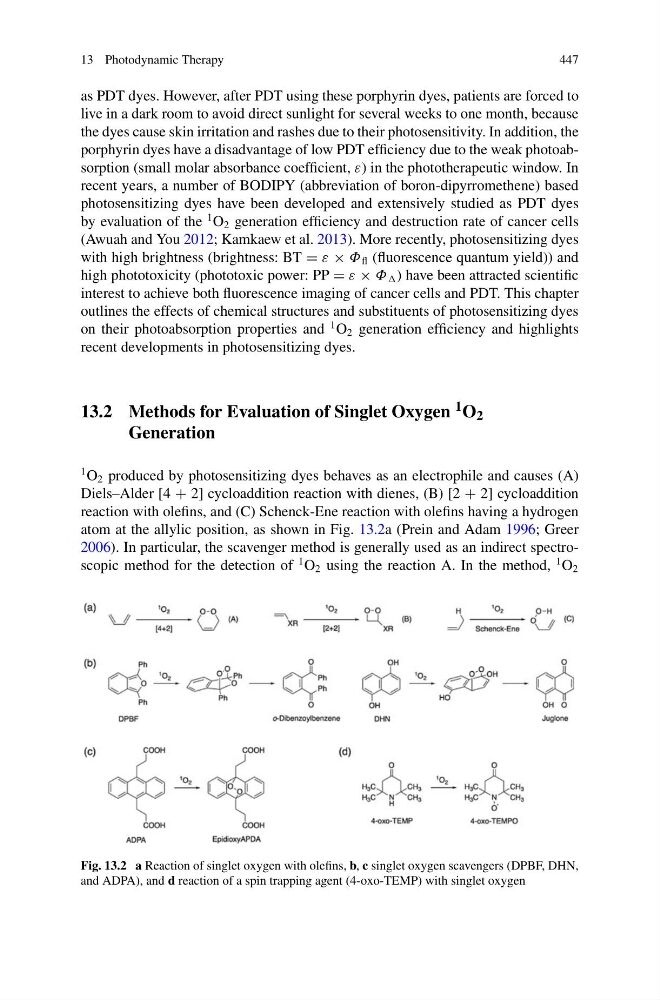
1 O 2 produced by photosensitizing dyes behaves as an electrophile and causes (A)
Diels–Alder [4 + 2] cycloaddition reaction with dienes, (B) [2 + 2] cycloaddition
reaction with olefins, and (C) Schenck-Ene reaction with olefins having a hydrogen
atom at the allylic position, as shown in Fig. 13.2a (Prein and Adam 1996; Greer
2006). In particular, the scavenger method is generally used as an indirect spectroscopic method for the detection of
1 O 2 using the reaction A. In the method,
1 O 2
Fig. 13.2 a Reaction of singlet oxygen with olefins, b, c singlet oxygen scavengers (DPBF, DHN,
and ADPA), and d reaction of a spin trapping agent (4-oxo-TEMP) with singlet oxygen
447
as PDT dyes. However, after PDT using these porphyrin dyes, patients are forced to
live in a dark room to avoid direct sunlight for several weeks to one month, because
the dyes cause skin irritation and rashes due to their photosensitivity. In addition, the
porphyrin dyes have a disadvantage of low PDT efficiency due to the weak photoabsorption (small molar absorbance coefficient, ε) in the phototherapeutic window. In
recent years, a number of BODIPY (abbreviation of boron-dipyrromethene) based
photosensitizing dyes have been developed and extensively studied as PDT dyes
by evaluation of the
1 O 2 generation efficiency and destruction rate of cancer cells
(Awuah and You 2012; Kamkaew et al. 2013). More recently, photosensitizing dyes
with high brightness (brightness: BT = ε × Φ fl (fluorescence quantum yield)) and
high phototoxicity (phototoxic power: PP = ε × Φ ) have been attracted scientific
interest to achieve both fluorescence imaging of cancer cells and PDT. This chapter
outlines the effects of chemical structures and substituents of photosensitizing dyes
on their photoabsorption properties and
1 O 2 generation efficiency and highlights
recent developments in photosensitizing dyes.
13.2 Methods for Evaluation of Singlet Oxygen 1 O 2
Generation
1 O 2 produced by photosensitizing dyes behaves as an electrophile and causes (A)
Diels–Alder [4 + 2] cycloaddition reaction with dienes, (B) [2 + 2] cycloaddition
reaction with olefins, and (C) Schenck-Ene reaction with olefins having a hydrogen
atom at the allylic position, as shown in Fig. 13.2a (Prein and Adam 1996; Greer
2006). In particular, the scavenger method is generally used as an indirect spectroscopic method for the detection of
1 O 2 using the reaction A. In the method,
1 O 2
Fig. 13.2 a Reaction of singlet oxygen with olefins, b, c singlet oxygen scavengers (DPBF, DHN,
and ADPA), and d reaction of a spin trapping agent (4-oxo-TEMP) with singlet oxygen